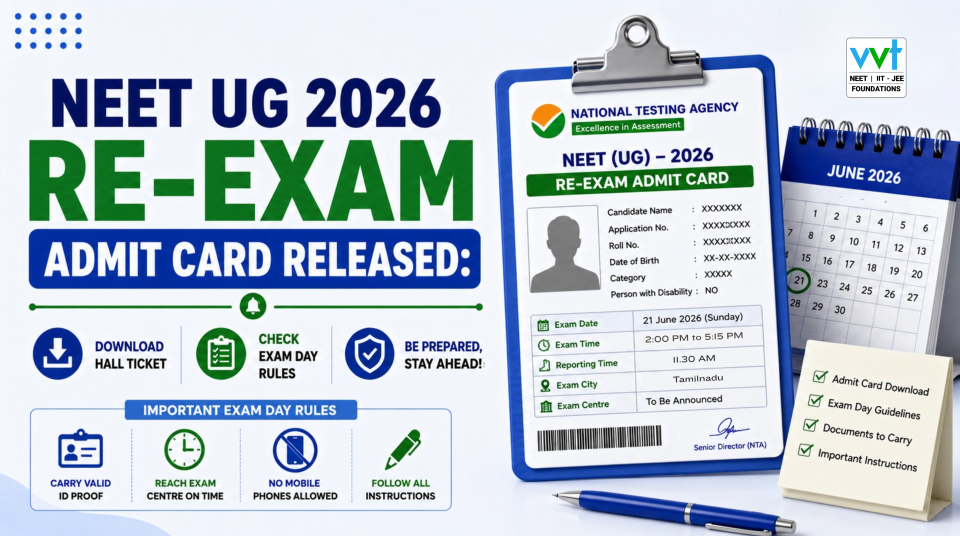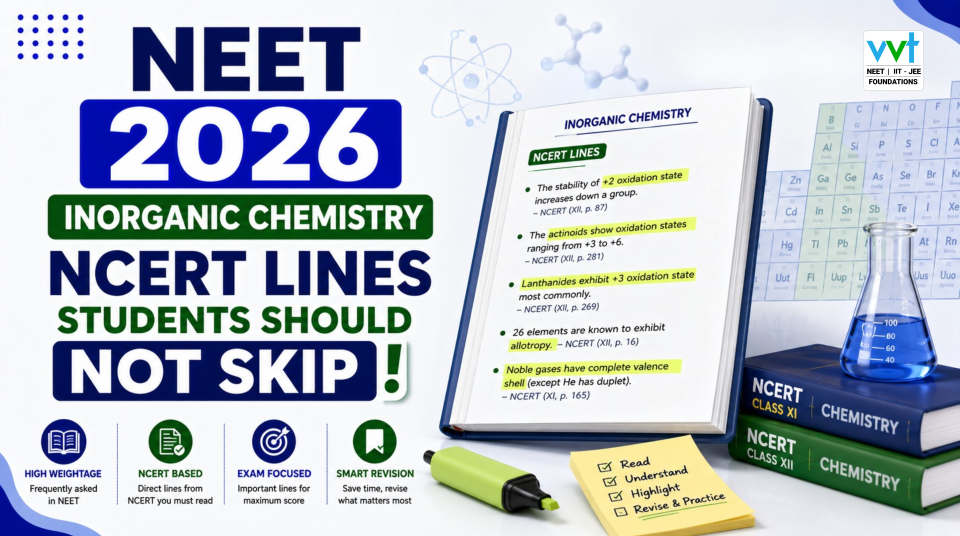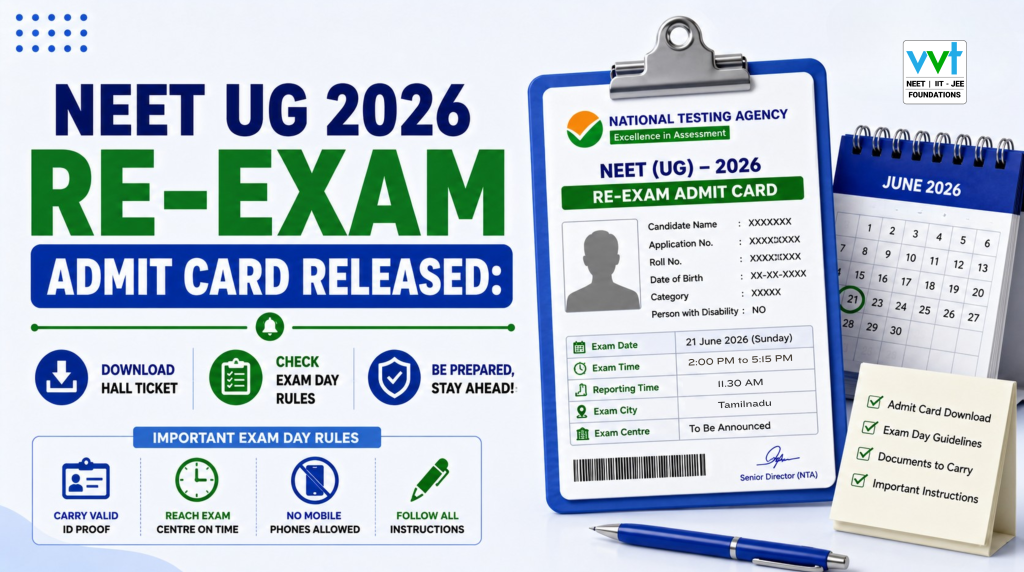

NEET 2026 Admit Card: Release Status, Download Steps, Details to Check & Exam Day Guide
April 17, 2026
How to Solve NEET Chemistry Faster: 45-Minute Strategy for 2026
April 19, 2026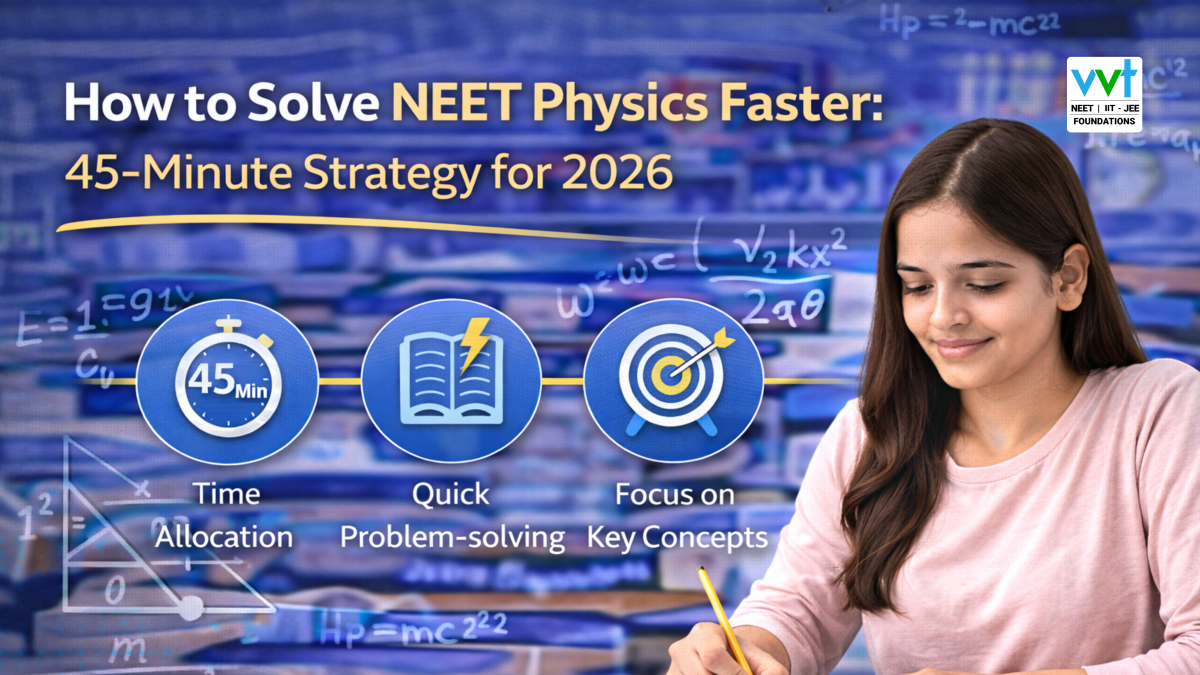
How to Solve NEET Physics Faster: 45-Minute Strategy for 2026
VVT Coaching Chennai – Ranked #1 Best NEET & JEE Coaching Centre by Times Now!
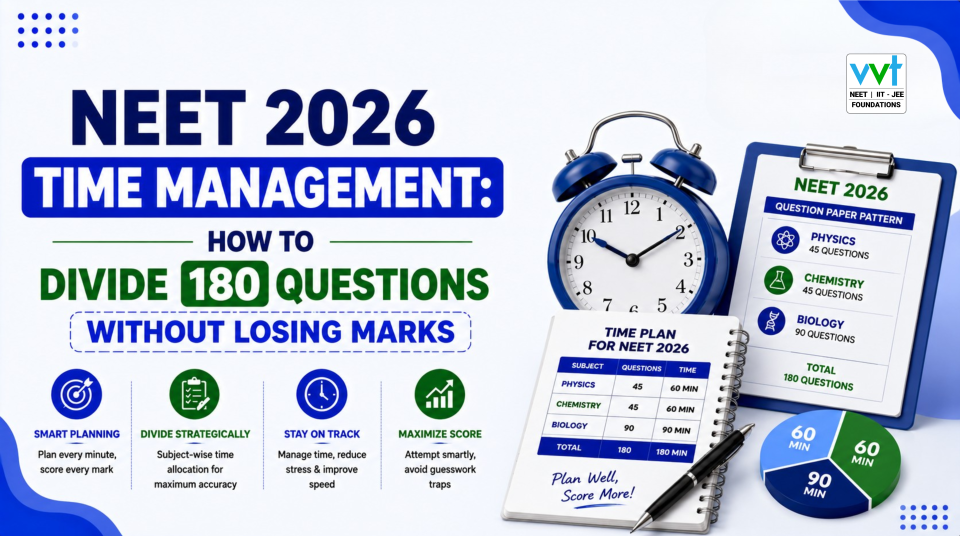
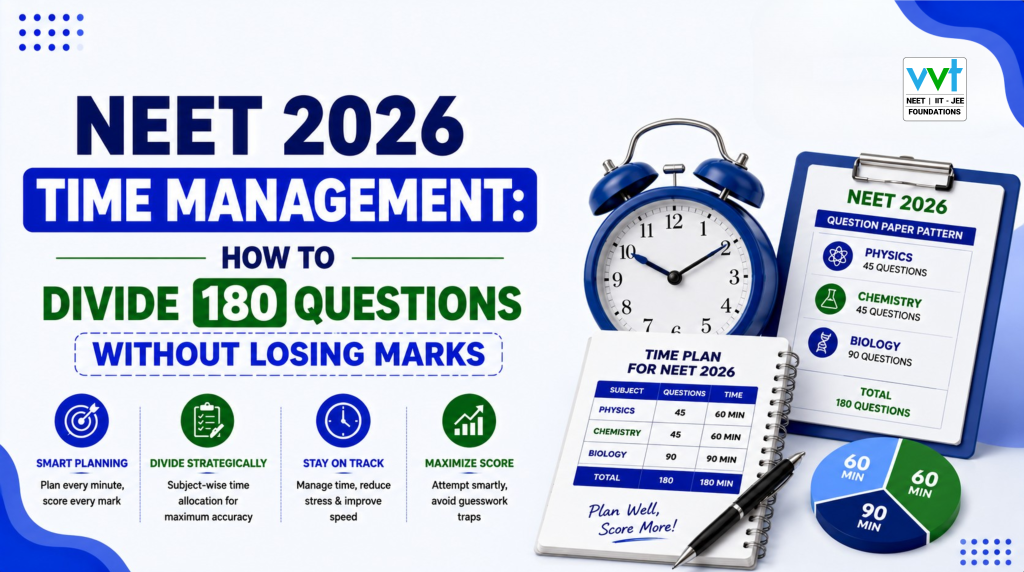
Physics is the section that quietly changes the mood of the entire NEET paper. Many students are comfortable with Biology, can still hold Chemistry together, but start losing control when Physics begins to feel slow, calculation-heavy, and mentally draining. That is exactly why the question “Can I attempt NEET Physics in 45 minutes?” matters so much. For NEET UG 2026, the official pattern remains 180 compulsory questions in 180 minutes, with 45 questions each in Physics and Chemistry and 90 in Biology, so the idea of giving Physics about 45 minutes is a strategy target, not an official NTA subject-wise time rule. The exam is scheduled for 3 May 2026.
That distinction is important. NTA does not say students must finish Physics in 45 minutes. What the official pattern does tell us is that the full paper is tightly timed, so students who let Physics consume too much time often damage the rest of the exam. That is why the “45-minute Physics strategy” should be understood as a paper management method, finishing the section in a disciplined, controlled time window so that Chemistry and Biology do not suffer later.
students should not prepare blindly. They should focus on high-return chapters, structured revision, timed practice, accuracy monitoring, and mistake correction. In Physics, that matters even more because time control is not just about speed. It is about selecting the right questions, avoiding trap questions early, and protecting confidence through the full paper.

First, is 45 minutes for Physics actually realistic?
Yes, for many students it is realistic, but only if it is handled strategically. easy questions first, moderate ones next, and difficult ones last. That approach is sensible because Physics in NEET is not won by solving every question in the order it appears. It is won by collecting the cleanest marks first and refusing to let one long problem damage the rest of the section.
The problem is that many students hear “45 minutes” and interpret it as “rush.” That is the wrong mindset. The goal is not to race through Physics carelessly. The goal is to prevent Physics from swallowing 60–70 minutes through hesitation, overthinking, and repeated rechecking. In NEET, a stable 45-minute Physics attempt is usually built on selection, rhythm, and confidence, not in hurry.
What must be true before this strategy works
Students should be honest here. A 45-minute Physics attempt works only when:
- the student has already revised core formulas,
- the student knows which chapters are fast-return chapters,
- and the student has practiced solving under time pressure.
If none of that is in place, then “45 minutes” becomes a slogan, not a strategy. That’s why an effective NEET 2026 preparation approach keeps returning to the same system: first select the chapter, then revise it properly, follow it with timed MCQ practice, and finally track accuracy to measure real progress.
The VVT way to think about Physics timing
The smartest way to attempt Physics in NEET is not to ask, “How fast can I solve?” The better question is, “Which 25–30 questions can I solve correctly without letting the section become emotionally expensive?”
That is the real shift.
Physics becomes dangerous when students:
- start with the hardest question,
- try to solve every numerical in full detail,
- keep returning to one stuck question too early,
- or confuse paper discipline with bravery.
Which Physics chapters are best for a 45-minute attempt?
A fast Physics section is not built from random chapter coverage. It is built from chapters that are easier to stabilise and quicker to solve under pressure. VVT’s current public content highlights chapters such as Current Electricity, Modern Physics, Ray Optics, Electrostatics, Work Energy and Power, Physics and Measurement, and Electronic Devices as strong strategic areas because they tend to give better revision return and cleaner question patterns than chapters students often find more time-consuming.
That does not mean other chapters are unimportant. It means that if your goal is to handle Physics inside 45 minutes, your preparation must be weighted toward chapters where you can identify, solve, and move on with less friction. A student who has built confidence in these chapters usually enters the section with far better control than a student who spent all revision time fighting only the heaviest Mechanics problems.
The best 45-minute Physics strategy: 3 rounds
The three-round model is still the best practical structure.
Round 1: Easy and direct questions first
In the opening part of Physics, students should attack only the most direct questions, formula based, concept clean, familiar model questions. This round is not about maximum coverage. It is about building a clean score base. It aligns well with a broader exam day mindset, stabilise first, then expand.
Round 2: Moderate questions
Once easy marks are collected, move into the questions that need a little more thought but are still manageable. These are the ones where students usually know the chapter, but need 40–60 seconds more than the direct questions. This is where time control matters most, because many students accidentally let moderate questions become long questions.
Round 3: Difficult or lengthy questions
The final round is for the questions that are calculation heavy, look unfamiliar, or clearly demand more time. If you reach them with time left, good. If not, they should never have been allowed to destroy the first two rounds. That is the central idea behind attempting Physics in 45 minutes, to protect the section from overinvestment early.

Also read: Best Physics Chapters to Score High in NEET 2026
Also read: Common Physics Topics for NEET 2026: Complete Chapter-Wise Guide
How much time should each round get?
A practical split can look like this:
- around 15 minutes for easy direct questions,
- around 20 minutes for moderate questions,
- and around 10 minutes for tougher returns and quick review.
This is not an official NTA prescription. It is a strategy structure built from the 45-minute target and the three round attempt model. The exact split can vary by student, but the principle should not: easy marks first, moderate next, difficult last.
The biggest mistakes students make while trying to do Physics fast
The first mistake is trying to solve Physics in 45 minutes without preparing Physics for 45-minute solving. Speed in Physics is not created in the exam hall. It is created in revision and timed practice.
The second mistake is letting ego lead the section. Students feel they must “show” they can do the hardest problem first. That is almost always a bad exam decision.
The third mistake is weak formula recall. Physics becomes slow when every question forces you to stop and rebuild the chapter mentally. Well, the core idea holds—but let’s tighten it so it sounds less promotional and more authoritative. Physics strategy guidance consistently treats formula mapping and chapter familiarity as essential, because they are what transform Physics from a slow, time-consuming subject into a manageable and scoring one.
The fourth mistake is poor unit and sign discipline. A student may solve quickly and still lose marks because of negative sign confusion, wrong unit conversion, or careless arithmetic.
What should students practice before exam day?
If the goal is a 45-minute Physics section, students should practice exactly that.
That means:
- chapter-wise timed sets,
- mixed 45-question Physics sessions,
- formula recall without notes,
- and mock tests where the student deliberately tracks how Physics time is being used.
Its broader NEET 2026 content places this practice inside a complete system, high-return chapter prioritisation, performance analysis, and correction loops rather than speed practice in isolation.
How VVT Coaching helps students attempt Physics faster
This is where VVT should speak with clarity.
At VVT, the answer is not “just solve faster.”
The real answer is:
reduce what makes Physics slow.
Students often become slow in Physics because of:
- weak chapter prioritisation,
- unstable formulas,
- poor question selection,
- repeated mistakes,
- and lack of timed section practice.
That is why VVT’s public NEET strategy articles keep focusing on:
- structured chapter planning,
- identifying high-return Physics chapters,
- building formula maps,
- and tightening performance through monitored practice.
So the VVT message on this topic should be simple:
You do not finish Physics in 45 minutes because you got lucky.
You do it because your preparation removed the delays.
How VVT Coaching Helps Students Attempt NEET Physics Faster Without Losing Marks
For many NEET aspirants, Physics is not just a subject. It is the section that often creates the most pressure in the paper.
Many students know the concepts but still lose time in Physics. Others get stuck in one lengthy numerical and damage the rest of the section. A difficult opening question can also trigger panic, leading some to attempt Physics emotionally instead of strategically. That is why at VVT Coaching Chennai, Physics preparation is not limited to chapter coverage alone. We train students to attempt Physics with better judgment, better speed, and better control.
Because in NEET, students do not lose marks in Physics only because they do not know the answer. They also lose marks because they:
- spend too long on low-return questions
- force difficult numericals too early
- make unit, sign, or formula slips in a hurry
- lose confidence after one hard question
- or mismanage time and enter the next subject already stressed
Error Exams – Fix the Physics mistakes that keep wasting time
A major reason students struggle to complete Physics in a controlled time window is that the same mistakes keep repeating across mocks.
These often include:
- getting trapped in lengthy calculation-based questions
- making sign mistakes in electrostatics, current electricity, or mechanics
- choosing the wrong formula under pressure
- spending too long on questions they should have skipped first
- missing easy theory-based or direct formula questions while chasing tougher ones
Instead of giving only more random papers, VVT uses Error Exams built from the student’s own recent Physics mistakes.
These include:
- questions similar to the ones the student got wrong or skipped
- repeated practice on recurring Physics trap patterns
- attempt → analysis → re-attempt cycles to improve decision-making
- targeted correction until that exact error pattern stops affecting score
Result: students stop wasting time on the same familiar traps and become much more efficient in how they move through the Physics section.
AI-Powered Mock Tests — Show where Physics time is actually getting lost
One of the biggest reasons students fail to finish Physics quickly is simple: they do not know where their time is disappearing.
That is why VVT’s AI-powered mock tests are especially useful for Physics. They help students see:
- which chapters take too much time
- which question types create overthinking
- where careless mistakes are happening
- where accuracy is dropping because of rushing
- whether the student is spending too long for too little return
- how Physics is affecting the balance of the full paper
This matters because attempting Physics in 45 minutes is not just about speed. It is about smart question filtering.
Result: students learn how to identify which questions to solve immediately, which to leave for later, and which to avoid forcing. That is what makes a fast Physics attempt realistic.
Personalised Guidance — Build a Physics attempt strategy that suits the student
Not every student should attempt Physics in the same way.
Many students are stronger in Modern Physics and Current Electricity. Others do better by starting with direct formula-based questions. For some, avoiding long numerically early helps them secure easier marks first. That is why VVT does not push a one-size-fits-all method.
Through personalised guidance, mentors help students:
- decide what type of Physics questions to start with
- identify their high-confidence chapters
- create a first-pass and second-pass approach
- avoid emotional decision-making when a question looks hard
- protect pace without reducing accuracy
This is especially important because many students lose time not from lack of knowledge, but from poor sequencing.
Result: students enter the exam with a clear Physics strategy instead of randomly reacting to the section.
Remedy Classes — Repair the small Physics gaps that slow the full section
Sometimes students struggle with Physics speed not because the whole subject is weak, but because a few small gaps create repeated hesitation.
These may include:
- confusion in sign conventions
- weak formula recall
- difficulty reading graphs quickly
- getting stuck in unit conversion or approximation
- recurring trouble in one micro-topic like ray optics, semiconductors, or rotational motion
VVT’s Remedy Classes are designed to fix these exact issues without forcing the student to reopen the entire subject.
These sessions are:
- short and focused
- built around one exact weak point at a time
- supported by mock analysis and faculty observation
- followed by quick retesting to confirm improvement
Result: The real aim is not just syllabus completion, but learning how to solve NEET Physics under pressure.

Get to Know VVT’s Three Friendly Campuses: Always Nearby and Welcoming
VVT has three spots across Chennai, each easy to reach and full of support. No matter where you live, one is close by. Our campuses mix bright classrooms, helpful teachers, and a warm feel to keep you going. Here’s a quick look at each, with a focus on how they help with NEET and staying options.
Adyar Campus: Easy Access and Positive Vibes
Right on busy L.B. Road next to Adyar Ananda Bhavan, this spot is super convenient. Step inside, and you’ll see big, airy rooms where learning feels fun. Staff greet you with smiles, and the energy pushes you to turn weak areas like tough Physics problems into strengths. We also offer hostel facilities here for boys, with clean rooms, meals, and support to make your stay comfortable and focused. No distractions, just a safe place to rest and review after classes.
Adyar Campus (VVT Coaching Centre): “Nibav Buildings”, 4th & 5th Floor, No.23, Old No.11, L.B. Road, Adyar, Chennai – 600020. (Next to Adyar Ananda Bhavan)
Get Directions: Open in google maps!
Anna Nagar Campus: Focus in the City Centre
In Shanthi Colony, Anna Nagar, this campus feels like an extension of home. Good bus links make it simple for city kids. There is no on-site hostel, but nearby options are plentiful for those who need them.
Anna Nagar Campus (VVT Coaching Centre): No.1621, 9th Main Road, Shanthi Colony, Block AI, Anna Nagar, Chennai – 600040.
Get Directions: Open in google maps!
Pallikaranai Girls Campus: Your Safe Place with Full Hostel
This is our special girls-only residential campus in a quiet area. It’s built as a true home away from home, with clean dorms, healthy meals in the canteen, and round-the-clock help.
We offer full hostel facilities here, clean rooms, study areas, and a community of girls supporting each other. It’s perfect if you’re from outside Chennai or just want a focused, safe space.
Pallikaranai (Saraswathi Girls Residential Campus): Plot No. 395 & 396, 1st Main Road, Kamakoti Nagar, Pallikaranai, Chennai – 600100.
Get Directions: Open in google maps
Conclusion
If you want the most practical answer to “How to attempt NEET Physics in just 45 minutes?”, it is this:
Do not try to make Physics fast on exam day.
Make Physics fast in practice first.
For NEET UG 2026, the official exam pattern gives you 180 minutes for the full paper, not separate official subject timers. So 45 minutes for Physics is a smart student strategy target, not an NTA rule. And that strategy works best when you:
- prioritise high-return Physics chapters,
- use a three-round attempt system,
- avoid early traps,
- and stop trying to defeat every question in real time.
At VVT Coaching, the focus is not only on completing the syllabus. We help students solve NEET Physics through timed mocks, error analysis, and section-wise strategy. That approach helps students solve NEET Physics with more confidence, better speed, and fewer avoidable mistakes.
Visit: vvtcoaching.com
Call: +91 81221 22333
Scholarships: Up to 100% via VVTSAT!
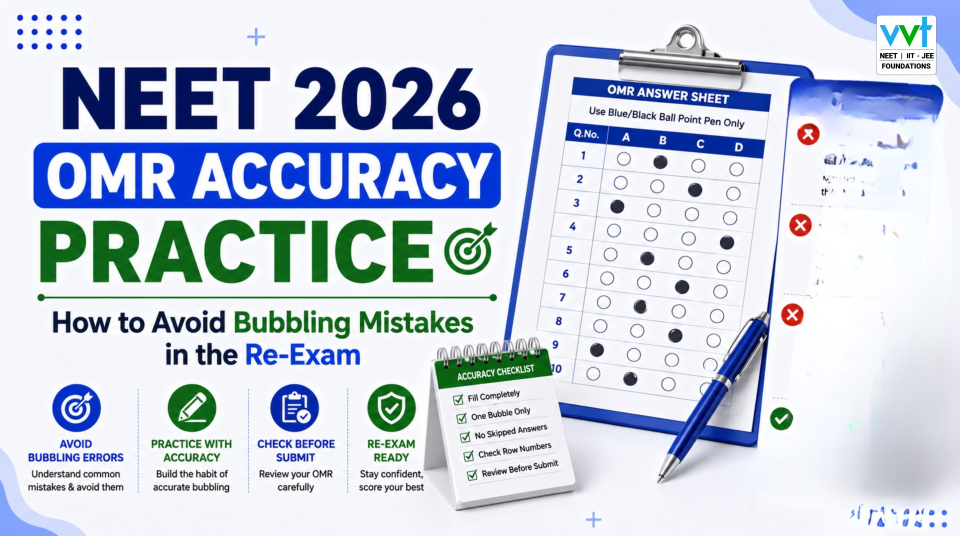
Also read: How to Fill the NEET 2026 OMR Sheet: Step-by-Step Guide for Students
Also read: NEET 2026 First 30 Minutes Guide: Build Confidence and Manage Time Better
FAQs
Does NTA officially say Physics must be finished in 45 minutes?
No. NTA gives the full paper pattern of 180 questions in 180 minutes. The 45-minute Physics target is a strategy approach, not an official rule.
What is the best strategy to attempt Physics quickly?
A three round method works best: easy questions first, moderate next, difficult last. This helps protect time and confidence.
Which Physics chapters help most in a fast attempt strategy?
Chapters such as Current Electricity, Modern Physics, Ray Optics, Physics and Measurement, Electrostatics, and Electronic Devices are widely considered high-return areas for efficient scoring.
What is the biggest reason students become slow in Physics?
Weak formula recall, poor question selection, and getting trapped in lengthy numerical too early are among the biggest reasons.
How can I solve NEET Physics faster in the exam?
To Solve NEET Physics faster in the exam, start with direct and familiar questions instead of getting stuck on one long numerical early. Students usually Solve NEET Physics better when they protect time, avoid panic, and return to difficult questions later. The smartest way to Solve NEET Physics is to follow a clear attempt strategy, secure easier marks first, and stay calm throughout the section.