
How to Manage Anxiety One Day Before NEET 2026
April 15, 2026
NEET 2026 Admit Card: Release Status, Download Steps, Details to Check & Exam Day Guide
April 17, 2026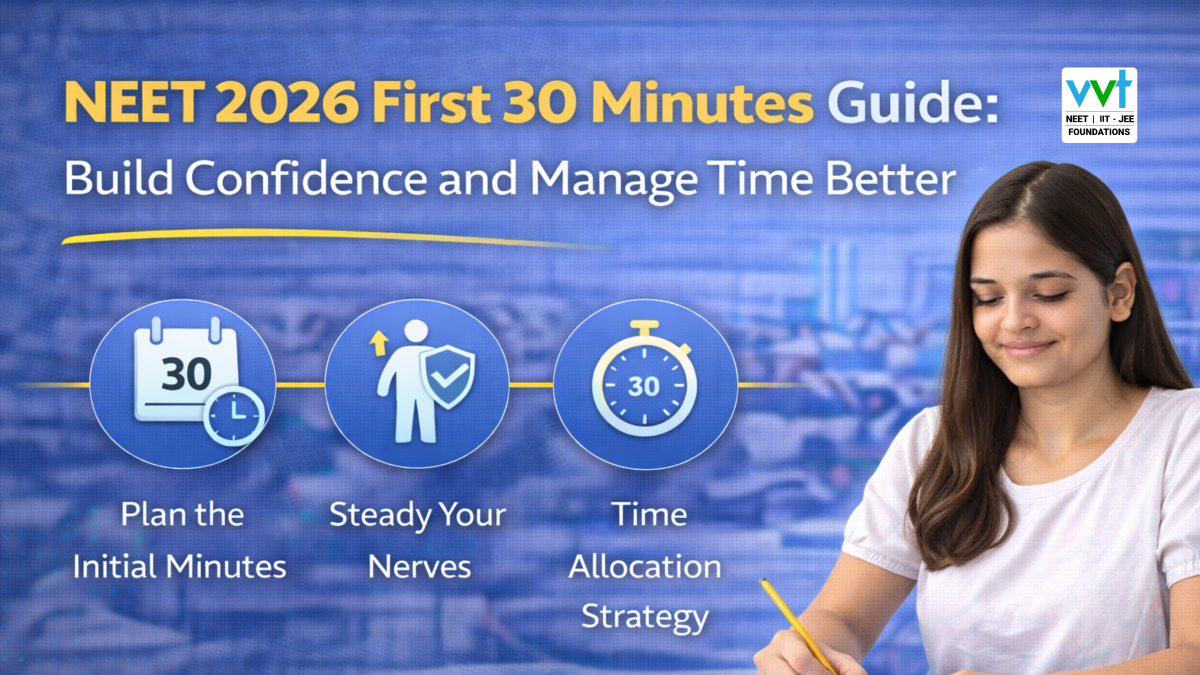
NEET 2026 First 30 Minutes Guide: Build Confidence and Manage Time Better
VVT Coaching Chennai – Ranked #1 Best NEET & JEE Coaching Centre by Times Now!
In NEET, the first 30 minutes can quietly decide the mood of the next 2.5 hours.
A lot of students do not lose control because the paper is impossible. They lose control because they start badly. They open with a tough Physics question, get stuck too early, panic, rush the next few pages, and suddenly the paper feels harder than it actually is. That is why the first 30 minutes are not just the “beginning” of NEET. They are the phase where students either build rhythm or damage it. For NEET UG 2026, the exam is officially scheduled for 3 May 2026, from 2:00 PM to 5:00 PM, in pen-and-paper mode, with 180 compulsory questions carrying 720 marks.
So if you are asking what the best first-30-minutes strategy is, here is the shortest answer:
Do not try to impress the paper in the first 30 minutes. Try to stabilise yourself.
Why the first 30 minutes matter so much
The first 30 minutes set three things:
- your confidence,
- your speed,
- and your emotional control.
If you begin with too much pressure, the rest of the exam becomes a recovery mission. If you begin with clarity, the paper starts feeling more manageable. That is why recent NEET strategy explainers emphasize solving easier Biology and Chemistry questions first, avoiding time-consuming traps early, and building confidence before getting pulled into heavier sections.
This recommendation also makes sense from the official paper structure itself. Biology carries the biggest share of the paper, while Physics is the subject where students most often burn time in the early phase. So the smartest first-half-hour is usually the one that protects accuracy and rhythm, not the one that chases the hardest marks first. That is a strategic inference from the official NEET pattern and VVT’s published exam-day guidance.
What students should not do in the first 30 minutes
The biggest mistake is starting with ego.
Many students feel they must begin with Physics because it looks ‘serious.’ Others believe they must solve every question in order. A few panic when the first questions feel hard and assume the entire paper is gone.
All three reactions are dangerous.
The first 30 minutes are not the time to prove bravery. They are the time to build control.
That means:
- do not get trapped in one long question,
- do not let one difficult concept shake your confidence,
- do not start blind guessing,
- and do not keep staring at the same problem hoping it will suddenly open up.
VVT’s recent article on common exam-hall mistakes is very clear on this broader point, students often lose marks because they panic, mismanage time, rush OMR decisions, or carry the stress of one difficult section into the next.
The best first 30 minutes strategy for NEET 2026
The smartest first-30-minutes approach is usually this:
Step 1: Start with familiar, direct questions
In the first few minutes, your goal is not maximum coverage. Your goal is to get the brain settled into exam mode. That is why many strong students begin with the easiest available questions from Biology and straightforward Chemistry, because these often allow faster recall and cleaner attempts. Begin with easier Biology and Chemistry questions, avoid time-consuming problems early, and use that phase to build confidence.
Step 2: Avoid long Physics traps immediately
This does not mean ignoring Physics. It means do not let the first 30 minutes get hijacked by a stubborn Physics question that requires multiple steps and steals your emotional balance.
Step 3: Build a quick rhythm of correct attempts
The first 30 minutes should feel like this:
- identify,
- solve,
- move,
- protect pace.
When students collect a run of correct, familiar questions early, the paper feels lighter. When they collect confusion early, the paper feels heavier. That is why the opening phase should favour clarity over difficulty.
Step 4: Mark and move, do not sit and suffer
If a question is not opening in a reasonable amount of time, leave it and move forward. The first 30 minutes are too valuable to spend arguing with one problem.
Which subject should you touch first?
There is no official NTA rule saying students must begin with one subject. This is strategy, not regulation. But for most students, the best opening is:
Biology first, then easy Chemistry, then controlled entry into Physics.
Why?
Because Biology usually gives the cleanest early recall, Chemistry can provide short direct returns, and Physics becomes safer once the mind is already settled.
Start with your strongest zone, but only if it gives fast and confident attempts.
If Chemistry is your best early-score subject, begin there. If Biology gives you the cleanest rhythm, start there. But whichever subject you choose, the rule stays the same, the first 30 minutes are for collecting stable marks, not dramatic attempts.
How many questions should you aim for in the first 30 minutes?
There is no fixed magic number, because students differ in speed and section strength. But the right measure is not “How many questions did I touch?” The better measure is:
Did the first 30 minutes make me calmer or more anxious?
That is the real test of a good start.
A strong first 30 minutes usually means:
- you have already settled into the paper,
- you have picked up early marks,
- you are not emotionally disturbed,
- and you still feel in control of the full 3-hour exam.
A bad first 30 minutes usually means:
- you are already behind your own pace,
- one tough question has damaged your mood,
- and you feel like you need to “recover” for the next 2.5 hours.
What about OMR bubbling in the first 30 minutes?
Students should not leave all OMR work to the very end if that creates panic for them. The best method is the one they have already practiced in mocks and can execute calmly.
VVT’s current NEET exam-day and OMR-related content strongly supports the idea that students lose marks not only because they do not know the answer, but because they mishandle the answer-recording process under stress. That is why the first 30 minutes should also include calm OMR discipline, not rushed marking decisions.
The safest rule is:
do not let the answer sheet become an afterthought.

Also read:NEET 2026 Exam Time, Reporting Schedule & Gate Closing Rules | VVT Coaching Centre
Also read: Common Exam Hall Mistakes Students Should Avoid for NEET 2026
The mindset students need in the first 30 minutes
The correct first-30-minutes mindset is not:
- “I must finish a huge chunk immediately”
- or “I must prove I’m strong in Physics”
- or “If the first page is hard, everything is over”
The correct mindset is:
- “I will settle the paper”
- “I will collect the cleanest marks first”
- “I will not let one hard patch control my emotions”
- “I will build the exam, not fight it”
This is the kind of exam temperament where students stay calm after a tough section, manage their time well, and enter the exam hall with a clear system instead of relying only on motivation.
How VVT Coaching Helps Students Start Strong and Protect Marks in the First 30 Minutes
In NEET, the first 30 minutes often decide the tone of the full paper.
Some students begin well, settle quickly, and build rhythm. Others panic early, get stuck on one difficult question, lose time, and carry that stress into the next section. That is why at VVT Coaching Chennai, we do not train students only to know answers. We train them to start the paper correctly.
Because in the exam hall, marks are often lost not in the last hour first, but in the opening phase, when students are still trying to control nerves, pace, and confidence.
Error Exams — Remove the mistakes that damage the opening flow
A big reason students lose confidence in the first 30 minutes is that they meet the same trap patterns again and react emotionally.
Many students repeatedly make early paper mistakes such as:
- getting stuck on the first lengthy Physics question
- misreading simple Biology statements in a hurry
- making sign or unit mistakes in Chemistry
- skipping easy questions after one difficult start
- doubting questions they actually know
That is why VVT uses Error Exams built from the student’s own recent mistakes.
These help students practise:
- question types they commonly get wrong in the beginning of mocks
- common trap patterns that break paper flow
- attempt → analysis → re-attempt cycles until the reaction becomes calmer
- better judgment on when to solve, skip, or return later
Result: students enter the actual exam with fewer repeated mistakes, better first-section control, and more confidence during the most sensitive opening minutes.
AI-Powered Mock Tests — Improve first 30-minute time control
One of the biggest reasons students lose marks early is poor time use at the start of the paper.
Some students:
- spend too long on one question
- start with low-confidence areas
- overthink easy questions
- panic if the paper feels unfamiliar
- lose rhythm before the exam even settles
That is why VVT’s AI-powered mock tests focus not just on marks, but on how the student begins the paper.
They show students:
- topic-wise and section-wise accuracy
- time spent per question
- where overthinking begins
- where careless errors appear early
- whether one subject is damaging the full-paper pace
- how the opening stretch is affecting the rest of the exam
Result: students learn how to use the first 30 minutes more intelligently, protect momentum, and avoid early mistakes that create pressure later.
Personalised Guidance – Build a stable first-section strategy
A strong start in NEET is not accidental. It usually comes from a clear plan.
At VVT, personalised mentoring helps students prepare for the first 30 minutes by guiding them on:
- how to enter the paper without panic
- which subject or question type to open with based on strengths
- how to respond if the first few questions feel difficult
- how to avoid emotional decisions after one bad start
- how to protect confidence without rushing
This is especially important because many students know the syllabus, but still lose control in the opening phase simply because they do not have a stable paper-entry strategy.
Result: students begin the exam with more clarity, better emotional control, and fewer mistakes caused by panic or confusion.
Remedy Classes – Fix the weak points that create early hesitation
Sometimes the first 30 minutes go badly not because the student is unprepared overall, but because a few weak areas create instant hesitation.
These may include:
- one formula area that causes doubt
- one concept that slows decision-making
- one type of trap question that keeps repeating
- one weak topic that damages confidence early
- one subject area that students avoid or fear at the start
VVT’s Remedy Classes focus on these exact weak points in a short and targeted way.
These sessions are:
- focused on one exact issue at a time
- planned using mock analysis and faculty insight
- designed to improve clarity, not overload the student
- followed by quick retesting to confirm the fix
Result: students go into the exam with fewer hesitation zones, which makes the first 30 minutes smoother and more productive.

Get to Know VVT’s Three Friendly Campuses: Always Nearby and Welcoming
VVT has three spots across Chennai, each easy to reach and full of support. No matter where you live, one is close by. Our campuses mix bright classrooms, helpful teachers, and a warm feel to keep you going. Here’s a quick look at each, with a focus on how they help with NEET and staying options.
Adyar Campus: Easy Access and Positive Vibes
Right on busy L.B. Road next to Adyar Ananda Bhavan, this spot is super convenient. Step inside, and you’ll see big, airy rooms where learning feels fun. Staff greet you with smiles, and the energy pushes you to turn weak areas like tough Physics problems into strengths. We also offer hostel facilities here for boys, with clean rooms, meals, and support to make your stay comfortable and focused. No distractions, just a safe place to rest and review after classes.
Adyar Campus (VVT Coaching Centre): “Nibav Buildings”, 4th & 5th Floor, No.23, Old No.11, L.B. Road, Adyar, Chennai – 600020. (Next to Adyar Ananda Bhavan)
Get Directions: Open in google maps!
Anna Nagar Campus: Focus in the City Centre
In Shanthi Colony, Anna Nagar, this campus feels like an extension of home. Good bus links make it simple for city kids. There is no on-site hostel, but nearby options are plentiful for those who need them.
Anna Nagar Campus (VVT Coaching Centre): No.1621, 9th Main Road, Shanthi Colony, Block AI, Anna Nagar, Chennai – 600040.
Get Directions: Open in google maps!
Pallikaranai Girls Campus: Your Safe Place with Full Hostel
This is our special girls-only residential campus in a quiet area. It’s built as a true home away from home, with clean dorms, healthy meals in the canteen, and round-the-clock help.
We offer full hostel facilities here, clean rooms, study areas, and a community of girls supporting each other. It’s perfect if you’re from outside Chennai or just want a focused, safe space.
Pallikaranai (Saraswathi Girls Residential Campus): Plot No. 395 & 396, 1st Main Road, Kamakoti Nagar, Pallikaranai, Chennai – 600100.
Get Directions: Open in google maps
Conclusion
If you want the most practical answer to “NEET 2026 first 30 minutes strategy,” it is this:
Start with familiarity.
Avoid early traps.
Collect quick correct attempts.
Do not let Physics steal your emotional balance too early.
Do not let one hard question decide the tone of your paper.
And do not treat the first 30 minutes like a race. Treat them like a setup.
With NEET UG 2026 on 3 May 2026 and the advance city intimation already released on 12 April 2026, this is exactly the right time to train that opening half-hour properly in mocks.
At VVT Coaching, that is the real goal:
not just helping students know the syllabus,
but helping them start the paper in a way that protects marks.
Visit: vvtcoaching.com
Call: +91 81221 22333
Scholarships: Up to 100% via VVTSAT!
Also read: How to Get 150 Marks in NEET 2026 in Just 15 Days!
Also read: How to Fill the NEET 2026 OMR Sheet: Step-by-Step Guide for Students!
FAQs
What is the best subject to start with in NEET 2026?
There is no official NTA rule for subject order. Strategically, many students do better by starting with their most familiar fast-return area, often Biology or easy Chemistry, rather than jumping into long Physics questions immediately.
Should I start NEET with Physics?
For many students, that is risky if Physics tends to slow them down early. A safer start is often the subject that gives clean, confidence-building attempts in the opening phase.
How important are the first 30 minutes in NEET?
They are very important because they shape confidence, pace, and emotional control for the rest of the paper. A bad start often leads to panic and poor section carryover.
Should I solve tough questions in the first 30 minutes?
Usually no. The first 30 minutes are better used for quick, stable marks and building momentum. Difficult questions can be revisited later.
Is the NEET 2026 city intimation slip released?
Yes. The official NEET website shows the advance city intimation notice published on 12 April 2026.