
How to Restart NEET Preparation After Exam Cancellation: A Practical Student Guide
May 26, 2026
NEET 2026 Physics Revision Strategy: Important Formulas & High-Weightage Chapters
May 28, 2026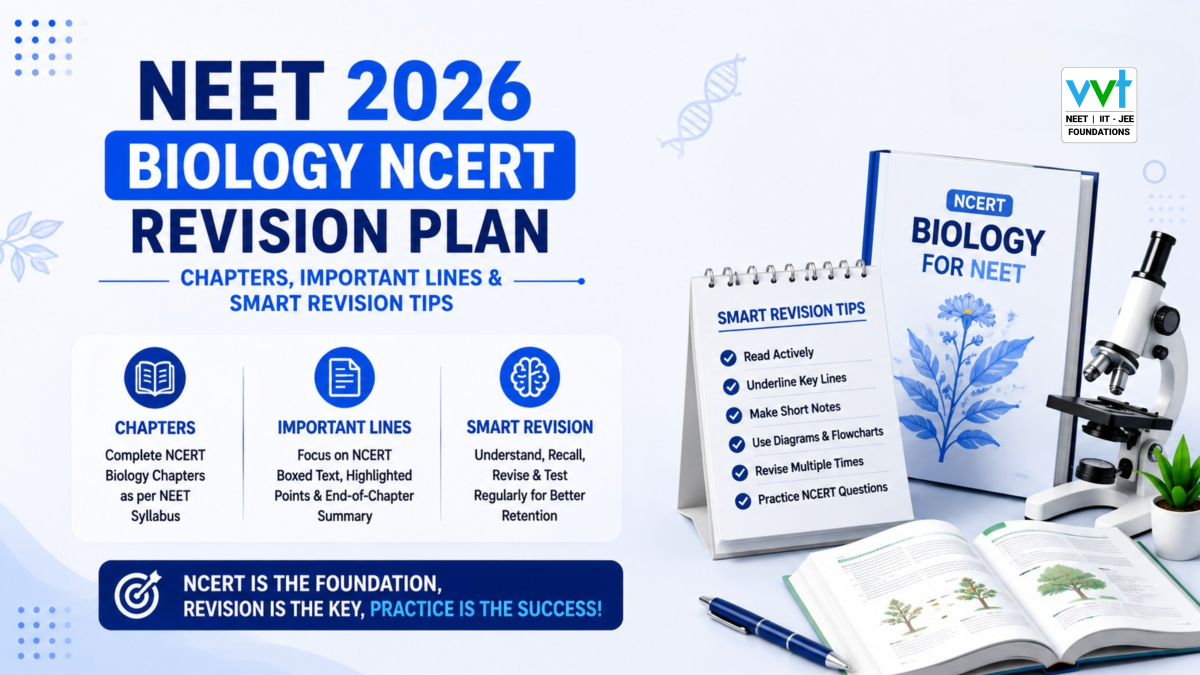
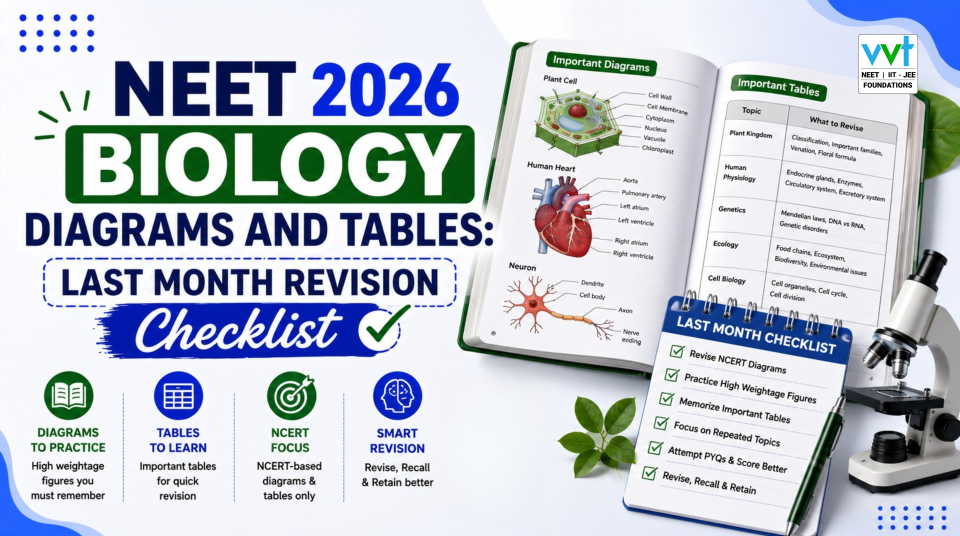
NEET 2026 Biology NCERT Revision Plan: Chapters, Important Lines & Smart Revision Tips
VVT Coaching Chennai – Ranked #1 Best NEET & JEE Coaching Centre by Times Now!
Biology is the subject that can protect your NEET score.
Many students fear Physics. Some students are inconsistent in Chemistry. But Biology is different. If you revise NCERT properly, read the lines carefully, practise statement based questions, and avoid careless mistakes, Biology can become your biggest scoring area.
For NEET UG 2026, Biology remains a major part of the paper. The official NEET 2026 pattern has 90 Biology questions out of 180 total questions, carrying 360 marks out of 720. That means Biology alone contributes half of the NEET paper. The official NEET UG 2026 syllabus is published by NTA/NMC, and students should revise from the official syllabus instead of depending on random chapter lists or social media shortcuts.
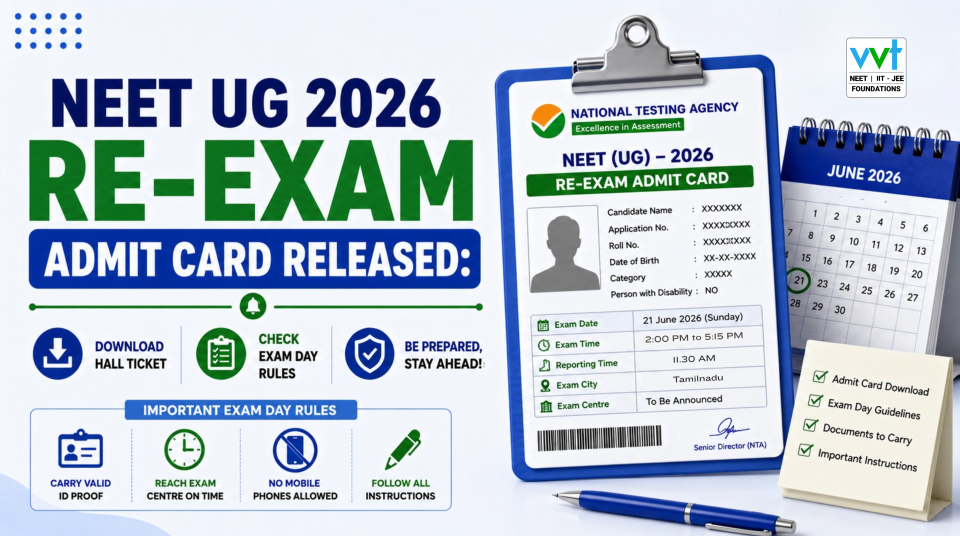
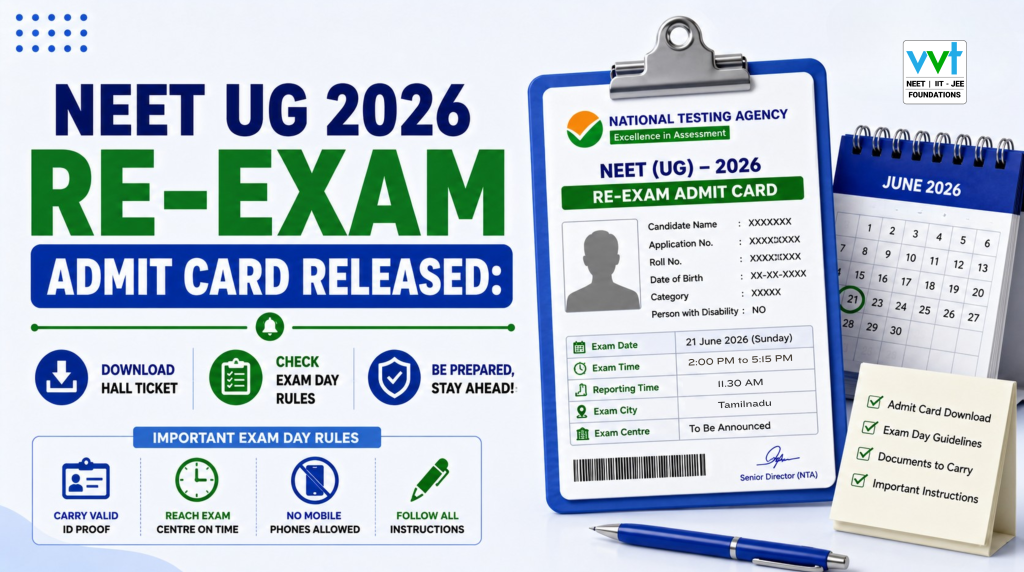
For students preparing for the NEET UG 2026 re-exam, Biology revision becomes even more important. NTA’s FAQ confirms that the re-examination is scheduled for 21 June 2026, Sunday, from 2:00 PM to 5:15 PM, including time for formalities.
So now the question is not:
“Should I revise Biology?”
The real question is:
“How do I revise NCERT Biology in a way that actually improves marks?”
At VVT Coaching, we tell students one thing clearly: Biology is not revised by simply reading pages. Biology is revised by reading, recalling, testing, correcting, and repeating.
Why NCERT Biology is so important for NEET 2026
For NEET Biology, NCERT is not just a book. It is the foundation.
A large number of Biology questions are based on:
- direct NCERT lines,
- diagrams,
- examples,
- tables,
- definitions,
- process steps,
- and statement-based understanding.
This is why students who read NCERT casually often feel shocked by the exam. They may say, “I knew the chapter,” but still lose marks because they missed one word in a question.
For example, Biology questions often test small differences like:
- correct vs incorrect statement,
- true vs false,
- match the following,
- diagram labels,
- Example based facts,
- sequence of processes,
- and NCERT wording.
That is why NCERT revision should not be passive. It should be active and question oriented.
NEET 2026 Biology revision: what should your goal be?
Your Biology goal should not be “finish NCERT once more.”
That is too vague.
Your real goals should be:
- revise all important NCERT chapters,
- strengthen high yield units,
- remember diagrams and examples,
- practise statement based questions,
- reduce silly mistakes,
- and improve accuracy in mock tests.
Biology is a scoring subject only when your accuracy is high. If you attempt many questions but make small mistakes, your score will not reflect your preparation.
So the VVT rule is simple:
Biology revision is successful only when it improves accuracy.
NEET 2026 Biology chapters: how to prioritise NCERT revision
The official NEET UG 2026 syllabus includes Biology topics across Class 11 and Class 12. Instead of revising randomly, divide Biology into priority zones. (National Testing Agency)
High priority Biology units for fast revision
These Biology units should be revised repeatedly during final NEET preparation because they are part of the official NEET UG 2026 syllabus and are commonly considered high-return areas based on previous exam trends:
| Unit | Why it matters |
| Human Physiology | Concept heavy and frequently tested |
| Genetics and Evolution | High scoring if concepts are clear |
| Ecology and Environment | NCERT lines, examples, and facts are very important |
| Reproduction | Direct NCERT and process based questions |
| Biotechnology and Its Applications | Compact and usually scoring |
| Biology and Human Welfare | NCERT facts, diseases, immunity, and microbes matter |
| Plant Physiology | Processes and diagrams are important |
| Cell Structure and Function | Basics support many other Biology chapters |
This does not mean other chapters are unimportant. NEET Biology can ask questions from any part of the official syllabus. It only means these units should not be left weak, especially during final revision.
Chapter wise Biology NCERT revision plan for NEET 2026
Below is a practical chapter wise revision plan students can follow during the RE-NEET preparation phase.
| Biology Area | What to Revise | Smart Revision Method |
| Diversity in Living World | Taxonomy, systematics, five kingdom classification, plant and animal classification, examples | Revise NCERT examples, tables, and classification features |
| Structural Organisation in Animals and Plants | Morphology, anatomy, tissues, plant parts, animal tissues, frog/insect basic systems | Label diagrams and revise family/examples |
| Cell Structure and Function | Cell organelles, biomolecules, enzymes, cell cycle, mitosis, meiosis | Revise definitions, diagrams, and process flow |
| Plant Physiology | Photosynthesis, respiration, plant growth and development, growth regulators | Revise cycles, factors, hormones, and NCERT diagrams |
| Human Physiology | Breathing, circulation, excretion, locomotion, neural control, endocrine system | Use flowcharts and practise application-based MCQs |
| Reproduction | Sexual reproduction in flowering plants, human reproduction, reproductive health | Revise processes, diagrams, NCERT terms, and sequence-based questions |
| Genetics and Evolution | Mendelian inheritance, molecular basis, chromosomal disorders, evolution | Practise numericals, pedigree, statement, and assertion-reason questions |
| Biology and Human Welfare | Diseases, immunity, cancer, HIV/AIDS, microbes in human welfare, drugs and alcohol abuse | Make disease-pathogen tables and revise NCERT examples |
| Biotechnology and Its Applications | Recombinant DNA technology, insulin, vaccines, gene therapy, Bt crops, biosafety | Revise steps, applications, and examples |
| Ecology and Environment | Organisms and environment, population interactions, ecosystem, biodiversity conservation | Revise NCERT examples, definitions, and flow diagrams |
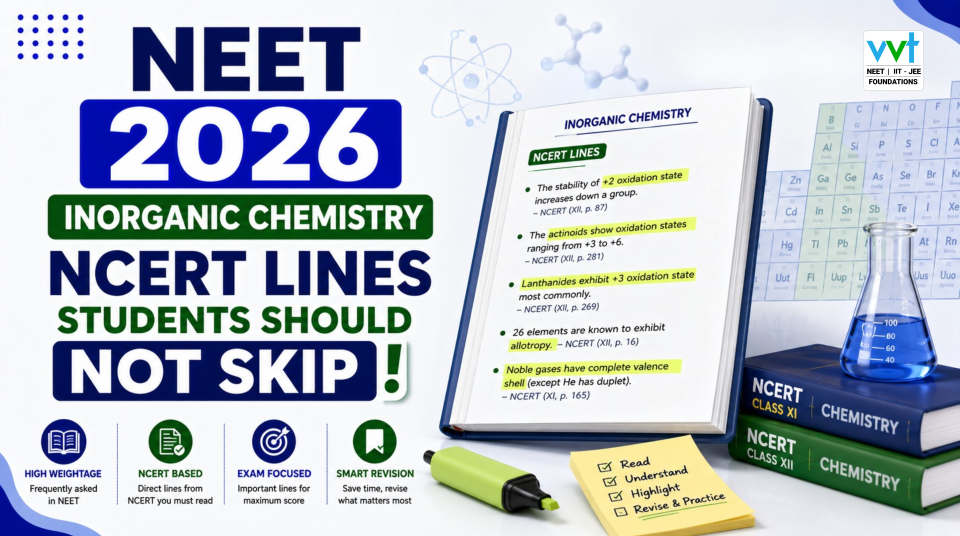
Important NCERT lines: what students should mark
Many students ask, “Which NCERT lines are important?”
The answer is not only highlighted textbook lines. NEET often tests ordinary looking lines too.
During revision, mark these types of lines:
1. Definition lines
Any line that defines a process, term, disease, structure, or biological phenomenon can become a direct or statement-based question.
2. Example lines
Examples are extremely important in Biology. Many questions ask which organism belongs to which group, which example matches which process, or which disease is caused by which pathogen.
3. Exception lines
If NCERT says “except,” “only,” “mostly,” “generally,” “rarely,” or “unlike,” mark that line carefully. These words often create tricky options.
4. Diagram labels
Do not just look at diagrams. Label them from memory. Diagrams from Human Physiology, Reproduction, Plant Anatomy, Cell Biology, Biotechnology, and Ecology are especially useful.
5. Tables and boxed information
NCERT tables are often ignored, but they are perfect for matching the following and statement based questions.
6. Process sequence lines
Any biological process with steps must be revised in order. Examples include DNA replication, transcription, translation, menstrual cycle, fertilisation, nerve impulse transmission, photosynthesis, and respiration.

Also read: NEET 2026 Re-Exam Preparation Plan: How to Use the Extra Time Wisely
Also read: Will NEET 2026 Re-Exam Follow a New Syllabus? Official Update & Student Guide
How to revise NCERT Biology without wasting time
Many students “read” NCERT for hours but do not retain much.
A better method is the 3R method:
Read
Read a small section carefully. Do not rush. Pay attention to keywords, examples, diagrams, and tables.
Recall
Close the book and ask yourself:
- What did I just read?
- What examples were given?
- What diagram was there?
- What process did the paragraph explain?
Reinforce
Solve 20–30 MCQs from the same topic immediately. This tells you whether you actually understood the section.
This is much more effective than reading 30 pages without testing yourself.
Biology revision plan for the next 30 days
Since the re-exam is scheduled for 21 June 2026, students should plan Biology revision in short, repeated cycles instead of one long reading marathon.
| Phase | Days | Biology Goal |
| Phase 1 | Days 1–7 | Finish high confidence chapters and rebuild rhythm |
| Phase 2 | Days 8–15 | Revise high yield units like Human Physiology, Genetics, Ecology |
| Phase 3 | Days 16–23 | Practise statement questions, diagrams, PYQ style MCQs |
| Phase 4 | Days 24–30 | Revise error notebook, NCERT marked lines, diagrams and mock mistakes |
This plan works because Biology improves through repetition. One reading is not enough. Multiple short revisions are better than one long revision.
Smart revision tips for NEET Biology
1. Do not make long notes now
If the exam is close, long notes will waste time. Use short notes, NCERT markings, tables, diagrams, and error lists.
2. Practise statement based questions daily
NEET Biology increasingly tests careful reading. So practise “correct/incorrect statement” questions every day.
3. Revise diagrams actively
Cover labels and redraw or relabel them. Passive looking is not enough.
4. Keep a Biology error notebook
Write only the mistakes that repeat:
- missed NCERT fact,
- wrong example,
- diagram confusion,
- wrong statement interpretation,
- similar option confusion.
5. Do not ignore easy chapters
Easy chapters are dangerous when students become overconfident. Revise them quickly but regularly.
6. Avoid too many resources
NCERT + your class notes + MCQs + mistakes are enough. Too many resources create confusion during final revision.
Common Biology mistakes students must avoid
Many students lose marks in Biology because of avoidable habits:
- reading NCERT without solving questions,
- ignoring diagrams and examples,
- memorising without understanding,
- skipping Ecology because it looks easy,
- not revising tables,
- overusing extra material,
- taking mocks but not correcting Biology mistakes,
- rushing statement-based questions.
How VVT Coaching Helps Students Master Biology NCERT Revision for NEET 2026
For NEET Biology, students do not lose marks only because they have not studied the chapter. Many times, they lose marks because they miss ordinary looking NCERT lines, confuse examples, ignore diagrams, forget tables, or misread statement based questions.
That is why at VVT Coaching Chennai, Biology revision is not treated as simple reading. We train students to revise NCERT with accuracy, repetition, and smart recall so that important lines turn into marks in the exam.
Error Exams — Fix NCERT based mistakes before they repeat
Many students make the same Biology mistakes again and again in mocks:
- misreading NCERT statement based questions
- confusing examples from Plant Kingdom, Animal Kingdom, Ecology, or Human Health
- forgetting exceptions and keywords like “only,” “mostly,” “rarely,” and “except”
- missing diagram labels
- losing marks in chapters they thought were easy
Instead of giving only random Biology practice, VVT uses Error Exams built from the student’s own mistake history.
These include:
- questions similar to the NCERT lines students got wrong
- repeated practice on confusing examples and exceptions
- statement-based questions from weak chapters
- short cycles of attempt → analysis → re-attempt
- targeted correction until the mistake pattern stops repeating
Result: students stop losing marks in familiar NCERT areas and become more confident in statement based Biology questions.
AI-Powered Mock Tests — Show which Biology chapters need revision first
In Biology, many students feel they have revised everything, but their mock scores show gaps. The problem is that they often do not know which NCERT areas are actually weak.
VVT’s AI-powered mock tests help students understand:
- Chapter- wise and topic wise Biology accuracy
- where NCERT line based mistakes are happening
- which chapters are strong and which need quick revision
- where students are losing marks due to careless reading
- which question types are causing confusion
- whether Biology accuracy drops under time pressure
Result: students do not revise Biology blindly. They know exactly which NCERT chapters, diagrams, examples, and tables need more attention.
Personalised Guidance — Build a smart Biology NCERT revision plan
Biology revision should not be random. Many students require extra revision in Human Physiology, while others lose marks in Genetics. Some continue to struggle with Plant Physiology, Ecology, Biotechnology, or classification chapters.
That is why VVT gives students personalised revision guidance.
Our mentors guide students on:
- which NCERT chapters to revise first
- how to mark important lines without over-highlighting everything
- how to revise examples, exceptions, diagrams, and tables
- how to handle statement-based questions calmly
- how to revise Biology daily without overload
- how to balance Botany and Zoology properly
Result: students revise Biology in a structured way instead of reading NCERT passively.
Remedy Classes – Repair small Biology gaps quickly
Many Biology mistakes come from small gaps, not full chapter weakness. A student may know the chapter but still lose marks because of one confusing example, one diagram label, one table, or one exception.
VVT’s Remedy Classes focus on these exact weak spots, such as:
- confusing examples in classification chapters
- weak NCERT memory in Ecology
- mistakes in Human Physiology diagrams
- repeated errors in Genetics concepts
- poor recall of Biotechnology steps
- confusion between similar biological terms
These sessions are short, focused, and based on actual student performance.
Result: students do not waste time re reading the entire chapter unnecessarily. They fix the exact NCERT gaps that can cost marks.

Get to Know VVT’s Three Friendly Campuses: Always Nearby and Welcoming
VVT has three spots across Chennai, each easy to reach and full of support. No matter where you live, one is close by. Our campuses mix bright classrooms, helpful teachers, and a warm feel to keep you going. Here’s a quick look at each, with a focus on how they help with NEET and staying options.
Adyar Campus: Easy Access and Positive Vibes
Right on busy L.B. Road next to Adyar Ananda Bhavan, this spot is super convenient. Step inside, and you’ll see big, airy rooms where learning feels fun. Staff greet you with smiles, and the energy pushes you to turn weak areas like tough Physics problems into strengths.We also offer hostel facilities here for boys, with clean rooms, meals, and support to make your stay comfortable and focused. No distractions, just a safe place to rest and review after classes.
Adyar Campus (VVT Coaching Centre): “Nibav Buildings”, 4th & 5th Floor, No.23, Old No.11, L.B. Road, Adyar, Chennai – 600020. (Next to Adyar Ananda Bhavan)
Get Directions: Open in google maps!
Anna Nagar Campus: Focus in the City Centre
In Shanthi Colony, Anna Nagar, this campus feels like an extension of home. Good bus links make it simple for city kids. There is no on-site hostel, but nearby options are plentiful for those who need them.
Anna Nagar Campus (VVT Coaching Centre): No.1621, 9th Main Road, Shanthi Colony, Block AI, Anna Nagar, Chennai – 600040.
Get Directions: Open in google maps!
Pallikaranai Girls Campus: Your Safe Place with Full Hostel
This is our special girls-only residential campus in a quiet area. It’s built as a true home away from home, with clean dorms, healthy meals in the canteen, and round-the-clock help.
We offer full hostel facilities here, clean rooms, study areas, and a community of girls supporting each other. It’s perfect if you’re from outside Chennai or just want a focused, safe space.
Pallikaranai (Saraswathi Girls Residential Campus): Plot No. 395 & 396, 1st Main Road, Kamakoti Nagar, Pallikaranai, Chennai – 600100.
Get Directions: Open in google maps
Conclusion
Biology can become your biggest strength in NEET 2026, but only if you revise NCERT properly.
NCERT should not be read like a storybook. Students must pay attention to diagrams, learn from examples, and analyse mistakes after every mock test.
Instead:
Read actively.
Recall daily.
Practise MCQs.
Revise diagrams.
Track mistakes.
Repeat weak chapters.
The NEET UG 2026 re-exam is scheduled for 21 June 2026, from 2:00 PM to 5:15 PM, so the remaining time should be used for focused revision and error correction.
At VVT Coaching Chennai, our message is simple:
Biology score improves when NCERT reading becomes active, tested, and mistake free.
That is how students convert NCERT revision into real NEET marks.
Visit: vvtcoaching.com
Call: +91 81221 22333
Scholarships: Up to 100% via VVTSAT!
Also read: How VVT Coaching Uses AI to Identify and Solve Your NEET Preparation Struggles
Also read: Best Way to Attempt NEET Paper in 2026: Time Management and Smart Strategy
FAQs
Is NCERT enough for NEET 2026 Biology?
NCERT is the foundation for NEET Biology. Students should revise NCERT lines, diagrams, examples, tables, and then practise MCQs to check recall and accuracy.
How should I revise Biology NCERT for NEET 2026?
Use the Read Recall Reinforce method. Read a small section, recall it without looking, then solve MCQs from that topic.
Which Biology chapters are most important for NEET 2026?
Human Physiology, Genetics and Evolution, Ecology, Reproduction, Biotechnology, Biology in Human Welfare, Plant Physiology, Cell Biology, and Biomolecules are high priority areas.
How many times should I revise NCERT Biology before NEET?
There is no fixed number, but repeated short revisions are better than one long reading. Important chapters, diagrams, and error areas should be revised multiple times.