
RE-NEET UG 2026 Fake Notice Alert: PIB Advisory for Students
June 12, 2026
NEET 2026 Entry Closing Time: Reporting Time, Late Entry Rules & Exam Day Guidelines
June 14, 2026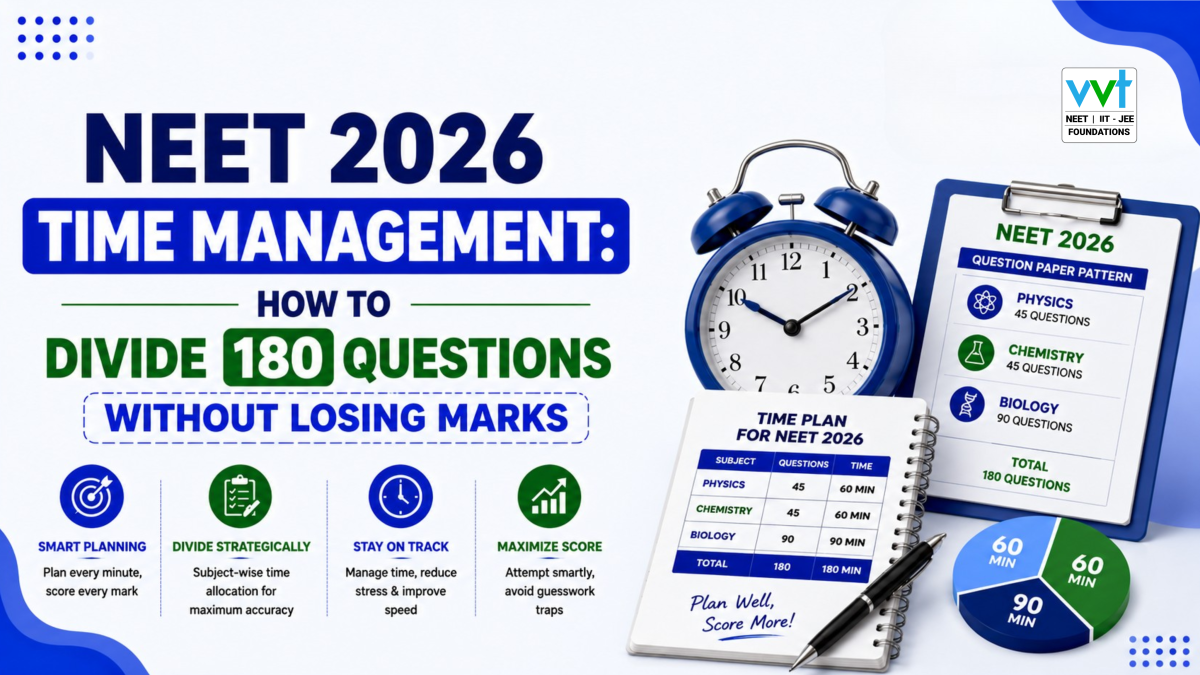
NEET 2026 Time Management: How to Divide 180 Questions Without Losing Marks
VVT Coaching Chennai – Ranked #1 Best NEET & JEE Coaching Centre by Times Now!
NEET is not only a test of knowledge. It is also a test of speed, calmness, accuracy, and decision making.
Many students know the answer but still lose marks because they spend too much time on one Physics question, rush Biology in the end, bubble the wrong option in OMR, or keep changing answers out of panic.
That is why NEET 2026 time management is not a small strategy. It can directly decide how many marks you protect in the final exam.
For NEET UG 2026, students have to handle 180 compulsory questions in 180 minutes. This means, on paper, you get only one minute per question. But in reality, you cannot divide the paper equally because Biology, Chemistry, and Physics need different levels of reading, calculation, and checking.
So the real question is:
How should you divide 180 questions without losing marks?
Let’s break it down in a simple, practical way

Why Time Management Matters More in NEET 2026
Most NEET aspirants focus only on revision. Revision is important, but during the actual exam, marks are lost for three common reasons:
- You know the concept but take too long to solve.
- You choose the correct answer in the question paper but mark the wrong bubble.
- You spend time on doubtful questions and miss easy scoring questions.
NEET has negative marking. A wrong answer does not just give you zero. It pulls your score down. That is why time management should not mean “attempt everything fast.” It should mean:
Attempt the right questions first, avoid unnecessary risk, and protect marks with accuracy.
This is especially important for repeaters and students who have already prepared well but struggle to convert their preparation into exam marks.
NEET 2026 Exam Pattern: What Students Must Remember
Before planning time, students must be clear about the exam structure.
NEET UG 2026 consists of:
| Subject | Questions | Marks |
| Physics | 45 | 180 |
| Chemistry | 45 | 180 |
| Biology | 90 | 360 |
| Total | 180 | 720 |
The marking scheme is:
- Correct answer: +4 marks
- Wrong answer: -1 mark
- Unanswered question: 0 marks
This means one careless wrong answer creates a 5 mark gap compared to a correct answer. That is why accuracy is more important than blind speed.
Also, students must remember that NEET is conducted in pen and paper mode. So your OMR strategy is part of your time management strategy.
Best Time Split for 180 Questions in 180 Minutes
A practical NEET 2026 time management plan should give more time to calculation heavy subjects and still keep a final buffer.
Here is a balanced time split for most students:
| Section | Suggested Time |
| Biology | 45–55 minutes |
| Chemistry | 35–45 minutes |
| Physics | 55–65 minutes |
| Final review + OMR checking | 20–30 minutes |
A simple target plan can be:
- Biology: 50 minutes
- Chemistry: 40 minutes
- Physics: 60 minutes
- Final review and OMR check: 30 minutes
This is not a fixed rule for every student. If you are very strong in Biology, you may finish it faster. If Physics is your weak area, you may need more time. But the main idea is to avoid giving unlimited time to any one subject.
Biology Time Plan
Biology has 90 questions and carries 360 marks, so it is the highest scoring section. But students should not become overconfident here.
For Biology:
- Target time: 45–55 minutes
- Do NCERT based direct questions first.
- Do not overthink simple factual questions.
- Be careful with statement-based and match-the-following questions.
- Mark doubtful questions and come back later.
A good Biology strategy is to complete the first round quickly but carefully. Do not spend three minutes on one confusing statement. That time may be more useful in Physics or final checking.
Chemistry Time Plan
Chemistry can be scored if you handle it smartly. The subject usually contains a mix of Physical Chemistry calculations, Organic reaction logic, and Inorganic NCERT memory-based questions.
For Chemistry:
- Target time: 35–45 minutes
- Attempt direct NCERT Inorganic questions first.
- Solve familiar Organic questions without overthinking.
- In Physical Chemistry, skip lengthy calculations in the first round if they look time consuming.
- Avoid guesswork in confusing assertion or statement questions.
Chemistry is the section where many students can save time for Physics. But this happens only if you practise Chemistry under timed mock test conditions.
Physics Time Plan
Physics is where most students lose time. One lengthy calculation can disturb your full paper strategy.
For Physics:
- Target time: 55–65 minutes
- Start with formula based and direct concept questions.
- Skip questions where the method is not clear within the first 40–60 seconds.
- Do not get emotionally attached to one question.
- Avoid rough work confusion by writing steps clearly.
A smart Physics rule is:
If you understand the question but the calculation is long, mark it for Round 2. If you do not understand the question at all, leave it for the final review only if time permits.
This one habit can protect your score.
The 3 Round Strategy to Attempt NEET Without Panic
Instead of trying to solve every question in one go, use a 3 round approach.
Round 1: Secure Easy Marks First
In the first round, your job is not to prove that you can solve every question. Your job is to collect all the easy and moderate marks.
Attempt questions that are:
- Direct
- Familiar
- NCERT based
- Formula based
- Clearly understood in the first reading
Skip questions that are:
- Too lengthy
- Confusing
- Calculation heavy
- Based on weak topics
- Causing panic
This round builds confidence. Once easy marks are secured, your mind becomes calmer.
Round 2: Return to Marked Questions
In the second round, go back to the questions you marked for review.
Now solve questions that need:
- Extra calculation
- Careful reading
- Formula substitution
- Comparison between two close options
- Slightly deeper thinking
This round should be controlled. Do not allow one question to eat five minutes.
Round 3: Final Check and OMR Safety
The final round is not for taking random risks. It is mainly for:
- Checking OMR bubbles
- Verifying question numbers
- Reviewing marked questions
- Correcting only obvious mistakes
- Leaving doubtful questions if the risk is high
Many students lose marks in the last 10 minutes because they panic and change correct answers. Do not change an answer unless you have a clear reason.

Also read: NEET 2026 Re-Exam Preparation Plan: How to Use the Extra Time Wisely
Also read: NEET 2026 Biology NCERT Revision Plan: Chapters, Important Lines & Smart Revision Tips
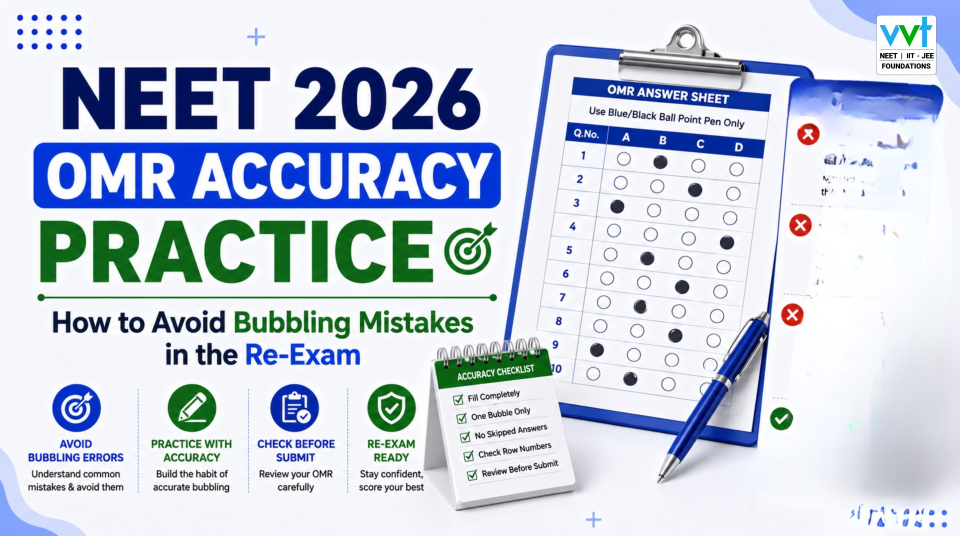
OMR Time Management: How to Avoid Bubbling Mistakes
OMR mistakes are painful because they usually happen even when the student knows the answer.
Avoid these mistakes:
- Bubbling all answers only at the end
- Bubbling after every single question and losing flow
- Marking the wrong question number
- Changing bubbles carelessly
- Rushing in the final five minutes
A safer method is batch bubbling.
For example:
- Solve 10–15 questions.
- Pause for a few seconds.
- Bubble those answers carefully.
- Cross check question number and option.
- Continue the next batch.
This method reduces the risk of last minute OMR panic.
For Biology, you may bubble after every 15 questions. For Chemistry and Physics, you may bubble after every 10 questions because calculations can break the flow and increase confusion.
Common Time Management Mistakes Students Make
1. Starting with the weakest subject
Some students start with the subject they fear the most. This can work for a few students, but for many, it creates early panic. If Physics is your weakest area, starting with a tough Physics question may affect your confidence for the full paper.
Start with the subject that gives you rhythm and confidence.
2. Spending too much time on one question
A NEET question is not worth losing five easy questions. If a question is taking too long, leave it and come back.
Remember: selection depends on total marks, not on solving one difficult question.
3. Leaving OMR for the end
This is one of the biggest mistakes. In the final minutes, hands shake, question numbers get mixed up, and students make avoidable bubbling mistakes.
Do not leave the full OMR for the last few minutes.
4. Guessing too much
Because of negative marking, blind guessing is dangerous. If you can eliminate two options confidently, you may consider the question. But if all four options look equally confusing, it is safer to leave it.
5. Not practising with a timer
Students who practise without time pressure often struggle in the actual exam. Every full mock test should be written like the real NEET exam, including OMR practice.
What Students Should Do Now
If you are preparing for NEET 2026, especially in the final stage, do not only revise chapters. Train your exam behaviour.
Here is a simple action plan:
- Write full length NEET mock tests in exactly 180 minutes.
- Use the same subject order in at least 3–5 mocks.
- Track how much time you spend on Biology, Chemistry, and Physics.
- Identify where you lose time.
- Practise OMR bubbling in batches.
- Analyse every wrong answer.
- Separate mistakes into concept mistakes, calculation mistakes, reading mistakes, and OMR mistakes.
- Create a personal “do not repeat” mistake list.
- Revise formulas, NCERT lines, and diagrams daily.
- Sleep properly before mock tests and the final exam.
The goal is not to attempt fast blindly. The goal is to attempt with control
What Our Academic Team Suggests
Our academic team at VVT Coaching suggests that students should enter the exam hall with a fixed attempt strategy, not a vague plan.
A student should already know:
- Which subject they will attempt first
- How much time they will give to each subject
- When they will bubble answers
- How they will mark doubtful questions
- What type of questions they will skip in Round 1
- How they will use the final 20–30 minutes
This strategy should be tested in mock exams before the final day.
Do not create a new strategy inside the exam hall. The exam hall is for execution, not experimentation.
How VVT Coaching Helps Students Manage 180 Questions Without Losing Marks
In NEET, time management is not only about finishing the paper. It is about finishing the paper with accuracy, calmness, and the right attempt strategy. Many students know the concepts but still lose marks because they spend too much time on one section, rush the last 30 minutes, bubble the OMR in a hurry, or panic after facing a few difficult questions.
That is why at VVT Coaching Chennai, preparation is not limited to syllabus coverage alone. We train students to handle all 180 questions with better planning, better speed, and better decision making.
Error Exams — Fix the mistakes that waste time repeatedly
Many students lose time in NEET because they repeat the same mistake patterns in every mock test. Some questions take too long, some traps create confusion, and some familiar questions are skipped because of pressure.
VVT’s Error Exams help students identify and correct:
- lengthy Physics questions where students get stuck
- Biology statements that are misread in a hurry
- Chemistry formula, sign, or unit mistakes
- questions skipped due to panic
- repeated traps that reduce speed and accuracy
Instead of giving only more random papers, VVT builds Error Exams from the student’s own recent mistakes. These include similar question types, repeated trap patterns, and short cycles of attempt → analysis → re-attempt.
Result: students learn which questions to solve, which questions to leave for later, and how to avoid wasting time on the same mistake again.
AI-Powered Mock Tests — Understand where time is being lost
One of the biggest challenges in NEET is dividing time across 180 questions. Many students spend too long on Physics. Others rush Biology even though it can improve their score. A few finish one subject quickly but lose accuracy. Others do not realise that their stamina drops in the second half of the paper.
VVT’s AI-powered mock tests help students understand:
- topic-wise and section-wise accuracy
- time spent per question
- where overthinking is happening
- where careless errors are costing marks
- which subject consumes extra time
- whether speed drops in the later part of the test
This helps students create a realistic time strategy instead of blindly copying someone else’s method.
Result: students learn how to divide their time across Physics, Chemistry, and Biology based on their own strengths and weaknesses.
Personalised Guidance — Build the right 180-question attempt strategy
There is no single perfect time management strategy for every student. A student strong in Biology may start differently from a student strong in Chemistry. A student who panics in Physics may need a different section order from someone who is confident in calculations.
At VVT, mentors guide students on:
- which subject to attempt first based on strengths
- how much time to spend on each section
- when to skip a question and return later
- how to avoid wasting time on ego questions
- how to manage the last 30 minutes calmly
- how to balance speed with accuracy
Result: students enter the exam hall with a clear plan instead of deciding everything under pressure.
Remedy Classes — Improve speed in weak micro-topics
Poor time management often comes from small weak areas. A student may know a chapter but still take too long because one micro topic is unclear. These small gaps create hesitation, and hesitation consumes time.
VVT’s Remedy Classes focus on:
- repeated formula slips
- confusing similar concepts
- slow calculation areas
- weak NCERT-based topics
- chapter-specific traps
- poor question judgment
These sessions are short, focused, and based on mock-test analysis and faculty observation.
Result: students become faster in the exact areas where they were losing time.

Get to Know VVT’s Three Friendly Campuses: Always Nearby and Welcoming
VVT has three spots across Chennai, each easy to reach and full of support. No matter where you live, one is close by. Our campuses mix bright classrooms, helpful teachers, and a warm feel to keep you going. Here’s a quick look at each, with a focus on how they help with NEET and staying options.
Adyar Campus: Easy Access and Positive Vibes
Right on busy L.B. Road next to Adyar Ananda Bhavan, this spot is super convenient. Step inside, and you’ll see big, airy rooms where learning feels fun. Staff greet you with smiles, and the energy pushes you to turn weak areas like tough Physics problems into strengths.We also offer hostel facilities here for boys, with clean rooms, meals, and support to make your stay comfortable and focused. No distractions, just a safe place to rest and review after classes.
Adyar Campus (VVT Coaching Centre): “Nibav Buildings”, 4th & 5th Floor, No.23, Old No.11, L.B. Road, Adyar, Chennai – 600020. (Next to Adyar Ananda Bhavan)
Get Directions: Open in google maps!
Anna Nagar Campus: Focus in the City Centre
In Shanthi Colony, Anna Nagar, this campus feels like an extension of home. Good bus links make it simple for city kids. There is no on-site hostel, but nearby options are plentiful for those who need them.
Anna Nagar Campus (VVT Coaching Centre): No.1621, 9th Main Road, Shanthi Colony, Block AI, Anna Nagar, Chennai – 600040.
Get Directions: Open in google maps!
Pallikaranai Girls Campus: Your Safe Place with Full Hostel
This is our special girls-only residential campus in a quiet area. It’s built as a true home away from home, with clean dorms, healthy meals in the canteen, and round-the-clock help.
We offer full hostel facilities here, clean rooms, study areas, and a community of girls supporting each other. It’s perfect if you’re from outside Chennai or just want a focused, safe space.
Pallikaranai (Saraswathi Girls Residential Campus): Plot No. 395 & 396, 1st Main Road, Kamakoti Nagar, Pallikaranai, Chennai – 600100.
Get Directions: Open in google maps
Conclusion
NEET 2026 time management is not about rushing through 180 questions. It is about making smart decisions for 180 minutes.
Give Biology enough time, use Chemistry to build scoring momentum, handle Physics with patience, and keep a final buffer for review and OMR safety.
Do not chase every difficult question. Protect the marks you deserve first.
With the right mock test practice, error analysis, and exam hall strategy, students can reduce panic, avoid silly mistakes, and improve their final score.
If you need expert guidance, structured mock tests, repeater support, or personal performance analysis, VVT Coaching Chennai can help you prepare with a clear plan and stronger confidence.
Visit: vvtcoaching.com
Call: +91 81221 22333
Scholarships: Up to 100% via VVTSAT!
Also read: Best Way to Attempt NEET Paper in 2026: Time Management and Smart Strategy
FAQs
1. What is the best NEET 2026 time management strategy?
The best NEET 2026 time management strategy is to divide the 180 minutes subject wise, attempt easy questions first, skip lengthy questions in Round 1, and keep 20–30 minutes for review and OMR checking.
2. Which subject should I attempt first in NEET?
Start with the subject that gives you confidence and speed. Many students prefer Biology first because it has 90 questions and can build momentum, but you should finalise your subject order after testing it in mock exams.
3. How much time should I give to Physics in NEET?
Physics usually needs 55–65 minutes because it involves calculations and application-based questions. Avoid spending too much time on one difficult question in the first round.
4. How can I avoid OMR mistakes in NEET 2026?
Use batch bubbling. Solve 10–15 questions, then carefully mark those answers in the OMR. Do not leave the full OMR sheet for the last few minutes.
5. How many mock tests should I take for better time management?
Students should write regular full length mock tests under real exam timing. More important than the number of tests is proper analysis after each test.