
RE-NEET 2026 Daily Timetable: Morning to Night Study Routine for the Last Month
June 5, 2026
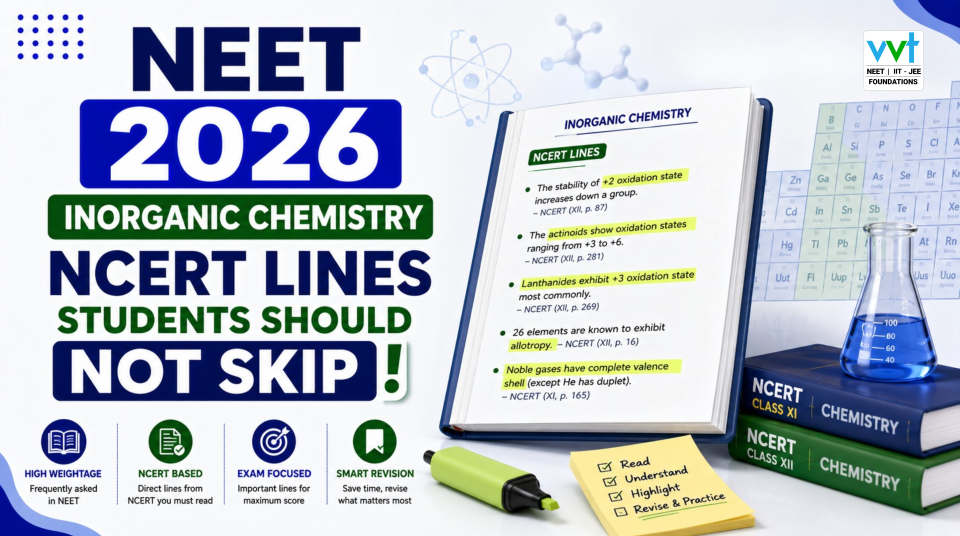
NEET 2026 Inorganic Chemistry NCERT Lines Students Should Not Skip
June 7, 2026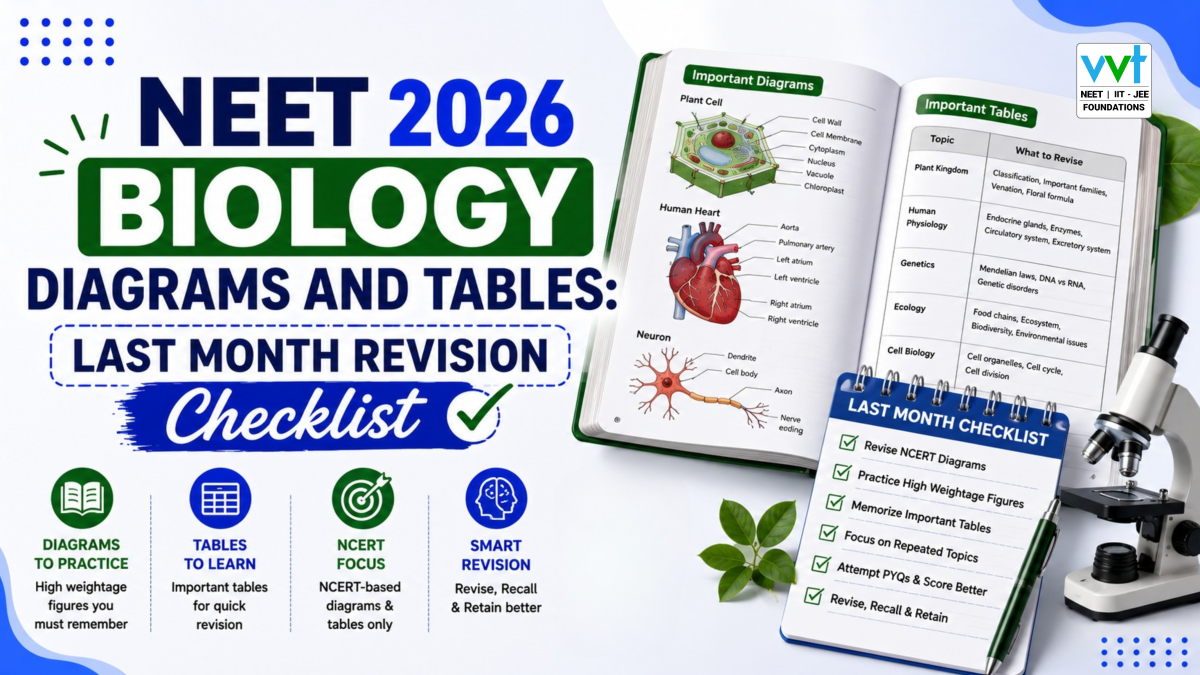
NEET 2026 Biology Diagrams and Tables: Last Month Revision Checklist
VVT Coaching Chennai – Ranked #1 Best NEET & JEE Coaching Centre by Times Now!
Biology can become the highest scoring subject in NEET, but only when revision is smart, NCERT based, and accurate. In the last month, students should not simply read every line again without direction. They should revise the diagrams, tables, flowcharts, examples, cycles, and small labels that often decide whether a question is answered confidently or guessed under pressure.
For NEET 2026 Biology, diagrams and tables are especially important because they help students remember facts faster. A single NCERT diagram can connect structure, function, examples, labels, and tricky one line statements. That is why this last month checklist is designed to help students revise Biology visually, quickly, and with better exam confidence.
This guide is useful for NEET 2026 aspirants, repeaters, and students preparing for final revision. It is also helpful for parents who want to understand what their child should focus on during the last phase instead of randomly revising everything.
Why Biology Diagrams and Tables Matter in NEET 2026
Biology is not just about memorising long paragraphs. Many NEET Biology questions are based on direct NCERT facts, diagram labels, examples, comparisons, and processes. When students revise only theory and ignore diagrams, they often miss simple marks.
Diagrams and tables help in three ways:
- They make complex topics easier to remember.
- They reduce confusion between similar terms.
- They improve speed during the exam.
For example, a student who has revised the structure of a nephron properly can answer questions on filtration, reabsorption, secretion, and urine formation faster. A student who has revised the menstrual cycle table or hormone chart can avoid mixing up FSH, LH, estrogen, and progesterone.
In the final month, your goal is not to become an artist. Your goal is to recognise, label, connect, and recall.

Latest NEET 2026 Context Students Should Know
NEET Biology includes Botany and Zoology and carries major scoring weight in the paper. The official NEET UG 2026 syllabus includes Biology units such as Diversity in Living World, Structural Organisation in Animals and Plants, Cell Structure and Function, Plant Physiology, Human Physiology, Reproduction, Genetics and Evolution, Biology and Human Welfare, Biotechnology, and Ecology.
This means students should not revise diagrams randomly. They should revise diagrams and tables unit wise from NCERT and connect them with the official syllabus.
For students preparing in the final month, especially those under pressure due to exam updates or re-exam preparation, the safest approach is simple:
- Follow the official syllabus.
- Prioritise NCERT diagrams and tables.
- Revise previous mistakes.
- Take Biology section tests regularly.
- Avoid unverified “most expected diagram” lists from random sources.
How to Use This Last Month Biology Checklist
Do not try to revise all diagrams in one day. It will create pressure and you may forget most of them. Instead, divide your revision into short cycles.
Use this method:
- Open the NCERT chapter.
- Mark every diagram, table, chart, and flowchart.
- Cover the labels and try to recall them.
- Read the paragraph before and after the diagram.
- Write 3–5 possible MCQ points from the diagram.
- Revisit the same diagram after 3 days.
- Attempt related MCQs after revision.
This method is far better than simply looking at the diagram and feeling “I know this.”
High Priority NCERT Biology Diagrams for NEET 2026
The following list is not a “prediction.” It is a practical revision checklist based on NCERT importance and common NEET style learning patterns.
Class 11 Biology Diagrams
1. Diversity in Living World
Revise classification charts and examples carefully. Students often lose marks because they confuse phylum, class, and examples.
Focus on:
- Five kingdom classification
- Plant groups: algae, bryophytes, pteridophytes, gymnosperms, angiosperms
- Animal kingdom flowcharts
- Non chordate and chordate classification
- Examples under each group
Do not only memorise the names. Learn the key features that separate one group from another.
2. Structural Organisation in Animals and Plants
This chapter is full of diagram based understanding. For Botany, focus on morphology and anatomy. For Zoology, focus on frog anatomy and tissue diagrams.
Revise:
- Root, stem, leaf modifications
- Inflorescence types
- Structure of flower
- Anatomy of dicot and monocot root
- Anatomy of dicot and monocot stem
- Tissues and tissue types
- Frog digestive system
- Frog circulatory system
- Frog reproductive system
Many students ignore frog diagrams because they feel the topic is small. That is a mistake. Even a simple diagram can become a direct MCQ.
3. Cell Structure and Function
This is one of the most diagram heavy units in Biology. It also connects with genetics, biotechnology, and physiology.
Revise:
- Prokaryotic cell
- Eukaryotic cell
- Plant cell and animal cell
- Fluid mosaic model of plasma membrane
- Mitochondria
- Chloroplast
- Endoplasmic reticulum
- Golgi apparatus
- Ribosome
- Nucleus
- Chromosome structure
- Cell cycle phases
- Mitosis stages
- Meiosis stages
Students should focus on labels and functions together. For example, do not just remember “mitochondria.” Revise cristae, matrix, inner membrane, outer membrane, and their role.
4. Plant Physiology
Plant Physiology becomes easier when you revise cycles and pathways visually.
Revise:
- Photosynthesis overview
- Light reaction
- Z scheme
- C3 cycle
- C4 pathway
- Photorespiration
- Glycolysis
- Krebs cycle
- Electron transport system
- Plant growth regulators table
- Seed germination stages
For Plant Physiology, make one page summary sheets. Write the pathway, location, input, output, and key enzyme wherever needed.
5. Human Physiology
Human Physiology is one of the most important areas for NEET Biology. It is full of diagrams, charts, organs, and tables.
Revise:
- Human digestive system
- Villus structure
- Human respiratory system
- Mechanism of breathing
- Oxygen dissociation curve
- Human heart
- ECG
- Cardiac cycle
- Nephron structure
- Counter-current mechanism
- Human brain
- Neuron structure
- Reflex arc
- Human eye
- Human ear
- Endocrine glands chart
In Human Physiology, students should connect diagrams with disorders. For example, while revising the heart, revise hypertension, coronary artery disease, angina, and heart failure in brief.

Also read: NEET 2026 Re-Exam Preparation Plan: How to Use the Extra Time Wisely
Also read: NEET 2026 Biology NCERT Revision Plan: Chapters, Important Lines & Smart Revision Tips
Class 12 Biology Diagrams
1. Reproduction
Reproduction has many diagram based and process based topics. Students must revise both Botany and Human Reproduction carefully.
Focus on:
- Structure of flower
- T.S. of anther
- Microsporangium
- Pollen grain
- Ovule structure
- Embryo sac
- Double fertilisation
- Development of embryo
- Human male reproductive system
- Human female reproductive system
- T.S. of testis
- T.S. of ovary
- Menstrual cycle chart
- Placenta and embryo development
- ART techniques overview
For this unit, revise sequence-based questions. NEET can test order, stages, and correct matching.
2. Genetics and Evolution
Genetics is not only about solving crosses. It also has important diagrams, charts, and tables.
Revise:
- Monohybrid cross
- Dihybrid cross
- Pedigree symbols
- Chromosomal disorders chart
- DNA structure
- DNA replication fork
- Transcription
- Translation
- Lac operon
- Human evolution flowchart
- Hardy Weinberg principle summary
A common mistake is revising Genetics only through problems. Students should also revise NCERT diagrams and theory based lines.
3. Biology and Human Welfare
This unit has many tables and examples. Students should revise disease-causing organisms, symptoms, transmission, and prevention.
Focus on:
- Human diseases table
- Pathogens and parasites
- Immunity flowcharts
- Antibody structure
- HIV replication cycle
- Cancer basics
- Microbes in household products
- Microbes in industrial production
- Sewage treatment flowchart
- Biocontrol agents and biofertilizers
Make a separate “disease table” with four columns: disease, pathogen, mode of transmission, key symptom.
4. Biotechnology and Its Applications
Biotechnology is highly visual. Students should revise the process step by step.
Revise:
- Recombinant DNA technology steps
- Restriction enzyme action
- Cloning vector diagram
- PCR
- Gel electrophoresis
- Bioreactor
- Gene therapy
- Bt cotton mechanism
- Transgenic animals
- ELISA basic concept
For Biotechnology, sequence matters. If you understand the order of steps, you can answer many MCQs quickly.
5. Ecology and Environment
Ecology may look easy, but students often make mistakes in charts and tables.
Revise:
- Population growth curves
- Age pyramids
- Ecological pyramids
- Food chain and food web
- Energy flow diagram
- Nitrogen cycle
- Biodiversity patterns
- Species-area relationship
- Ecological succession
- National parks, sanctuaries, biosphere reserves
- Red Data Book and endangered species examples
Ecology revision should be example-based. Do not read only definitions. Revise NCERT examples clearly.
Must Revise NCERT Biology Tables for NEET 2026
NCERT tables are very important because they present direct facts in a compact form. Many students skip tables while reading chapters, but in the last month, tables should be revised repeatedly.
Prioritise tables related to:
- Biological classification examples
- Plant families and features
- Animal phyla features
- Enzyme classification
- Plant growth regulators
- Digestive enzymes and secretions
- Respiratory volumes
- Blood groups
- Excretory products in animals
- Hormones and glands
- Reproductive hormones
- Genetic disorders
- Human diseases
- Microbes and their uses
- Biotechnology tools
- Ecological examples
A simple trick: convert every NCERT table into MCQ format. Ask yourself, “If this table becomes a question, what can be asked?”
30-Day Biology Diagrams and Tables Revision Plan
Days 1–5: Class 11 Botany Base
Revise plant classification, morphology, anatomy, photosynthesis, respiration, and plant growth regulators. Focus on diagrams and tables from each chapter.
Days 6–10: Class 11 Zoology and Human Physiology
Revise animal tissues, frog, digestion, respiration, circulation, excretion, neural control, and endocrine system. Practise labelled diagrams and organ functions.
Days 11–15: Class 12 Reproduction and Genetics
Revise flowering plant reproduction, human reproduction, reproductive health, inheritance, DNA, RNA, replication, transcription, translation, and lac operon.
Days 16–20: Biotechnology, Human Welfare, Ecology
Revise disease tables, microbes, biotechnology process diagrams, ecological pyramids, cycles, and biodiversity charts.
Days 21–25: MCQ Practice + Error Revision
Take Biology chapter-wise tests. After every test, identify diagrams and table mistakes. Create a small “mistake notebook” only for visual facts.
Days 26–30: Final Rapid Revision
Revise only marked diagrams, tables, wrong questions, NCERT highlights, and mock test mistakes. Avoid learning too many new sources in the last few days.
Common Mistakes Students Make While Revising Diagrams
Many students work hard but lose marks because their revision method is weak. Avoid these mistakes:
- Reading diagrams without covering the labels
- Ignoring NCERT tables
- Depending only on coaching notes
- Revising only high weightage chapters
- Forgetting examples from Biology classification
- Mixing up similar diagrams like mitosis and meiosis
- Not practising MCQs after diagram revision
- Studying late at night without proper recall
- Watching too many last minute videos without active revision
In the final month, passive reading gives false confidence. Active recall gives real confidence.
What Students Should Do Now
If your NEET 2026 Biology revision feels incomplete, do not panic. Start with a clear checklist.
Do this from today:
- Keep NCERT as your main source.
- Make a chapter-wise diagram list.
- Revise 10–15 diagrams daily.
- Revise 5–8 NCERT tables daily.
- Practise at least 80–100 Biology MCQs daily.
- Analyse every wrong answer.
- Maintain a mistake book.
- Give one Biology section test every 2–3 days.
- Do not chase random prediction videos.
- Sleep properly before mock tests and final exam days.
Your goal is not to revise everything perfectly. Your goal is to reduce avoidable mistakes.
How VVT Coaching Helps Students Revise Biology Diagrams and Tables Smartly
In the last month before NEET, Biology revision should not be limited to reading chapters again and again. Students also need to revise NCERT diagrams, tables, flowcharts, examples, labels, and key comparisons because many NEET Biology questions are directly built around visual memory and factual clarity.
At VVT Coaching Chennai, we guide students with one clear message:
Do not revise Biology randomly. Revise diagrams and tables with purpose.
Error Exams — Fix repeated Biology mistakes from diagrams and tables
In Biology, repeated mistakes often come from the same areas:
- misreading NCERT tables
- forgetting diagram labels
- confusing similar structures
- mixing up examples in classification chapters
- missing small details in cycles and flowcharts
- choosing the wrong option in statement-based questions
VVT’s Error Exams help students focus on these exact weak areas.
These exams include:
- questions based on diagrams students got wrong earlier
- table-based questions from NCERT
- repeated practice on confusing Biology facts
- statement-based questions from high-yield chapters
- short attempt → analysis → re-attempt cycles
Result: students stop repeating the same Biology mistakes and become stronger in the exact diagram and table areas that can improve marks quickly.
AI-Powered Mock Tests — Show which Biology areas need last-month revision
In the final month, students should not revise every Biology topic with the same intensity. Some areas need deeper attention because they are still causing mistakes.
VVT’s AI-powered mock tests help students understand:
- chapter-wise Biology accuracy
- topic-wise weak areas
- time spent on Biology questions
- careless mistakes in NCERT-based questions
- confusion in diagram-based and table-based concepts
- chapters where memory recall is weak
Result: students know whether they need more revision in Human Physiology, Genetics, Ecology, Plant Anatomy, Biotechnology, Reproduction, or other important Biology areas instead of revising blindly.
Personalised Guidance — Build a clear last-month Biology checklist
A strong Biology revision plan in the last month should include more than chapter reading. Students need a checklist for:
- important NCERT diagrams
- tables and examples
- cycles and flowcharts
- common labels
- chapter-wise facts
- confusing comparisons
- repeatedly missed questions
At VVT, mentors help students organise Biology revision properly so that the final month does not become overwhelming.
Our mentors guide students on:
- what to revise first
- which diagrams need repeated recall
- which NCERT tables must be memorised carefully
- how to revise Biology without panic
- how to balance Biology with Physics and Chemistry
Result: students revise Biology with structure, confidence, and better memory retention.
Remedy Classes — Fix small Biology gaps before they cost marks
Many Biology mistakes come from small gaps, not full chapter weakness. A student may know the chapter but still lose marks because of one confusing table, one unclear diagram, or one missed NCERT line.
VVT’s Remedy Classes help students fix:
- confusing diagram labels
- difficult NCERT tables
- Mixed up examples
- Classification based confusion
- weak memory in cycles and processes
- repeated mistakes in statement-based questions
These sessions are short, focused, and based on actual student performance.
Result: students close small Biology gaps before they become avoidable mistakes in the exam.

Get to Know VVT’s Three Friendly Campuses: Always Nearby and Welcoming
VVT has three spots across Chennai, each easy to reach and full of support. No matter where you live, one is close by. Our campuses mix bright classrooms, helpful teachers, and a warm feel to keep you going. Here’s a quick look at each, with a focus on how they help with NEET and staying options.
Adyar Campus: Easy Access and Positive Vibes
Right on busy L.B. Road next to Adyar Ananda Bhavan, this spot is super convenient. Step inside, and you’ll see big, airy rooms where learning feels fun. Staff greet you with smiles, and the energy pushes you to turn weak areas like tough Physics problems into strengths.We also offer hostel facilities here for boys, with clean rooms, meals, and support to make your stay comfortable and focused. No distractions, just a safe place to rest and review after classes.
Adyar Campus (VVT Coaching Centre): “Nibav Buildings”, 4th & 5th Floor, No.23, Old No.11, L.B. Road, Adyar, Chennai – 600020. (Next to Adyar Ananda Bhavan)
Get Directions: Open in google maps!
Anna Nagar Campus: Focus in the City Centre
In Shanthi Colony, Anna Nagar, this campus feels like an extension of home. Good bus links make it simple for city kids. There is no on-site hostel, but nearby options are plentiful for those who need them.
Anna Nagar Campus (VVT Coaching Centre): No.1621, 9th Main Road, Shanthi Colony, Block AI, Anna Nagar, Chennai – 600040.
Get Directions: Open in google maps!
Pallikaranai Girls Campus: Your Safe Place with Full Hostel
This is our special girls-only residential campus in a quiet area. It’s built as a true home away from home, with clean dorms, healthy meals in the canteen, and round-the-clock help.
We offer full hostel facilities here, clean rooms, study areas, and a community of girls supporting each other. It’s perfect if you’re from outside Chennai or just want a focused, safe space.
Pallikaranai (Saraswathi Girls Residential Campus): Plot No. 395 & 396, 1st Main Road, Kamakoti Nagar, Pallikaranai, Chennai – 600100.
Get Directions: Open in google maps
Conclusion
NEET 2026 Biology diagrams and tables should not be left for the last few days. They are a scoring area if revised properly and a risky area if ignored. The safest strategy is to follow NCERT, revise diagrams actively, convert tables into MCQs, and practise regularly.
Students should remember one thing: Biology rewards clarity. If you revise visually, test yourself honestly, and correct repeated mistakes, you can improve both speed and accuracy.
Use this checklist daily, stay calm, and focus on what can still be improved. The final month is not for fear. It is for focused correction.
Visit: vvtcoaching.com
Call: +91 81221 22333
Scholarships: Up to 100% via VVTSAT!
Also read: How VVT Coaching Uses AI to Identify and Solve Your NEET Preparation Struggles
Also read: Best Way to Attempt NEET Paper in 2026: Time Management and Smart Strategy
FAQs
1. Which Biology diagrams are most important for NEET 2026?
Important diagrams include cell organelles, mitosis, meiosis, human heart, nephron, brain, reproductive systems, flower structure, embryo sac, DNA structure, lac operon, PCR, gel electrophoresis, and ecological pyramids.
2. Can NEET ask direct questions from Biology diagrams?
Yes, NEET can test diagram-based understanding through labels, functions, process steps, examples, and related NCERT statements.
3. Should I draw every Biology diagram for NEET revision?
No. You do not need perfect drawing practice for every diagram. Focus on recognition, labelling, function, sequence, and NCERT-based MCQ application.
4. Are NCERT tables important for NEET Biology?
Yes, NCERT tables are very important because they contain direct facts, examples, comparisons, and classifications that can easily become MCQs.