
NEET 2026 Re-Exam Syllabus: Will NTA Change the Topics or Pattern?
May 24, 2026
How to Restart NEET Preparation After Exam Cancellation: A Practical Student Guide
May 26, 2026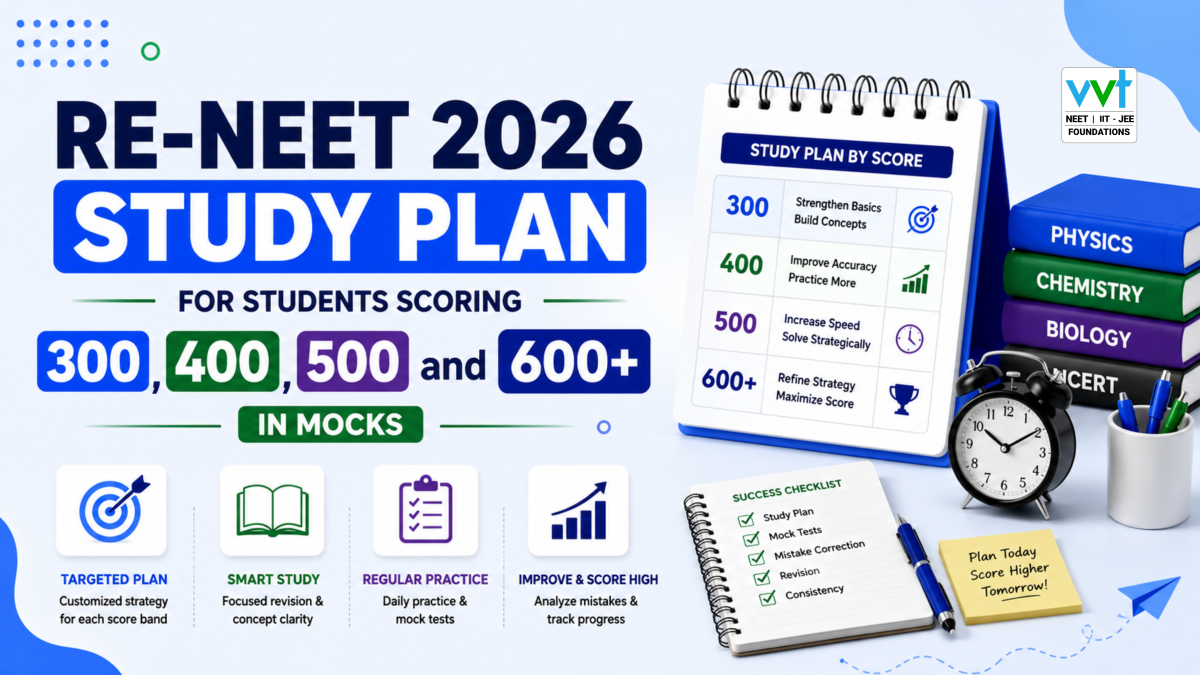
RE-NEET 2026 Study Plan for Students Scoring 300, 400, 500 and 600+ in Mocks
VVT Coaching Chennai – Ranked #1 Best NEET & JEE Coaching Centre by Times Now!
The NEET re-exam study plan 2026 needs to be personalised because not every student is starting from the same position. The extra preparation window should be used differently depending on your current mock-test performance.
A student scoring around 300 in mocks requires a different strategy from someone already scoring 600+. Those around 400 need stability and consistency, students near 500 should focus on converting mistakes into marks, and 600+ scorers must protect performance rather than making drastic changes.
That is why a single common study plan does not work for everyone.
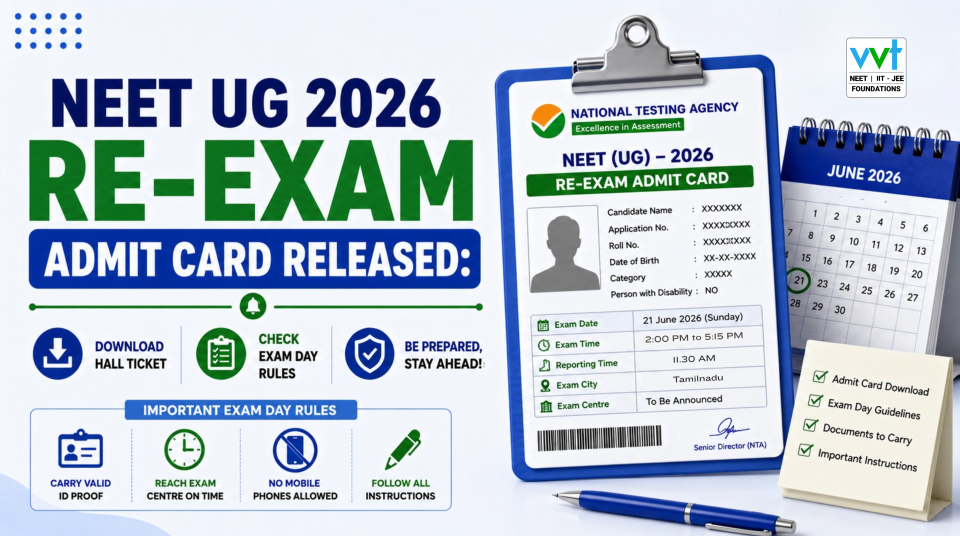
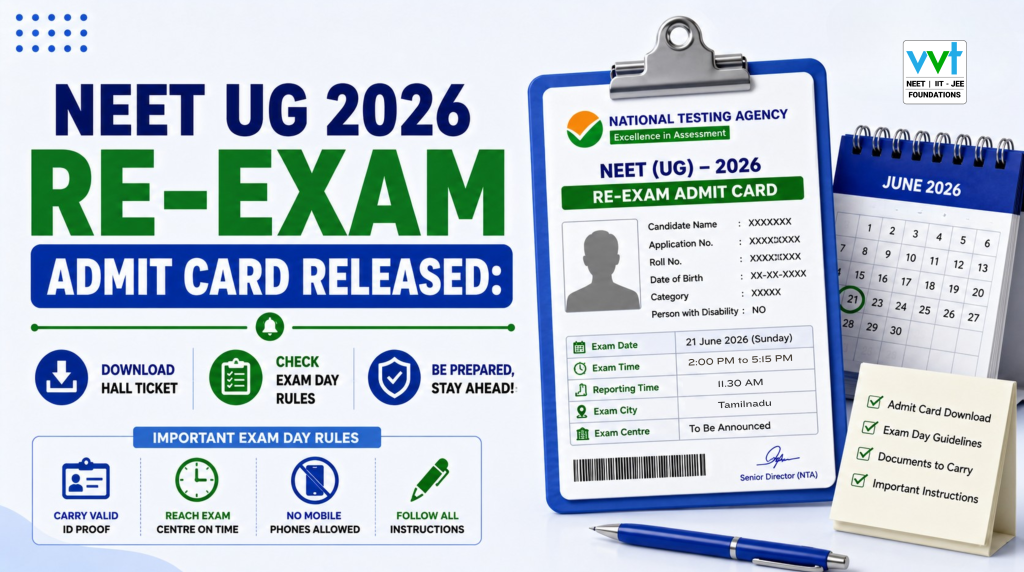
As per the official NTA FAQ, the NEET UG 2026 re-examination will be conducted on 21 June 2026, Sunday, from 2:00 PM to 5:15 PM, including time for formalities. NTA has also clarified that the extra 15 minutes are for documentation, verification, and other exam related formalities.
So the smartest question now is not, “How do I study everything again?”
The better question is:
“Based on my current mock score, what should I fix first?”
At VVT Coaching, we treat the re-exam phase as a score correction window, not a full restart. The student who improves now will be the student who understands their current score level and follows the right plan for that level.
First, identify your mock score category honestly
Before planning, students must be honest about their current mock performance. Do not judge yourself based on your best ever mock only. Look at your recent average.
| Current Mock Score Range | Current Situation | Main Goal Before RE-NEET |
| Around 300 | Syllabus is weak or scattered | Build minimum score stability |
| Around 400 | Some chapters are known, but accuracy is inconsistent | Convert known chapters into marks |
| Around 500 | Decent base, but repeated mistakes block score growth | Fix score leaks and improve test strategy |
| 600+ | Strong base, but every mistake matters | Protect accuracy and push rank level performance |
This score wise approach is more practical than giving the same timetable to every student.

If you are scoring around 300 in mocks
First, do not panic.
A 300 level score does not always mean you know nothing. Often, it means your preparation is scattered. You may know some Biology, a little Chemistry, and a few Physics formulas, but you are not converting them into stable marks.
At this stage, your target should not be perfect. Your target should be score stability.
What 300 score students should do now
Your first priority should be Biology. Biology gives the fastest recovery when revised from NCERT with MCQs. Do not waste time trying to master every difficult Physics topic now. Instead, build a score base.
Focus on:
- NCERT Biology line revision
- diagrams, examples, and tables
- easy and moderate Chemistry chapters
- basic Physics formulas
- previous wrong questions
- daily MCQs from familiar chapters
The goal is to stop blank attempts and start collecting marks from chapters you can still control.
What to avoid
Do not restart the full syllabus from Chapter 1. Instead of watching long lectures all day, focus on targeted revision. Avoid spending hours on one difficult Physics chapter, and never judge your progress by comparing yourself with 600+ scorers.
Your comeback will come from selective revision, not emotional overwork.
Best daily structure for 300 score students
Morning should go to Biology NCERT and Biology MCQs. In the afternoon I should go to Chemistry basics and formula revision. Evening can be used for limited Physics formula based practice. Night should be used only for reviewing mistakes.
Your goal is simple:
Make known chapters stronger before touching too many new areas.
If you are scoring around 400 in mocks
A 400 level student usually has a base, but the score is unstable.
Some mocks may feel okay. Some may collapse. Usually, the problem is not only syllabus coverage. The real problem is accuracy.
You may be losing marks because of:
- careless mistakes
- weak revision
- poor question selection
- Biology statement confusion
- Chemistry formula/reaction gaps
- Physics time wastage
At this stage, your focus should be converting knowledge into marks.
What 400 score students should do now
You should divide chapters into three groups:
Group 1: Strong chapters
Revise quickly and protect marks.
Group 2: Medium chapters
Spend maximum time here because they can improve fastest.
Group 3: Weak and time consuming chapters
Do only selective revision unless they are very high return.
Revise Biology mainly through repeated NCERT reading. In Chemistry, focus on formulas, reactions, named reactions, and NCERT-based Inorganic content, while Physics preparation should emphasise standard models and formula-based questions.
What to avoid
Do not keep saying, “I will revise first and take mocks later.” That is dangerous. At 400, testing is necessary because you need to know whether revision is actually converting into marks.
Do not take mocks blindly either. Every mock must be analysed.
Ask:
- Which chapter caused the score drop?
- Which mistakes repeated?
- Which questions were left due to fear?
- Which subject disturbed timing?
This is where improvement starts.
If you are scoring around 500 in mocks
A 500 level student is already in the serious competition zone.
But this is also a frustrating stage because students often feel, “I know the syllabus, but my score is not moving.”
Usually, the reason is repeated score leakage.
At this level, you do not need a motivational plan. You need a correction plan.
What 500 score students should do now
Your focus should be:
- reducing negative marks
- improving accuracy in medium chapters
- revising weak subtopics
- analysing every mock deeply
- improving time control
- protecting Biology score
- avoiding careless Chemistry and Physics mistakes
At 500, small corrections can create visible jumps. If you reduce repeated mistakes, your score can move faster than you expect.
Biology plan for 500 score students
Biology should not be treated casually. Many 500 level students lose marks in Biology not because they do not know the chapter, but because they misread statements or forget NCERT details.
Revise:
- NCERT examples
- diagrams
- tables
- Statement based questions
- Assertion reason type questions
- previous mistakes from mocks
Chemistry plan for 500 score students
Chemistry should become your stabiliser.
Focus on formulas and standard numerical types in Physical Chemistry. Organic Chemistry should be revised through GOC, reagents, named reactions, and conversions, while Inorganic Chemistry requires strong revision of NCERT facts, trends, exceptions, and coordination compounds.
Every Chemistry revision block should end with MCQs.
Physics plan for 500 score students
Physics should be handled strategically. Do not let one lengthy question destroy your time. Practise easy and moderate numericals first, then move to tougher questions.
Your target should be:
clean attempts, not heroic attempts.

Also read: NEET 2026 Re-Exam Preparation Plan: How to Use the Extra Time Wisely
Also read: Will NEET 2026 Re-Exam Follow a New Syllabus? Official Update & Student Guide
If you are scoring 600+ in mocks
A 600+ student does not need a full restart.
A 600+ student needs refinement.
At this level, every small error matters. One misread Biology statement, one wrong unit in Physics, one Organic reaction confusion, or one careless OMR decision can affect rank.
Your goal now is not to study more randomly. Your goal is to protect your score and push accuracy higher.
What 600+ students should do now
Focus on:
- full syllabus revision in short cycles
- mock analysis
- High level error correction
- silly mistake reduction
- time discipline
- OMR discipline
- mental calm
- final exam temperament
At this stage, do not overload yourself with random extra material. Stay with your trusted sources and strengthen execution.
What to avoid
Do not become overconfident, but also avoid taking too many mocks without recovery. Prioritise sleep, stick to a consistent strategy, and focus on high-return revision instead of chasing extremely rare question types.
For 600+ students, the score is already strong. The danger is not lack of preparation. The danger is carelessness and emotional overcorrection.
Score wise RE-NEET 2026 study plan table
| Mock Score | Main Problem | Main Focus | Mock Strategy | Biggest Mistake to Avoid |
| 300 | Scattered preparation | Biology base + Chemistry basics + Physics formulas | Short tests + selected full mocks | Restarting full syllabus randomly |
| 400 | Knowledge exists but accuracy is weak | Medium chapters + mistake correction | Full mock every few days with analysis | Taking mocks without analysing |
| 500 | Score leakage and repeated errors | Error notebook + time control + weak subtopics | Regular full mocks in exam timing | Ignoring repeated mistakes |
| 600+ | Small errors affecting rank | Accuracy, speed, OMR, temperament | High-quality mocks + deep review | Overconfidence or sudden strategy change |
Why mock analysis matters more than mock count now
In the re-exam phase, writing more and more tests is not enough.
A student scoring 300 may need different corrections from a student scoring 600. A raw score only tells what happened. It does not explain why it happened.
This is exactly why VVT’s AI-Based Error Exam system is useful. VVT explains that students write tests for four weeks, the AI system studies their performance in detail, and the fifth week’s Error Exam is created based on weak areas found in those tests. VVT also states that these Error Exams use similar model questions rather than simply repeating old questions, so students can prove real concept improvement.
That is the correct re-exam mindset:
Do not just test. Test, analyse, correct, and retest.
What every student must avoid now
No matter what your mock score is, avoid these mistakes:
- restarting everything from zero
- following too many teachers at once
- ignoring Biology NCERT
- taking mocks without analysis
- overusing social media
- changing strategy suddenly
- studying late into the night every day
- ignoring sleep and food
- waiting passively for admit-card updates
- assuming the re-exam centre will be the same
NTA’s FAQ clearly says the re-exam centre may not necessarily be the same as the earlier centre because centres are allotted based on the city selected by the candidate. It also confirms that no additional payment is required for the re-exam.
So students should stay updated officially but not lose study rhythm because of logistics.
How VVT Coaching Helps Students Follow a Smart RE-NEET 2026 Study Plan
A RE-NEET situation can feel mentally heavy for students. Many aspirants feel tired because they have already prepared once, written the exam once, and gone through the pressure once. But the re-exam phase should not become a period of panic, random revision, or emotional studying.
At VVT Coaching Chennai, we guide students with one clear message:
RE-NEET preparation is not about starting from zero. It is about correcting what went wrong and strengthening what can still improve marks.
A good RE-NEET 2026 study plan should focus on smart revision, mock test analysis, mistake correction, and calm execution.
Error Exams — Fix the mistakes that affected the first attempt
In RE-NEET preparation, students should first understand where marks were lost earlier. Many students lose marks not because they do not know the syllabus, but because they repeat the same mistake patterns under pressure.
These mistakes may include:
- getting trapped in lengthy Physics questions
- misreading Biology statements
- making formula, sign, or unit mistakes in Chemistry
- skipping familiar questions due to panic
- losing marks in questions they actually knew
That is why VVT uses Error Exams based on each student’s own mistake history.
These exams include:
- questions similar to the ones students got wrong or skipped
- repeated practice on common trap patterns
- short attempt → analysis → re-attempt cycles
- focused correction until the mistake pattern stops repeating
Result: students do not waste the RE-NEET study period on random practice. They focus on the exact errors that can help them recover marks.
AI-Powered Mock Tests — Build a study plan based on real performance
A RE-NEET study plan should not be based on fear or guesswork. Students should not revise everything equally or take mocks without understanding the result.
VVT’s AI-powered mock tests help students understand:
- Topic wise and section wise accuracy
- time spent per question
- overthinking zones
- careless errors versus concept errors
- stamina drops in the later part of the paper
- which subject is disturbing overall score balance
This helps students know what to revise first, which chapters need more attention, and where marks are still being lost.
Result: students follow a study plan based on data, not panic.
Personalised Guidance — Keep the RE-NEET preparation realistic
The RE-NEET phase can create emotional pressure. Some students over study because they are scared. Exhaustion causes many students to lose motivation, while constant exposure to new videos and comparisons with friends pushes others into changing plans every day.
At VVT, mentors help students:
- create a realistic daily study plan
- balance Physics, Chemistry, and Biology properly
- decide what to revise and what to avoid
- schedule mocks without burnout
- protect sleep, routine, and confidence
- stay calm until the re-exam day
Result: students do not drift, panic, or overload themselves. They follow a structured plan that improves performance step by step.
Remedy Classes — Repair small weak areas before RE-NEET
In RE-NEET preparation, students usually do not need full chapter re teaching. They need quick correction of the exact gaps that are still costing marks.
VVT’s Remedy Classes focus on:
- repeated formula slips
- confusing similar concepts
- weak micro topics
- Chapter specific trap questions
- poor question judgment under pressure
These sessions are short, focused, and based on actual student performance.
Result: students close the small leaks that can make a big difference in the RE-NEET score.

Get to Know VVT’s Three Friendly Campuses: Always Nearby and Welcoming
VVT has three spots across Chennai, each easy to reach and full of support. No matter where you live, one is close by. Our campuses mix bright classrooms, helpful teachers, and a warm feel to keep you going. Here’s a quick look at each, with a focus on how they help with NEET and staying options.
Adyar Campus: Easy Access and Positive Vibes
Right on busy L.B. Road next to Adyar Ananda Bhavan, this spot is super convenient. Step inside, and you’ll see big, airy rooms where learning feels fun. Staff greet you with smiles, and the energy pushes you to turn weak areas like tough Physics problems into strengths.We also offer hostel facilities here for boys, with clean rooms, meals, and support to make your stay comfortable and focused. No distractions, just a safe place to rest and review after classes.
Adyar Campus (VVT Coaching Centre): “Nibav Buildings”, 4th & 5th Floor, No.23, Old No.11, L.B. Road, Adyar, Chennai – 600020. (Next to Adyar Ananda Bhavan)
Get Directions: Open in google maps!
Anna Nagar Campus: Focus in the City Centre
In Shanthi Colony, Anna Nagar, this campus feels like an extension of home. Good bus links make it simple for city kids. There is no on-site hostel, but nearby options are plentiful for those who need them.
Anna Nagar Campus (VVT Coaching Centre): No.1621, 9th Main Road, Shanthi Colony, Block AI, Anna Nagar, Chennai – 600040.
Get Directions: Open in google maps!
Pallikaranai Girls Campus: Your Safe Place with Full Hostel
This is our special girls-only residential campus in a quiet area. It’s built as a true home away from home, with clean dorms, healthy meals in the canteen, and round-the-clock help.
We offer full hostel facilities here, clean rooms, study areas, and a community of girls supporting each other. It’s perfect if you’re from outside Chennai or just want a focused, safe space.
Pallikaranai (Saraswathi Girls Residential Campus): Plot No. 395 & 396, 1st Main Road, Kamakoti Nagar, Pallikaranai, Chennai – 600100.
Get Directions: Open in google maps
Conclusion
The RE-NEET 2026 phase is not about one common plan for everyone.
- Students scoring 300 should focus on building stability.
- At the 400 level, improving accuracy becomes the priority.
- Those around 500 need to identify and fix score leaks.
- For 600+ scorers, the goal is protecting rank-level performance.
The re-exam is officially scheduled for 21 June 2026, from 2:00 PM to 5:15 PM, including formalities.
So now, the smartest thing is not to panic or restart blindly.
Study according to your current score.
Correct repeated mistakes.
Practise in the official exam timing.
Use mocks properly.
And keep your mind calm.
At VVT Coaching Chennai, our message is simple:
Every student can improve from their current level — but only when the plan matches the score.
That is how RE-NEET 2026 preparation becomes focused, realistic, and result oriented.
Visit: vvtcoaching.com
Call: +91 81221 22333
Scholarships: Up to 100% via VVTSAT!
Also read: How VVT Coaching Uses AI to Identify and Solve Your NEET Preparation Struggles
Also read: Best Way to Attempt NEET Paper in 2026: Time Management and Smart Strategy
FAQs
What is the best NEET re-exam study plan 2026?
The best NEET re-exam study plan 2026 depends on your current score, weak subjects, and revision status. A smart plan should focus on revision, mock test analysis, and mistake correction rather than restarting the entire syllabus.
Should I restart the full syllabus in my NEET re-exam study plan 2026?
No. A good NEET re-exam study plan 2026 does not require restarting the syllabus from Chapter 1. Instead, students should focus on revision, retention, and fixing recurring mistakes.
How can students scoring 500 improve before RE-NEET 2026?
Students scoring around 500 should focus on reducing negative marks, correcting repeated errors, improving time management, and strengthening weak subtopics through targeted practice.
What are the biggest mistakes to avoid in a NEET re-exam study plan 2026?
Common mistakes include changing resources frequently, restarting preparation randomly, ignoring sleep, following rumours, and taking too many mock tests without analysis. A successful NEET re-exam study plan 2026 should remain structured and consistent.
Should students practise mocks in the official re-exam timing?
Yes. Since the re-exam is from 2:00 PM to 5:15 PM, students should practise mocks in that afternoon window whenever possible.