

NEET Response Sheet 2026: OMR Sheet, Score Calculation & Next Steps
June 30, 2026
Tamil Nadu MBBS/BDS Admission 2026: Apply Online, Eligibility & Quota Details
July 2, 2026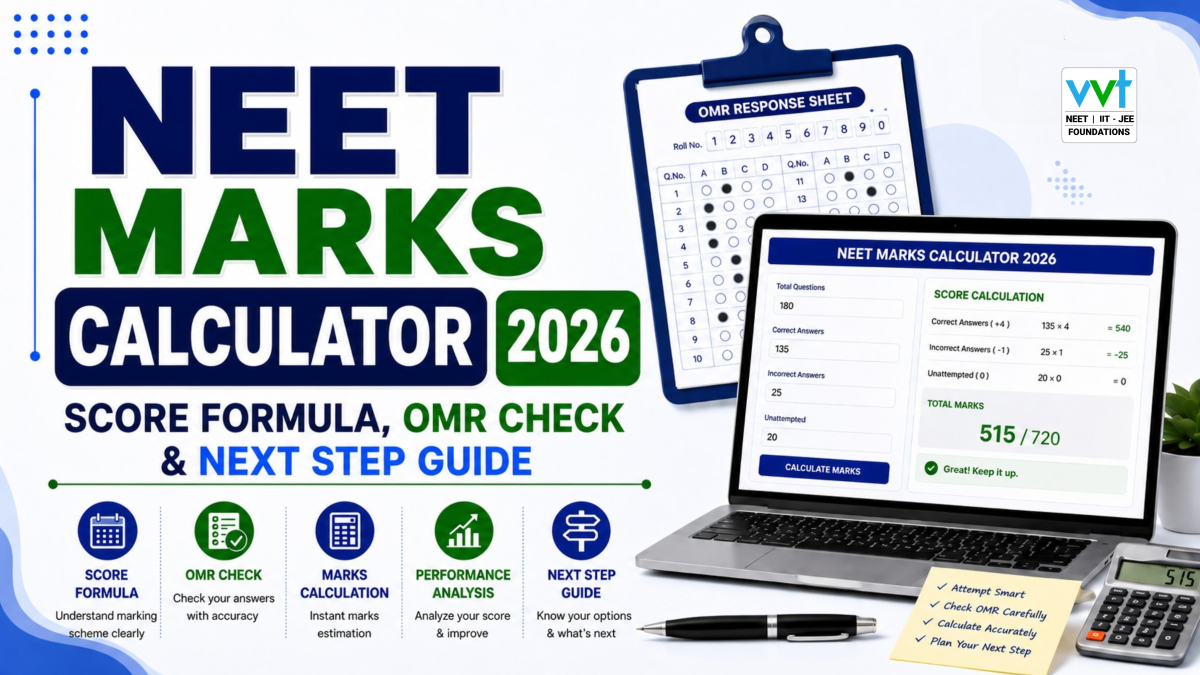
NEET Marks Calculator 2026: Score Formula, OMR Check & Next Step Guide
Trying to calculate your NEET 2026 marks before the result? The safest way is to compare your marked responses with the official NTA answer key and then apply the NEET marking formula.
The formula is simple:
NEET Score = Correct Answers × 4 − Wrong Answers × 1
Unattempted questions get 0 marks.
But students often make mistakes while matching the answer key, checking the question paper code, or handling dropped questions. So don’t rush the calculation. A small counting error can change your estimated score and increase unnecessary tension.
How to Calculate NEET 2026 Marks
To calculate your NEET 2026 marks:
- Download the official answer key from the NTA NEET website.
- Check your question paper code or series carefully.
- Compare your responses with the official key.
- Count correct answers and incorrect answers separately.
- Use the formula:
NEET Score = Correct Answers × 4 − Incorrect Answers × 1 - Do not deduct marks for unattempted questions.
NTA’s official NEET 2026 information confirms that the paper has 180 compulsory questions for 720 marks, with Physics carrying 180 marks, Chemistry 180 marks, and Biology 360 marks.
NEET 2026 Marking Scheme at a Glance
| Response Type | Marks |
| Correct answer | +4 |
| Incorrect answer | −1 |
| Unattempted question | 0 |
| Total questions | 180 |
| Maximum marks | 720 |
As per the official NEET 2026 Information Bulletin, every correct answer gets +4, every incorrect option marked gets −1, and an unanswered question gets 0.
This is why accuracy matters so much in NEET. One wrong answer does not just lose the chance of getting +4. It also reduces one extra mark through negative marking.
What You Need Before Calculating Your Score
Before opening a calculator, keep these things ready:
- Your NEET question paper or question paper code
- Official NTA answer key
- Your OMR response sheet, once available
- A rough sheet or spreadsheet to count correct and wrong answers
- Calm mind and enough time to cross check properly
The NTA NEET website is the official place for latest NEET updates, answer key notices, and candidate activities. The official site has listed NEET 2026 re-exam answer key challenge and provisional answer key notices under latest news/public notices.
Avoid calculating only from memory. After a stressful exam, students may remember some answers incorrectly. Always use the OMR response sheet when it is available.
Step by Step Method to Calculate NEET Marks Safely
Step 1: Match the Correct Question Paper Code
This is the first and most important step.
NEET answer keys are released according to question paper code or series. If you compare your answers with the wrong set, your score estimate will become completely wrong.
Before counting marks, check:
- Test booklet code
- Question number sequence
- Subject order
- Official answer key set
For example, if your paper code is different from your friend’s paper code, the answer sequence may not match. Do not copy someone else’s answer key comparison.
Step 2: Compare Your Responses Carefully
Now compare each answer one by one.
Use a simple marking system:
- Put a tick for correct answers
- Put a cross for wrong answers
- Mark “U” for unattempted questions
- Mark “D” for dropped questions, if any are shown in the final official key
Do not calculate subject wise marks first if you are anxious. First finish the full paper comparison. Then calculate subject wise performance separately.
Step 3: Count Correct, Wrong, and Unattempted Questions
After comparing all 180 questions, make a small table like this:
| Category | Count |
| Correct answers | ___ |
| Wrong answers | ___ |
| Unattempted questions | ___ |
| Dropped / special-case questions | ___ |
The total should normally add up to 180, depending on how the final key handles dropped or special cases.
This table helps you avoid double-counting mistakes.
Step 4: Apply the NEET Score Formula
Use this formula:
NEET Score = Correct Answers × 4 − Wrong Answers × 1
Example:
| Item | Count | Marks |
| Correct answers | 145 | 145 × 4 = 580 |
| Wrong answers | 22 | 22 × 1 = 22 deducted |
| Unattempted | 13 | 0 |
| Estimated score | 580 − 22 = 558 |
So, the estimated NEET score is 558 out of 720.=
Step 5: Recheck Dropped or Multiple Correct Questions
This is where many students get confused.
According to the NEET 2026 Information Bulletin, if more than one option is found correct, marks are awarded to candidates who marked any of the correct options. If a question is dropped or found wrong, +4 is awarded to all candidates who appeared, whether they attempted that question or not.
So, do not apply your own logic for dropped questions. Always follow the final official answer key and NTA rules.
NEET Marks Calculation Example
Let us take a practical example.
A student checks the official answer key and finds:
- Correct answers: 152
- Wrong answers: 18
- Unattempted questions: 10
Now calculate:
Correct marks = 152 × 4 = 608
Negative marks = 18 × 1 = 18
Final estimated score = 608 − 18 = 590
So, the student’s estimated NEET score is 590 marks.
Now, suppose one question is officially dropped and NTA awards +4 to all candidates. In that case, the final score may change according to the final answer key rules.
That is why students should treat the first calculation as an estimated score, not the final result.
What Happens If a Question Is Dropped?
A dropped question means the question is not considered valid for normal evaluation. It may happen if the question has an error or none of the options is accepted.
For NEET 2026, the official bulletin explains that if a question is dropped, all candidates who appeared are awarded +4 marks, whether they attempted it or not.
This is important because students sometimes make two mistakes:
- They count a dropped question as wrong.
- They ignore the dropped question and do not add +4.
Both can lead to an incorrect score estimate.
Also, during the provisional answer key stage, the score can still change if NTA accepts challenges and revises the final answer key. The NTA public notice for the NEET 2026 re-exam answer key challenge stated that accepted corrections would be applied uniformly across all sets, and the finalized answer key after the challenge process would be treated as final.
Common Mistakes Students Make While Calculating NEET Marks
1. Using an unofficial answer key as final
Coaching institute answer keys can be useful for early estimation, but the final calculation should always be based on the official NTA key.
2. Checking the wrong paper code
This is one of the most common mistakes. Even one wrong set comparison can create panic.
3. Counting unattempted questions as wrong
Unattempted questions carry 0 marks. Do not deduct marks for them.
4. Forgetting negative marking
Every wrong answer reduces 1 mark. Include it in the final calculation.
5. Ignoring dropped questions
Dropped questions must be handled only as per the official final answer key.
6. Calculating in a hurry
Many students calculate immediately after the answer key release and keep changing their score again and again. Take a calm 20–30 minutes and do it properly once.
7. Treating estimated score as final rank
Marks and rank are not the same. Rank depends on difficulty level, number of candidates, highest scores, tie breaking rules, and official result data.
What Students Should Do After Calculating NEET Marks
Once you have your estimated score, don’t stop at “I got this much.” The next step is more important.
If your score looks strong
Start preparing for counselling documents and stay updated with official counselling notifications. Do not become careless after a good score estimate.
If your score is borderline
Do not panic. Check state quota possibilities, category rules if applicable, and counselling options carefully. Tamil Nadu students should follow official state counselling updates when released.
If your score is lower than expected
Do not make emotional decisions on the same day. First analyse:
- Which subject reduced your score?
- Was it a concept gap or silly mistake?
- Did negative marking affect you badly?
- Did you lose marks due to time pressure?
- Did you make more errors in Physics, Chemistry, Botany, or Zoology?
This analysis will help you decide whether you need counselling support, a repeater course, or a structured improvement plan.
Conclusion
Calculating NEET 2026 marks is simple when you follow the correct formula. But doing it accurately requires patience, the right answer key, correct paper code, and careful handling of dropped or changed answers.
Use this formula:
NEET Score = Correct Answers × 4 − Wrong Answers × 1
After that, don’t stop with the number. Understand your mistakes, prepare for counselling, and take expert guidance if you are unsure about the next step.
For students and parents in Chennai and Tamil Nadu, VVT Coaching can help with NEET score discussion, counselling guidance, repeater planning, mock tests, and structured preparation for the next academic goal.
Visit: vvtcoaching.com
Call: +91 81221 22333
Scholarships: Up to 100% via VVTSAT!
Also read: NEET 2026 Chemistry Paper Analysis: Difficulty Level, Topic-Wise Review & Student Strategy
Also read: NEET 2026 Physics Paper Analysis: Difficulty Level, Important Topics and What Students Should Learn from the Re-Exam
FAQs
1. How do I calculate NEET marks 2026?
Use the formula NEET Score = Correct Answers × 4 − Wrong Answers × 1. Unattempted questions get 0 marks. Always use the official NTA answer key and your OMR response sheet.
2. What is the NEET 2026 marking scheme?
NEET 2026 gives +4 marks for each correct answer, −1 mark for each wrong answer, and 0 marks for unattempted questions. The maximum score is 720 marks.
3. Is there negative marking in NEET 2026?
Yes. For every incorrect answer, 1 mark is deducted. That is why accuracy is very important in NEET.
4. Can I calculate NEET marks before the result?
Yes. You can calculate an estimated score after the official answer key and OMR response sheet are available. However, the final score will be confirmed only in the official result.