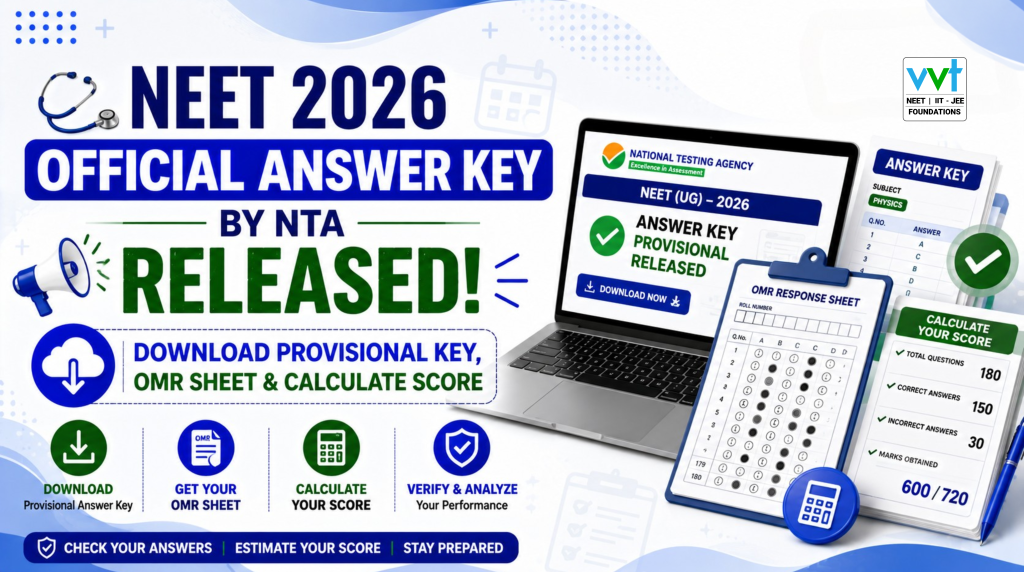

NEET 2026 Official Answer Key by NTA Released: Download Provisional Key
June 26, 2026
NEET OMR Sheet 2026
June 29, 2026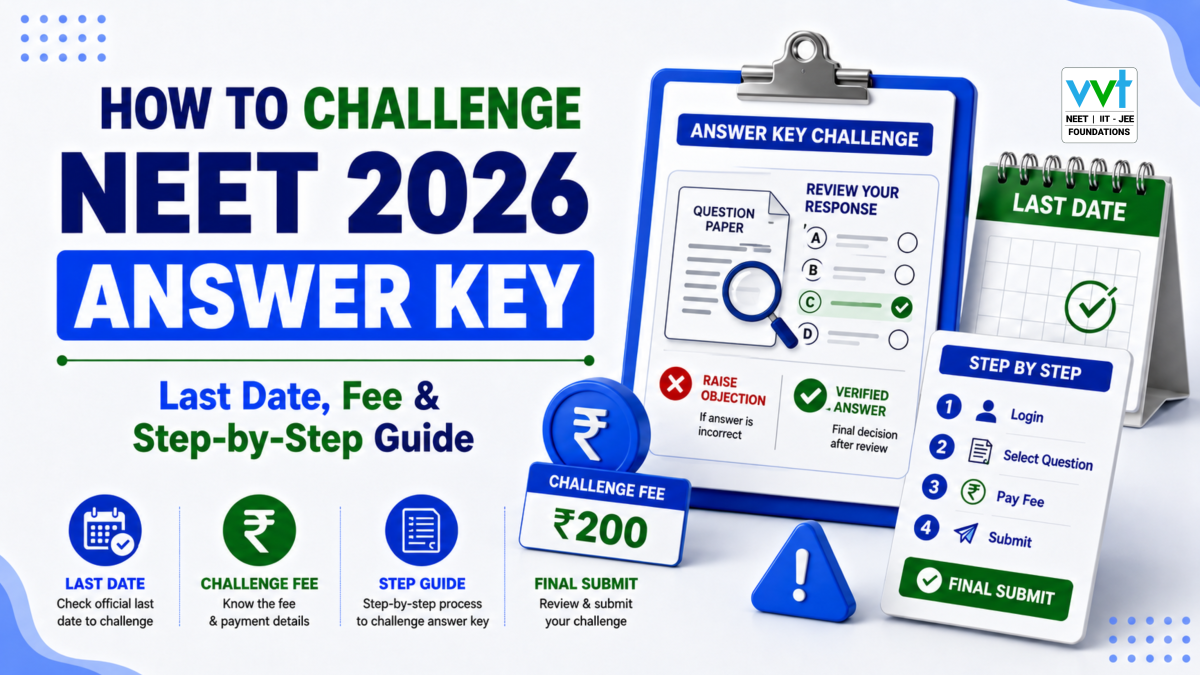
How to Challenge NEET 2026 Answer Key: Last Date, Fee, Steps
The Re-NEET 2026 provisional answer key has been released, and many students are now checking their responses, estimating their scores, and looking carefully for any doubtful questions. This stage is very important because the provisional answer key is not the final answer key. If a student finds a genuine error, NTA allows the candidate to raise an online challenge within the given time.
For students and parents, this can feel a little stressful. Many students feel unsure while checking the answer key, especially when it comes to the question paper series code or the type of proof needed for a challenge. Some may also wonder whether raising an objection is necessary or whether it is better to wait for the final answer key.
At VVT Coaching, our mentors always advise students to handle the answer key challenge process calmly, carefully, and only with proper academic proof. A challenge should not be based on guesswork or social media discussion. It should be based on strong evidence from NCERT, standard textbooks, or reliable academic sources.
NEET 2026 Answer Key Challenge: Important Dates and Details
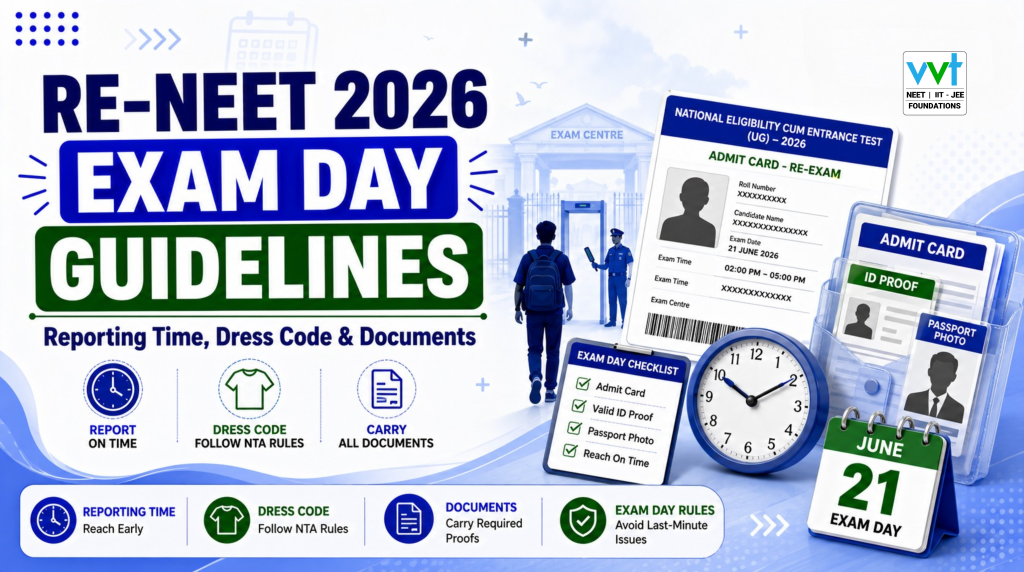
The National Testing Agency conducted the NEET UG 2026 re-examination on 21 June 2026. After the examination, NTA uploaded the question papers for all four sets and released the provisional answer keys for candidates to check.
Here are the important details every student should know:
| Particular | Details |
| Exam Name | NEET UG 2026 Re-Examination |
| Re-Exam Date | 21 June 2026 |
| Provisional Answer Key Challenge Start Date | 25 June 2026 |
| Last Date to Challenge | 28 June 2026 |
| Last Time for Fee Payment | 28 June 2026 up to 11:50 PM |
| Challenge Fee | ₹200 per question |
| Refund Rule | Refundable in full only for accepted challenges |
| Mode of Challenge | Online only |
| Official Website | https://neet.nta.nic.in/ |
Students should not wait until the final hour to submit a challenge. Login issues, payment delays, slow servers, or document upload problems can happen near the deadline. If you are sure about a valid challenge, complete the process early.
Why This Answer Key Challenge Window Matters
In NEET, even one question can make a real difference. Four marks can affect rank, cutoff chances, government college possibilities, and counselling confidence. For students standing near expected cutoff ranges, one accepted correction can become very important.
But this does not mean students should challenge every doubtful question. A weak challenge without proper proof is unlikely to help. It may only waste time and money.
VVT Coaching recommends this simple approach:
First, check the official answer key calmly.
Second, calculate your expected score.
Third, mark only genuinely doubtful questions.
Fourth, verify them using NCERT or standard academic references.
Fifth, challenge only if the evidence is strong.
A good challenge is not emotional. It is clear, academic, and supported by proof.
NEET 2026 Answer Key Challenge Fee
The answer key challenge fee is ₹200 per question challenged.
For example:
| Number of Questions Challenged | Fee |
| 1 Question | ₹200 |
| 2 Questions | ₹400 |
| 5 Questions | ₹1,000 |
| 10 Questions | ₹2,000 |
The important point is that the fee is refundable in full only if the challenge is accepted by the expert panel. If the challenge is not accepted, the fee will not be refunded.
How to Challenge NEET 2026 Answer Key: Step by Step Process
Here is the step by step process students should follow.
Step 1: Visit the Official NEET Website
Go to the official NEET website:
Open the candidate activity link related to the Re-NEET 2026 provisional answer key challenge.
Students should avoid third party links and use only the official website.
Step 2: Login to the Candidate Portal
Login using the required candidate details. These may include application number, date of birth, password, or other login credentials shown on the portal.
After logging in, read all instructions carefully before selecting any question.
Step 3: Enter Your Question Paper Series Code
Enter the Question Paper Series Code printed on the cover of your test booklet. This code should match the booklet you actually attempted in the examination hall.
Do not guess the series code. If you are unsure, check your physical test booklet carefully.
Step 4: Select the Questions You Want to Challenge
After entering the correct series code, select the question or questions for which you want to challenge the declared provisional answer.
Do not select questions in a hurry. Go one by one. Compare the official answer with your understanding and the proof available.
Step 5: Add Remarks and Upload Supporting Evidence
This is the most important part of the challenge.
You need to upload documentary evidence to support your claim. Acceptable sources include NCERT, standard textbooks, and other reputable academic publications.
Your evidence should be clear and verifiable. Ideally, it should include:
- Subject name
- Chapter name
- Textbook or reference name
- Page number
- Exact statement, formula, table, diagram, or concept
- A short explanation of why the official answer may need correction
For Biology and Inorganic Chemistry, NCERT references are especially important. For Physics and Physical Chemistry, use proper formulas, derivations, and standard academic references.
Avoid uploading unclear screenshots, random coaching notes, or social media posts. The proof must be academic and reliable.
Step 6: Review Your Challenges Carefully
Before payment, review every selected question carefully. Check whether the question number, series code, selected challenge option, remarks, and supporting evidence are correct.
This step is very important because submission is one time and final. After final submission, no additions or modifications are possible.
Step 7: Pay the Challenge Fee
Pay ₹200 per question challenged. The payment can be made through the online payment options available on the portal, such as debit card, credit card, or net banking.
The challenge will be processed only after successful payment. If the payment is incomplete or unsuccessful, the challenge may not be considered.
The last date and time for payment is 28 June 2026 up to 11:50 PM.
Step 8: Submit Final Confirmation
After payment and review, submit the final confirmation.
By submitting, you confirm that the question paper series code entered by you matches the test booklet you attempted and that the selected challenges are ready for expert review.
Do not submit until you are fully sure.
Step 9: Save the Acknowledgement
After successful submission, save the acknowledgement and transaction details for future reference.
Take a screenshot or download the confirmation page. Keep it safely until the answer key and result process is complete.
What Happens After You Submit the Challenge?
After the challenge window closes, all submitted challenges are placed before a panel of subject matter experts.
If a challenge is found correct on merit, the provisional answer key for that question will be revised. The revised answer will be applied uniformly to every candidate across all four sets.
Individual decisions on each challenge will not be sent separately to candidates. Instead, the revised final answer key will be published on the official website before the results are declared.
The final answer key prepared after the expert review will be treated as final. No further challenge will be accepted after the closure of the challenge window or declaration of results.
Will All Students Get Benefit If a Challenge Is Accepted?
Yes. If a challenge is accepted by the expert panel, the correction will be applied uniformly to all relevant candidates across all four sets.
This is a very important point. Students do not need to challenge the same question under multiple series codes. One valid accepted correction will be applied as per NTA’s final decision.
This rule protects fairness and ensures that all candidates receive the same benefit wherever applicable.
What Kind of Proof Should Students Upload?
A strong challenge needs strong proof. The evidence should be authentic, academic, and directly related to the question being challenged.
Students can use:
- NCERT textbook references
- Standard textbooks
- Reputable academic publications
- Formula based derivations
- Clearly marked diagrams or tables
- Chapter and page citations
For example, if you are challenging a Biology question, a direct NCERT line with chapter and page reference will usually carry strong value. If you are challenging a Physics question, show the correct formula, concept, and logical calculation clearly.
Your uploaded proof should not simply say “this answer is wrong.” It should clearly show why another answer is correct or why the given answer is doubtful.
Common Mistakes Students Must Avoid
1. Challenging Without Proper Evidence
A challenge without proof is weak. NTA experts will review objections based on academic merit, not personal doubt.
2. Using the Wrong Series Code
Always challenge your own question paper series code. Do not select a random paper code based on online discussions.
3. Depending on Social Media
Telegram groups, YouTube videos, and WhatsApp forwards may be helpful for discussion, but they are not official proof. Use NCERT and standard references.
4. Waiting Until the Last Minute
The deadline is strict. Payment must be completed before the closing time. Last minute server or payment issues can create unnecessary problems.
5. Uploading Blurry or Incomplete Proof
Your document should be clear and readable. Mention chapter and page details wherever possible.
6. Challenging Too Many Questions Randomly
Do not challenge ten questions just because you are anxious. Challenge only those where you have strong academic support.
7. Forgetting to Save the Acknowledgement
After submission, save the confirmation and transaction details. This is your record for future reference.
Conclusion
The Re-NEET 2026 answer key challenge process is an important opportunity for students to raise valid objections against the provisional answer key. But it must be done carefully.
Remember the key points:
The challenge window is open from 25 June to 28 June 2026.
The fee is ₹200 per question.
The fee is refunded only if the challenge is accepted.
Challenges must be submitted online only.
Students must use their own question paper series code.
Scanned OMR sheets are not part of this stage.
Submission is one time and final.
The final answer key after expert review will be used for result preparation.
VVT Coaching advises students to stay calm, avoid rumours, and submit challenges only with strong academic proof. This is not the time for panic. It is the time for careful verification and smart decision making.
If you are confused about whether a question should be challenged, take guidance from an experienced teacher before submitting. A well-prepared challenge can help. A careless challenge can waste time and money.
Visit: vvtcoaching.com
Call: +91 81221 22333
Scholarships: Up to 100% via VVTSAT!
Also read: NEET 2026 Chemistry Paper Analysis: Difficulty Level, Topic-Wise Review & Student Strategy
Also read: NEET 2026 Physics Paper Analysis: Difficulty Level, Important Topics and What Students Should Learn from the Re-Exam
FAQs
What is the last date to challenge the Re-NEET 2026 answer key?
The last date to challenge the Re-NEET 2026 provisional answer key is 28 June 2026. The fee payment must also be completed by 28 June 2026 up to 11:50 PM.
What is the fee for challenging the Re-NEET 2026 answer key?
The fee is ₹200 per question challenged.
Is the answer key challenge fee refundable?
Yes. The fee is refundable in full only if the challenge is accepted by the expert panel.
What proof is required for challenging an answer?
Students should upload proper academic evidence from NCERT, standard textbooks, or reputable academic publications. The proof should include chapter and page reference wherever possible.