
NEET 2026 Re-Exam Security Measures: What Students Must Know…
June 19, 2026
NEET 2026 Chemistry Paper Analysis
June 23, 2026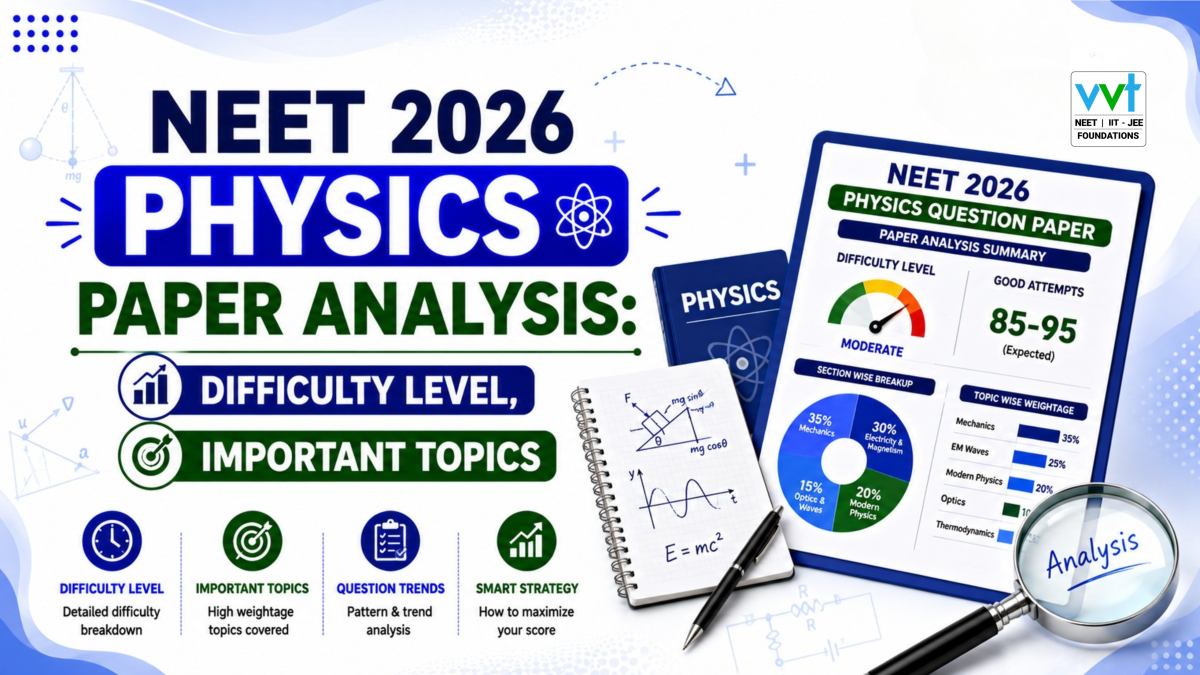
NEET 2026 Physics Paper Analysis: Difficulty Level, Important Topics and What Students Should Learn from the Re-Exam
The NEET 2026 Physics paper analysis makes one thing clear: Physics was not impossible, but it demanded patience, practice, and clear concepts. Many students felt that the section took more time compared to Biology and Chemistry.
Biology was manageable for most students, and Chemistry had both direct and tricky areas. Physics tested calculation speed and application skills. Students who only memorised formulas found it tiring, while those who practised regular models and mock questions were able to attempt it with better confidence
The NEET UG 2026 re-exam was conducted on 21 June 2026, and the Physics section carried 45 questions for 180 marks. Since every Physics question carries four marks, even a small difference of 5 to 8 correct questions can change the final score in a big way.
That is why this Physics paper analysis is not just about saying whether the paper was easy or tough. The real purpose is to help students understand:
- What was the overall difficulty level?
- Which chapters appeared important?
- Why did students find Physics time consuming?
- What should future NEET aspirants learn from this paper?
- How can students use this analysis for score improvement?
At VVT Coaching, we always tell students that Physics is not a subject to fear. It is a subject of structure. The student who prepares formulas, concepts, standard models, mock analysis and time management together usually performs better than the student who only reads theory.
NEET 2026 Pysics Paper: Overall Difficulty Level
The Physics section in the NEET 2026 re-exam can be described as moderate to difficult.
It was not impossible. It was not completely unexpected. But it was definitely not a paper where students could depend only on direct formula recall. Many questions required careful reading, application of concepts and quick calculation decisions.
The main difficulty came from three areas:
- Numerical based questions took time
- Some questions required more than one step
- Students had to choose questions wisely to avoid time loss
This is where many students struggled. They did not necessarily fail because they did not know the chapter. They struggled because they spent too much time deciding how to begin the question.
In Physics, time management is as important as knowledge. If one question takes four minutes, it can disturb the full paper rhythm.
Why Physics Felt Lengthy for Many Students
Most NEET students do not find Physics difficult because every topic is new. They find it difficult because the exam does not give them enough time to think slowly.
In the re-exam Physics section, students had to move quickly between different types of questions:
- Formula based numericals,
- conceptual MCQs,
- Application based questions,
- Statement style understanding,
- and topic linking questions.
Knowing a chapter is not enough in NEET Physics. A student may understand Current Electricity, but slow circuit solving can affect the score. Ray Optics can still go wrong if the sign convention is weak, and Thermodynamics becomes risky when process conditions are not revised properly.
students practice Physics in exam format, not only in chapter format.
Reading a chapter gives understanding.
Solving MCQs gives speed.
Analysing mistakes gives improvement.
All three are needed.
NEET 2026 Physics Paper Highlights
Here is a simple overview of the Physics section:
| Particular | Details |
| Exam | NEET UG 2026 Re-Exam |
| Subject | Physics |
| Total Questions | 45 |
| Total Marks | 180 |
| Overall Difficulty | Moderate to Difficult |
| Main Challenge | Time consuming numerical and application based questions |
| Student Reaction | Physics was tougher and lengthier than expected for many |
| Best Performing Students | Those with strong formulas, standard models and timed practice |
This table gives only the surface level view. The deeper message is clear: Physics rewarded students who had practised with discipline.
Important Topics Asked in NEET 2026 Re-Exam Physics
Based on memory based discussion and early exam analysis, Physics covered a broad mix of Class 11 and Class 12 topics. The paper did not depend on just one unit. It tested students across Mechanics, Heat and Thermodynamics, Electricity, Magnetism, Optics and Modern Physics.
Some important topic areas included:
| Physics Area | Topics Students Reported |
|---|---|
| Thermodynamics | Thermodynamic processes, specific heat capacity, thermal expansion |
| Optics | Refraction, refraction by lenses, optical concepts |
| Modern Physics | Photoelectric effect, Bohr model, radioactivity, wave nature of matter |
| Electrostatics | Electrostatic potential, conductors, continuous charge distribution, capacitors |
| Current Electricity | Resistance in conductors and related circuit ideas |
| Magnetism | Force between parallel currents, magnetic field due to current |
| EMI and AC | Faraday’s law, self-induction, LCR circuit, combination of inductors |
| SHM and Waves | Velocity and acceleration in SHM, stationary waves, systems executing SHM |
| Mechanics | Circular motion, work calculation, collisions, angular momentum, Newton’s first law |
| Gravitation | Escape speed, Kepler’s laws |
| Fluids | Viscosity, Bernoulli’s principle |
| Units and Measurements | Measuring instruments, dimensional analysis |
| Semiconductor Electronics | Semiconductor diode and special purpose PN junction diodes |
| Electromagnetic Waves | EM spectrum and characteristics of electromagnetic waves |
The important point is that Physics was not limited to only “big chapters.” Even smaller chapters like Units and Measurements, Semiconductors, EM Waves and Experimental type concepts became useful.
This is why students should never completely ignore compact chapters. Sometimes these chapters give faster marks than long, difficult chapters.

Chapter Wise Understanding: What the Paper Tells Us
The NEET 2026 re-exam Physics paper again proved that students should not prepare Physics randomly.
Not every chapter had the same weightage, but that does not mean low question chapters were unimportant. Some topics gave direct marks, while others became scoring only when formulas, concepts, and basic applications were fresh in memory.
1. Electrostatics and Capacitance
Electrostatics continued to be important. Questions from electric potential, conductors, charge distribution and capacitors required both conceptual clarity and formula confidence.
Many students treat Electrostatics as only a formula chapter, but that is a mistake. The chapter also tests field, potential, direction, conductor behaviour and capacitor energy ideas.
2. Ray Optics
Ray Optics appeared as a high value area. Lens based questions, refraction and optical instruments are usually scored if sign conventions are clear.
The common mistake in Optics is not lack of knowledge. It is wrong sign usage, wrong image distance interpretation or confusion between mirror and lens formulas.
3. Modern Physics
Modern Physics again showed why it is one of the best Physics areas for NEET. Photoelectric effect, Bohr model, radioactivity and wave nature of matter are topics that students can revise quickly but must practise properly.
These chapters are generally more formula direct than heavy Mechanics, but they still require conceptual accuracy.
4. Thermodynamics and Thermal Physics
Thermodynamics, specific heat and thermal expansion appeared in the discussion around the re-exam. These topics test formula clarity and process understanding.
Students often confuse isothermal, adiabatic, isobaric and isochoric conditions. That confusion can easily lead to wrong answers.
5. SHM and Waves
Simple Harmonic Motion and Waves were also important. Questions linked to velocity, acceleration, stationary waves and oscillating systems need formula comfort.
These chapters become scoring when students revise formulas repeatedly and solve standard models.
6. Magnetism, EMI and AC
Questions from Magnetism, EMI, self induction and LCR circuits showed that the Electricity Magnetism block cannot be ignored.
This area can feel heavy, but it gives good returns for students aiming for higher scores.
Class 11 vs Class 12 Physics: What Students Should Notice
A common mistake students make is thinking only Class 12 Physics matters for NEET. The 2026 re-exam again showed that Class 11 topics cannot be ignored.
Class 11 topics such as Units and Measurements, Kinematics, Laws of Motion, Work Energy and Power, Rotational Motion, Gravitation, Thermodynamics, SHM, Waves and Fluids still played an important role.
Class 12 topics such as Electrostatics, Current Electricity, Magnetism, EMI, AC, Optics, Modern Physics and Semiconductors were also highly relevant.
So the right strategy is not Class 11 vs Class 12.
The right strategy is:
High return chapters first, weak chapters next, and repeated mistakes always corrected.
Was the Physics Paper Tougher Than Expected?
For many students, yes, Physics felt tougher and more time consuming than expected.
But this does not mean the paper was unfair. It means the paper tested whether students could apply concepts under time pressure.
A student who only memorised formulas may have found the paper difficult. A student who had solved timed MCQs and analysed mistakes would have handled it better.
This is the key learning:
Physics preparation must be active.
You cannot simply read formulas and expect marks. You must solve, analyse, correct and retest.
What Students Should Do After the Physics Paper
After the NEET 2026 re-exam, students should not depend only on emotional memory.
Many students come out thinking, “Physics went badly,” but after answer checking, the score may be better than expected. Some students feel they did well, but later realise they made calculation mistakes.
So students should follow a calm post exam process:
- Wait for official answer key updates.
- Do not trust every memory based answer blindly.
- Calculate expected score carefully.
- Check negative marking properly.
- Compare subject wise performance.
- Avoid panic discussions on social media.
- Start preparing documents for counselling related steps.
The exam is over. Now the next stage needs patience and clarity.
Conclusion
The NEET 2026 re-exam Physics paper was not a paper that rewarded careless speed. It rewarded students who had practised Physics with structure.
The paper was moderate to difficult, time consuming for many, and spread across important areas like Electrostatics, Optics, Modern Physics, Thermodynamics, Magnetism, EMI, SHM, Waves, Mechanics and Semiconductors.
The biggest takeaway is simple:
Physics cannot be prepared at the last minute by only reading formulas.
Students need:
- Chapter wise planning,
- formula revision,
- timed MCQ practice,
- mock analysis,
- error correction,
- and calm question selection.
At VVT Coaching Chennai, this is exactly the kind of preparation system we believe in. A strong Physics score does not come from fear. It comes from structure, repetition and correction.
For future NEET aspirants, this paper gives one clear message:
Do not run away from Physics. Train it properly, and it can become one of the biggest score changing subjects in NEET.
FAQs
1. What was the difficulty level of the NEET 2026 re-exam Physics paper?
The NEET 2026 re-exam Physics paper was generally considered moderate to difficult. Many students found it time consuming because several questions required formula application, concept clarity, and careful calculation.
2. Which topics were asked in NEET 2026 re-exam Physics?
Important topics included Electrostatics, Current Electricity, Magnetism, EMI, AC, Ray Optics, Modern Physics, Thermodynamics, SHM, Waves, Gravitation, Fluids, Semiconductors, and Units and Measurements.
3. Was NEET 2026 Physics tougher than Biology and Chemistry?
For many students, Physics felt tougher than Biology and Chemistry because it required more calculations and time management. Biology was more NCERT based, while Physics tested application and numerical accuracy.
4. Which Physics chapters are most important for NEET 2026 preparation?
High priority Physics chapters include Current Electricity, Electrostatics, Ray Optics, Modern Physics, Magnetism, EMI, AC, Thermodynamics, Work Energy and Power, SHM, Waves, and Rotational Motion.