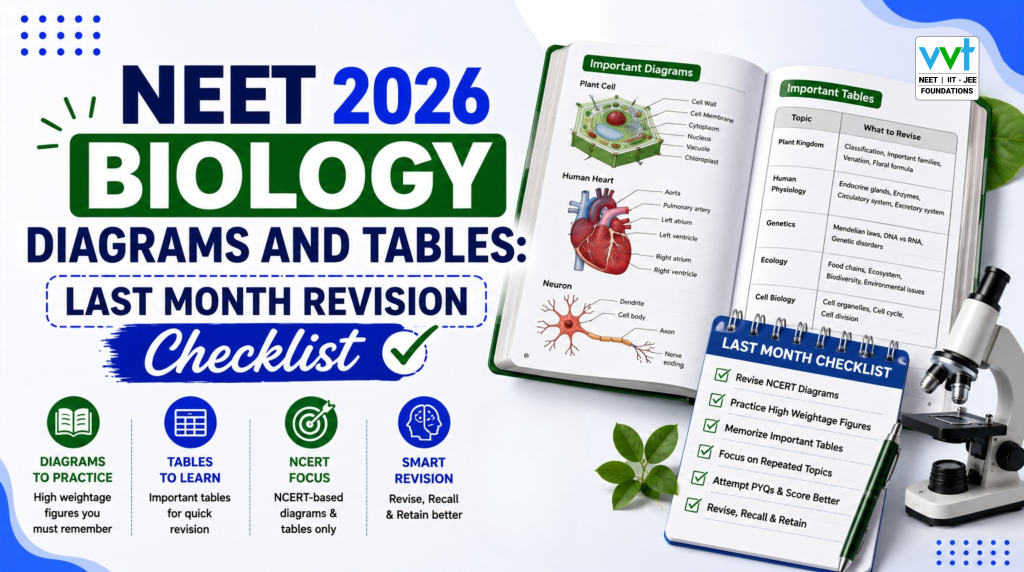

NEET 2026 Biology Diagrams and Tables: Last Month Revision Checklist
June 6, 2026
NEET UG 2026 Re-Exam City Intimation Slip Released: Download Steps, Admit Card Update
June 8, 2026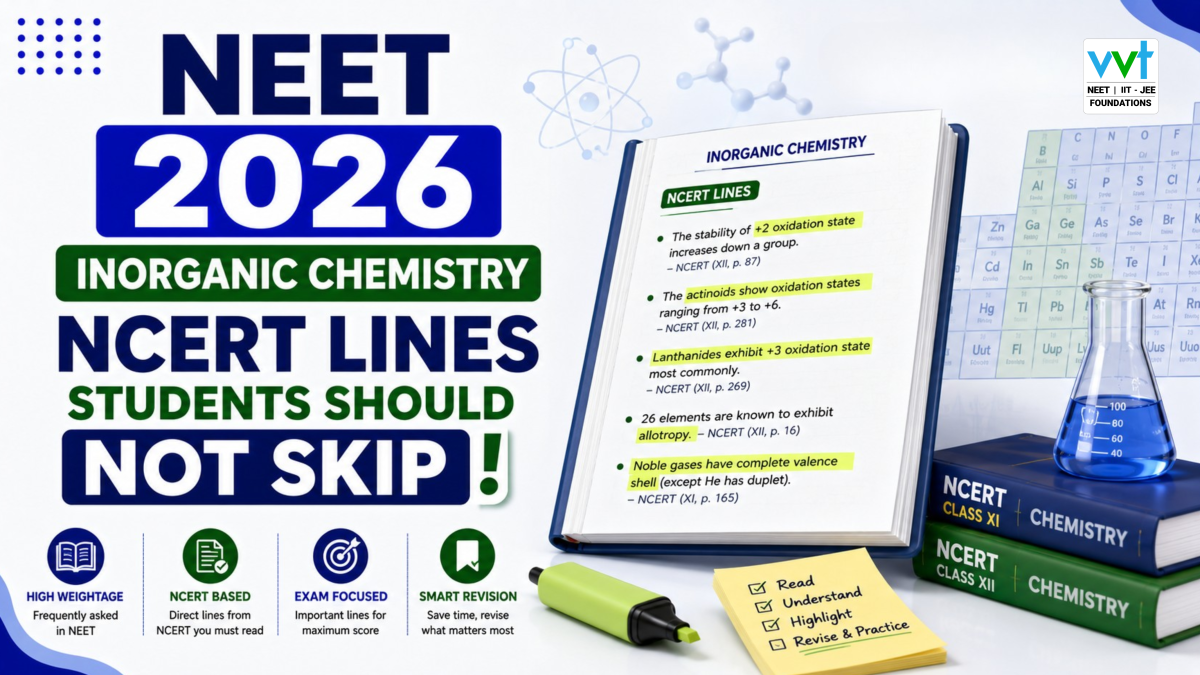
NEET 2026 Inorganic Chemistry NCERT Lines Students Should Not Skip
VVT Coaching Chennai – Ranked #1 Best NEET & JEE Coaching Centre by Times Now!
For NEET 2026 Inorganic Chemistry, students should not treat NCERT as a “reading book” that can be quickly scanned one week before the exam. Inorganic Chemistry is one of those areas where a single line from NCERT can become the base of a direct question, statement based question, assertion reason question, or matching type question.
Many students revise formulas and reactions well, but they lose marks because they skip small NCERT statements such as exceptions, trends, colours, uses, oxidation states, magnetic behaviour, coordination terms, and periodic properties. These lines may look simple while reading, but in the exam, they become tricky because the options are usually very close.
This blog gives you a clear, chapter wise checklist of NEET 2026 Inorganic Chemistry NCERT lines students should not skip. It is useful for Class 11 students, Class 12 students, NEET repeaters, and parents who want to understand how Chemistry revision should be planned.

Why NCERT Lines Matter So Much in NEET Inorganic Chemistry
Inorganic Chemistry is different from Physical Chemistry and Organic Chemistry.
Physical Chemistry needs formula practice and numerical accuracy. Organic Chemistry needs mechanism clarity, reagents, and reaction logic. But Inorganic Chemistry needs strong NCERT memory plus concept understanding.
In NEET, Inorganic questions often test:
- Trends in the periodic table
- Exceptions to general rules
- Oxidation states
- Colours of compounds and ions
- Magnetic properties
- Preparation and uses of important compounds
- Coordination compound terminology
- IUPAC naming
- Biological and industrial importance
- NCERT based statement comparison
That is why students should not read only coaching notes and leave NCERT. Notes are useful for quick revision, but NCERT gives the exact language and detail level that students must be comfortable with.
The smart approach is not to mug up every page blindly. The smart approach is to know which type of NCERT lines are repeatedly important.
NEET 2026 Inorganic Chemistry: What the Official Syllabus Covers
For NEET 2026, Inorganic Chemistry mainly includes these areas:
- Classification of Elements and Periodicity in Properties
- p-Block Elements
- d- and f-Block Elements
- Coordination Compounds
- Practical Chemistry-related inorganic portions such as inorganic compound preparation and salt analysis basics
This means students should not restrict Inorganic Chemistry only to p-block or Coordination Compounds. Periodic trends, transition elements, qualitative analysis, and practical chemistry also need proper revision.
A good NEET Chemistry score usually comes from combining three things:
- NCERT line by line reading
- Regular MCQ practice
- Error based revision from mock tests
If any one of these is missing, Inorganic Chemistry becomes weak.
Chapter Wise NCERT Lines Students Should Not Skip
1. Classification of Elements and Periodicity
This chapter may look theoretical, but it builds the base for almost every other Inorganic Chemistry chapter. Many students skip it because they feel it is “easy”. That is a mistake.
Do not skip NCERT lines related to:
- Modern periodic law
- Present form of the periodic table
- s, p, d, and f block classification
- Atomic radius and ionic radius trends
- Ionization enthalpy trends
- Electron gain enthalpy trends
- Electronegativity trends
- Oxidation states
- Metallic and non metallic character
- Diagonal relationship
- Anomalous behaviour of second period elements
Students should especially focus on trend based exceptions. NEET questions may not always ask direct definitions. Instead, they may ask which statement is correct or incorrect. That is where NCERT language becomes important.
For example, do not just remember that atomic size increases down the group. Also understand why it increases and how the shielding effect plays a role. Similarly, do not only remember ionization enthalpy trends; revise exceptions and the reason behind them.
2. p-Block Elements
The p-block chapter is one of the most feared areas in Inorganic Chemistry because it contains many facts, trends, and exceptions. But for NEET, the strategy should be simple: read NCERT repeatedly and convert confusing facts into small revision tables.
Do not skip NCERT lines related to:
- General electronic configuration
- Group wise trends from Group 13 to Group 18
- Unique behaviour of the first element in each group
- Inert pair effect
- Oxidation states
- Acidic and basic nature of oxides
- Hydrides and their stability
- Halides and their nature
- Interhalogen compounds
- Oxoacids of halogens
- Noble gases and their compounds
- Important uses mentioned in NCERT
Students often make the mistake of reading only the “important compounds” and skipping the general introduction. But the general trend lines are very important. Many NEET questions are framed from comparisons such as stability, acidity, basicity, bond strength, oxidising nature, and reactivity order.
For p-block revision, create four small tables:
- Oxidation states
- Important compounds
- Acid base nature of oxides
- Uses and special properties
Revise these tables every 2–3 days instead of trying to memorise the full chapter in one sitting.
3. d- and f-Block Elements
The d- and f-block chapter is very scoring if students revise the right NCERT lines. This chapter is not just about electronic configuration. NEET can test properties, colours, magnetic behaviour, catalytic activity, complex formation, and important compounds.
Do not skip NCERT lines related to:
- Definition of transition elements
- Why some elements are not considered typical transition elements
- Electronic configuration of 3d series
- Variable oxidation states
- Colour of transition metal ions
- Magnetic properties
- Catalytic behaviour
- Interstitial compound formation
- Alloy formation
- Complex formation
- Preparation, properties, and uses of KMnO₄
- Preparation, properties, and uses of K₂Cr₂O₇
- Lanthanoid contraction
- Oxidation states of lanthanoids and actinoids
Students should pay extra attention to the reason based lines. For example, why transition elements show colour, why they show variable oxidation states, why they form complexes, and why they act as catalysts.
For KMnO₄ and K₂Cr₂O₇, students should revise:
- Preparation
- Oxidation reactions
- Colour changes
- Uses
- Important reaction conditions
A common mistake is revising only the formula and skipping reaction behaviour. In NEET, even a small condition or colour based clue can help you eliminate wrong options.
4. Coordination Compounds
Coordination Compounds is one of the most important Inorganic chapters for NEET because it combines memory, naming rules, bonding, and application based understanding.
Do not skip NCERT lines related to:
- Werner’s theory
- Primary valence and secondary valence
- Ligands
- Coordination number
- Denticity
- Chelation
- IUPAC nomenclature
- Isomerism
- Valence bond theory basics
- Crystal field theory basics
- Colour and magnetic properties
- Importance of coordination compounds in biological systems
- Importance in qualitative analysis
- Importance in extraction of metals
Students should not study this chapter only through shortcuts. Naming rules and isomerism require practice. Bonding and magnetic properties require concept clarity. Importance and applications require NCERT reading.
For NEET revision, make a separate page for:
- Common ligands and their charges
- Coordination number examples
- Ambidentate ligands
- Strong and weak field ligands
- Common IUPAC naming patterns
- Types of isomerism
- Biological examples
If you are making repeated mistakes in Coordination Compounds, do not simply reread the chapter. Solve 30–40 targeted MCQs and mark the exact NCERT line or concept behind each mistake.
5. Practical Chemistry and Salt Analysis Basics
Many students ignore practical chemistry because they assume it is less important. But the syllabus includes practical chemistry principles, qualitative salt analysis, inorganic compound preparation, and titrimetric exercises.
Do not skip NCERT/syllabus based areas related to:
- Mohr’s salt
- Potash alum
- Acid base indicators
- Oxalic acid vs KMnO₄
- Mohr’s salt vs KMnO₄
- Cations and anions in qualitative salt analysis
- Basic principles of inorganic compound preparation
Students do not need to go beyond the syllabus and study very advanced laboratory chemistry. But the listed practical chemistry points should be revised because they can appear as direct or concept based questions.

Also read: NEET 2026 Re-Exam Preparation Plan: How to Use the Extra Time Wisely
Also read: NEET 2026 Biology NCERT Revision Plan: Chapters, Important Lines & Smart Revision Tips
How to Read NCERT Inorganic Chemistry Without Forgetting It
The main problem is not that students do not read NCERT. The real problem is that they read it passively.
Passive reading means your eyes move through the page, but your brain does not store the information properly.
Use this method instead:
Step 1: First Reading for Understanding
Read the chapter once without trying to memorise everything. Understand the flow, headings, subheadings, and major ideas.
Step 2: Second Reading with Highlighting
Now highlight only high value lines:
- Exceptions
- Trends
- Definitions
- Uses
- Colours
- Oxidation states
- Special properties
- Named compounds
- NCERT examples
Do not highlight every line. If everything is highlighted, nothing is important.
Step 3: Convert NCERT Lines into Questions
For every important line, ask:
- Can this become a statement based question?
- Can this become an assertion reason question?
- Can this be asked as “correct/incorrect statement”?
- Can this be converted into a match-the-following question?
This method trains your brain to think like the exam.
Step 4: Make a Mistake Notebook
Every time you make a mistake in Inorganic Chemistry, write:
- Chapter name
- Topic
- Wrong answer
- Correct answer
- Exact reason
- NCERT line or concept behind it
Before mocks, revise this notebook. It is more powerful than rereading the entire chapter again and again.
Step 5: Revise in Short Cycles
Inorganic Chemistry is not suitable for one time study. It needs repeated revision.
Use this cycle:
- Day 1: Read and mark
- Day 3: Revise marked lines
- Day 7: Solve MCQs
- Day 14: Revise mistakes
- Every week: Quick table revision
This keeps the memory fresh.
Common Mistakes Students Make in Inorganic Chemistry
Mistake 1: Reading Only Coaching Notes
Coaching notes are useful, but they should not replace NCERT. Inorganic Chemistry is heavily dependent on exact textbook style understanding. Use notes for summary, but use NCERT for final revision.
Mistake 2: Memorising Without Understanding Trends
If you only memorise trends, you may forget them under pressure. Understand the reason behind trends like atomic size, ionization enthalpy, electron gain enthalpy, oxidation states, and reactivity.
Mistake 3: Skipping First and Last Paragraphs
Many students read only tables and reactions. But NCERT often hides important conceptual lines in introductions, examples, notes, and end paragraphs.
Mistake 4: Ignoring Uses and Applications
Uses may look simple, but they are often asked directly. Do not skip uses of compounds, coordination compounds in biological systems, industrial importance, and qualitative analysis applications.
Mistake 5: Not Practising Statement Based Questions
Inorganic Chemistry revision is incomplete without statement based MCQs. These questions test whether you truly remember NCERT lines.
What Students Should Do Now
Here is a practical action plan for NEET 2026 Inorganic Chemistry revision:
1. Start with the Official Syllabus
Do not study randomly. First check whether the topic is part of the syllabus. This prevents wasting time on unnecessary areas.
2. Read NCERT Chapter Wise
Follow this order:
- Classification and Periodicity
- p-Block Elements
- d- and f-Block Elements
- Coordination Compounds
- Practical Chemistry portions
This order helps because periodic trends support p-block and d-block understanding.
3. Mark High Yield Lines
Use different markings:
- Yellow: Definitions and trends
- Green: Exceptions
- Pink: Uses and applications
- Blue: Compounds and reactions
- Red underline: Mistakes from mock tests
4. Solve MCQs Immediately After Reading
Do not wait for the chapter to become “perfect”. Read one section, then solve MCQs from that section. This improves retention.
5. Revise Mistakes More Than Correct Answers
Correct answers build confidence, but wrong answers build rank improvement. Focus on why you made a mistake.
6. Take Chapter Wise Tests
For Inorganic Chemistry, chapter wise tests are very useful because they expose weak subtopics quickly.
7. Do Full Mock Test Analysis
In full mock tests, check:
- Did you lose marks because of memory?
- Did you confuse two trends?
- Did you misread the statement?
- Did you forget an exception?
- Did you guess instead of eliminating?
This analysis tells you exactly what to revise next.
How VVT Coaching Helps Students Master NCERT Inorganic Chemistry Lines
In NEET Inorganic Chemistry, students often lose marks not because the question is completely unknown, but because they miss one word, confuse one exception, or forget one NCERT statement. Many Inorganic Chemistry questions are built around direct or slightly modified NCERT lines, which means careless reading can quietly reduce the score.
At VVT Coaching Chennai, we train students to treat NCERT Inorganic Chemistry as a scoring weapon, not just a theory section to read casually.
The goal is simple:
Read NCERT carefully. Remember the right lines. Avoid repeated mistakes. Convert revision into marks.
Error Exams — Fix the NCERT lines students keep missing
Many students repeatedly lose marks in Inorganic Chemistry because of the same patterns:
- missing exceptions in the periodic table
- confusing trends in atomic size, ionisation enthalpy, or electronegativity
- forgetting colours, compounds, ores, or reactions
- misreading “not correct” and “incorrect statement” questions
- mixing up similar NCERT lines from p-block, d-block, coordination compounds, or chemical bonding
That is why VVT uses Error Exams based on the student’s own mistakes.
These exams include:
- NCERT based questions similar to the ones students got wrong
- repeated practice on confusing factual lines
- statement-based questions from high-yield Inorganic chapters
- short attempt → analysis → re-attempt cycles
- targeted correction until the same NCERT mistake stops repeating
Result: students stop losing marks on familiar NCERT lines and become more confident in statement-based Inorganic questions.
AI-Powered Mock Tests — Show which NCERT areas are actually weak
In Inorganic Chemistry, students often say, “I read this chapter, but I still got it wrong.” The problem is usually not reading. The problem is weak retention, poor line recognition, or confusion between similar facts.
VVT’s AI-powered mock tests help students understand:
- which Inorganic chapters are causing repeated errors
- which NCERT lines are being misread or forgotten
- where careless mistakes are happening
- whether errors are due to concept confusion or memory gaps
- which topics need quick revision before the next mock
- how Inorganic performance is affecting the overall Chemistry score
Result: students stop revising Inorganic Chemistry blindly. They know exactly which NCERT areas need more attention.
Personalised Guidance — Help students revise NCERT the right way
Inorganic Chemistry revision can become boring if students simply read pages again and again without direction. Many students underline everything, but remember very little during the exam.
At VVT, mentors help students revise Inorganic Chemistry more intelligently by guiding them on:
- which NCERT lines need repeated revision
- how to make short memory cues for exceptions and trends
- how to revise statement-based questions
- how to avoid confusing similar facts
- how to balance Inorganic revision with Physical and Organic Chemistry
- how to use mistakes from mocks to plan the next revision cycle
Result: students revise NCERT with purpose instead of randomly reading the same pages without retention.
Remedy Classes — Repair small Inorganic gaps before they cost marks
Inorganic Chemistry mistakes usually come from small gaps that are easy to ignore but costly in the exam.
These may include:
- confusion in periodic trends
- weak memory of p-block reactions
- missed NCERT exceptions
- poor recall of coordination compound terms
- confusion between similar compounds, colours, or properties
- difficulty handling statement-based questions
VVT’s Remedy Classes are designed to fix these exact weak areas quickly.
These sessions are:
- short and focused
- based on real mock test mistakes
- built around one specific NCERT weakness at a time
- supported by teacher explanation and quick retesting
Result: students repair the exact Inorganic gaps that can cost easy marks in NEET.

Get to Know VVT’s Three Friendly Campuses: Always Nearby and Welcoming
VVT has three spots across Chennai, each easy to reach and full of support. No matter where you live, one is close by. Our campuses mix bright classrooms, helpful teachers, and a warm feel to keep you going. Here’s a quick look at each, with a focus on how they help with NEET and staying options.
Adyar Campus: Easy Access and Positive Vibes
Right on busy L.B. Road next to Adyar Ananda Bhavan, this spot is super convenient. Step inside, and you’ll see big, airy rooms where learning feels fun. Staff greet you with smiles, and the energy pushes you to turn weak areas like tough Physics problems into strengths.We also offer hostel facilities here for boys, with clean rooms, meals, and support to make your stay comfortable and focused. No distractions, just a safe place to rest and review after classes.
Adyar Campus (VVT Coaching Centre): “Nibav Buildings”, 4th & 5th Floor, No.23, Old No.11, L.B. Road, Adyar, Chennai – 600020. (Next to Adyar Ananda Bhavan)
Get Directions: Open in google maps!
Anna Nagar Campus: Focus in the City Centre
In Shanthi Colony, Anna Nagar, this campus feels like an extension of home. Good bus links make it simple for city kids. There is no on-site hostel, but nearby options are plentiful for those who need them.
Anna Nagar Campus (VVT Coaching Centre): No.1621, 9th Main Road, Shanthi Colony, Block AI, Anna Nagar, Chennai – 600040.
Get Directions: Open in google maps!
Pallikaranai Girls Campus: Your Safe Place with Full Hostel
This is our special girls-only residential campus in a quiet area. It’s built as a true home away from home, with clean dorms, healthy meals in the canteen, and round-the-clock help.
We offer full hostel facilities here, clean rooms, study areas, and a community of girls supporting each other. It’s perfect if you’re from outside Chennai or just want a focused, safe space.
Pallikaranai (Saraswathi Girls Residential Campus): Plot No. 395 & 396, 1st Main Road, Kamakoti Nagar, Pallikaranai, Chennai – 600100.
Get Directions: Open in google maps
Conclusion
NEET 2026 Inorganic Chemistry is not about reading everything randomly. It is about reading the right NCERT lines repeatedly and understanding how those lines can turn into exam questions.
Do not skip periodic trends, p-block general trends, transition element properties, coordination compound definitions, applications, oxidation states, colours, uses, and practical chemistry basics. These areas may look small, but they can decide your Chemistry score.
Students should revise NCERT actively, solve statement-based questions, maintain a mistake notebook, and take regular tests. Parents should support students with a calm environment and structured revision instead of pushing them toward too many books.
With the right plan, Inorganic Chemistry can become a scoring area for NEET 2026.
For guided NEET Chemistry revision, mock tests, repeater coaching, and structured academic support in Chennai, students can connect with VVT Coaching and prepare with a clear, exam-focused approach.
Visit: vvtcoaching.com
Call: +91 81221 22333
Scholarships: Up to 100% via VVTSAT!
Also read: How VVT Coaching Uses AI to Identify and Solve Your NEET Preparation Struggles
Also read: Best Way to Attempt NEET Paper in 2026: Time Management and Smart Strategy
FAQs
1. Is NCERT enough for NEET 2026 Inorganic Chemistry?
NCERT is essential for NEET 2026 Inorganic Chemistry because many questions are based on textbook concepts, trends, definitions, and statements. However, students should also practise MCQs and mock tests to apply those NCERT lines correctly.
2. Which NCERT lines are most important for NEET Inorganic Chemistry?
The most important NCERT lines are usually related to exceptions, periodic trends, oxidation states, colours, magnetic properties, uses, preparation of important compounds, coordination terms, and applications.
3. How should I revise p-block for NEET 2026?
Revise p-block by making short tables for oxidation states, compounds, trends, oxides, hydrides, halides, oxoacids, and uses. Read NCERT repeatedly and solve statement-based questions.
4. What should I not skip in d- and f-block for NEET?
Do not skip electronic configuration, variable oxidation states, colour, magnetic behaviour, catalytic properties, complex formation, alloy formation, lanthanoid contraction, KMnO₄, and K₂Cr₂O₇.