
NEET UG 2026 Fee Refund Deadline Extended: New Last Date, Eligibility & Complete Process
May 30, 2026
NEET 2026 Important Chapters in Biology: High Weightage Topics, NCERT Tips
June 1, 2026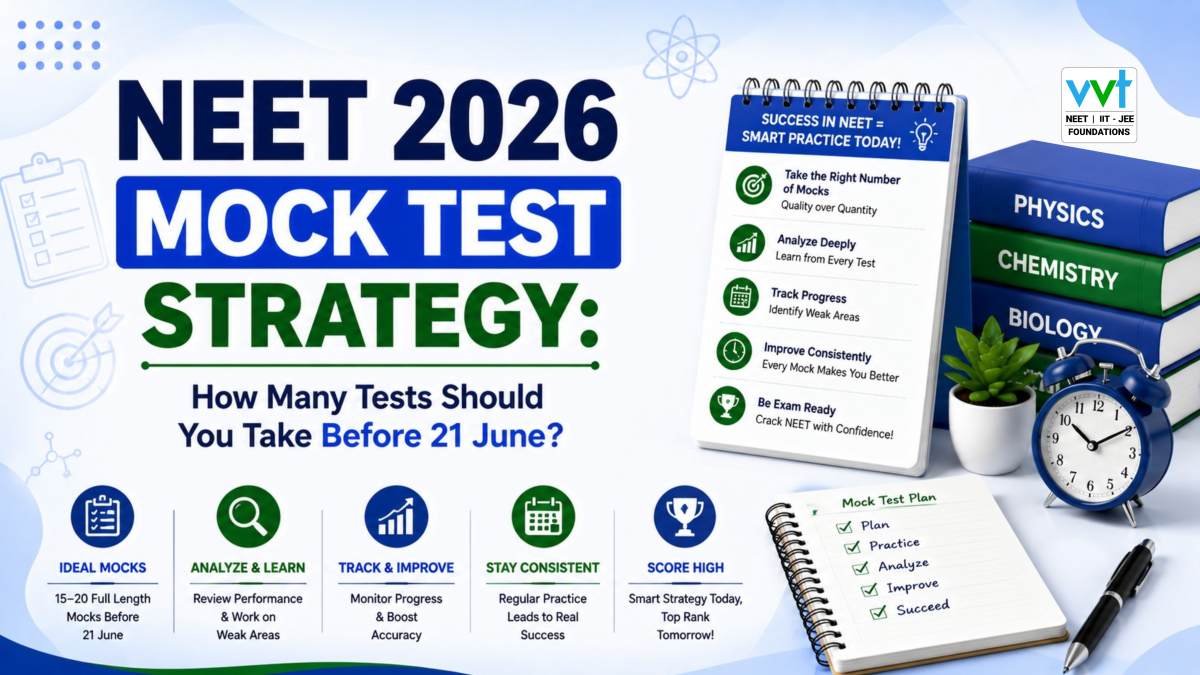
NEET 2026 Mock Test Strategy: How Many Tests Should You Take Before 21 June?
VVT Coaching Chennai – Ranked #1 Best NEET & JEE Coaching Centre by Times Now!
When NEET gets closer, students usually ask one common question:
“How many mock tests should I take before the exam?”
For RE-NEET 2026, this question has become even more important because students are not preparing for the first time. They have already gone through one full exam cycle, experienced pressure once, and now have a second chance to improve their performance before the re-examination.
As per NTA’s official updates, the NEET UG 2026 re-examination process is live, and the official NEET website lists the re-examination notice and candidate activity updates for NEET UG 2026. The NTA homepage also lists the Frequently Asked Questions on NEET UG 2026 Re-examination and Conduct of Re-examination for NEET UG 2026 notices.
So now, the goal is not just to study more.
The real goal is:
How do you test yourself correctly before 21 June without burning out?
At VVT Coaching, our answer is very clear: mock tests are important, but mock analysis is even more important. A mock without analysis is just a score. A mock with correction becomes an improvement.

First, how many mock tests should you take before 21 June?
There is no single perfect number for every student.
A student scoring around 300 does not need the same mock schedule as someone scoring 600+. Those with weak syllabus coverage require more revision and targeted tests. Meanwhile, students with strong preparation benefit more from full-length mocks and accuracy correction.
But as a practical rule, most students should aim for:
| Student Level | Full Length Mocks Before 21 June | Sectional / Chapter Tests | Main Focus |
| Scoring around 300 | 4–6 full mocks | 12–18 short tests | Build stability and reduce blank attempts |
| Scoring around 400 | 6–8 full mocks | 15–20 short tests | Improve accuracy and revise medium chapters |
| Scoring around 500 | 8–10 full mocks | 18–25 targeted tests | Fix repeated mistakes and improve timing |
| Scoring 600+ | 10–12 high-quality mocks | Need based error tests | Protect accuracy and reduce silly mistakes |
This does not mean you should blindly take one mock every day. If you take too many mocks without correcting mistakes, your score may not improve much.
The better rule is:
One mock + deep analysis is more valuable than three mocks without correction.
Why mock tests matter more before RE-NEET 2026
Mock tests are not just for checking marks.
They help students practise the actual exam experience:
- sitting for a long duration,
- handling pressure,
- choosing questions smartly,
- avoiding panic,
- managing time,
- and keeping accuracy stable.
This is exactly what students need before 21 June.
Because in the re-exam phase, the biggest problem is not always lack of knowledge. Many students already know the syllabus. The real problem is score conversion.
Mock tests should match the real exam timing
One of the smartest things students can do before RE-NEET is to practise mocks in the same afternoon window as the actual exam.
The NEET website and NTA public notice section confirm that official re-exam updates are being published through NTA/NEET channels. Students should keep checking only official updates and use the remaining time to train their body and mind for the actual exam setting. (NEET)
That means your full length mock should ideally be taken during the afternoon exam slot, not late at night.
Why?
Because many students study well at night but feel sleepy or slow in the afternoon. If the exam is in the afternoon, your mock practice should also train you for afternoon alertness.
So whenever possible:
- eat lunch at the same timing you plan for exam day,
- sit for the mock in one stretch,
- avoid phone breaks,
- use the same OMR style discipline,
- and analyse the paper after a short break.
This builds real exam stamina.
Mock test strategy for students scoring around 300
If you are scoring around 300, do not panic.
Your problem may not be that you know nothing. Usually, the problem is that your preparation is scattered. You may know some Biology, a few Chemistry topics, and some Physics formulas, but you are not converting them into marks consistently.
For 300 score students, too many full mocks can become discouraging. So the better plan is:
- 1 full mock every 4–5 days
- daily Biology NCERT based MCQs
- short Chemistry practice tests
- Physics formula based tests
- error notebook revision every night
Your target is not to suddenly jump to 650. Your first target is stability.
Ask after every mock:
- Which subject gave me the most marks?
- Which subject gave me the least?
- Which chapters were completely blank?
- Which questions did I leave because of fear?
- Which chapters can give me faster improvement?
For 300 score students, mocks should guide revision. Do not take mock after mock just to feel worse. Use each mock to find the next correction step.
Mock test strategy for students scoring around 400
If you are scoring around 400, you have a base, but your score is not stable enough.
You may know many chapters, but mistakes are stopping your score from rising. At this level, the mock test plan should focus on accuracy and medium chapter improvement.
A good plan is:
- 2 full mocks per week
- 3–4 sectional tests per week
- Biology NCERT revision daily
- Chemistry formula and reaction practice
- Physics timed question sets
- detailed analysis after every mock
After each mock, divide mistakes into three categories:
| Error Type | Meaning | What to Do |
| Concept Error | You did not understand the topic properly | Revise the concept and solve 20 MCQs |
| Careless Error | You knew it but marked wrongly | Track and avoid the pattern |
| Time Error | You could not attempt because of poor timing | Practise timed sets |
This simple classification can change your score faster than random revision.

Also read: NEET 2026 Re-Exam Preparation Plan: How to Use the Extra Time Wisely
Also read: NEET 2026 Biology NCERT Revision Plan: Chapters, Important Lines & Smart Revision Tips
Mock test strategy for students scoring around 500
A 500 level student is close to a better score, but repeated mistakes are blocking the jump.
This is the stage where mock analysis becomes extremely important.
You should take:
- 2 full mocks per week
- 1 additional full mock if recovery time is good
- 4–5 targeted tests per week
- one error only revision session every day
At this level, you should not simply ask, “How much did I score?”
Ask:
- Which 20 marks did I lose unnecessarily?
- Which chapter repeatedly creates negative marks?
- Which subject consumes too much time?
- Which questions did I overthink?
- Which easy Biology questions did I misread?
- Which Chemistry questions were lost due to confusion?
- Which Physics problems took too long?
For a 500 score student, even a 30–50 mark improvement can make a huge difference. But that improvement will usually come from reducing score leaks, not from studying completely new material.
Mock test strategy for students scoring 600+
If you are scoring 600+, your preparation is already strong.
Now the goal is not quantity. The goal is precision.
You should take:
- 2 to 3 high quality full mocks per week
- deep analysis after every mock
- regular error notebook revision
- targeted tests only for weak pockets
- timed practice for risky chapters
- enough rest between major tests
At 600+, the danger is different.
You may lose marks due to:
- overconfidence,
- changing correct answers,
- rushing easy questions,
- ignoring sleep,
- taking too many mocks,
- or trying rare difficult questions while missing safe marks.
Your biggest job is to protect your score.
A 600+ student does not need random extra pressure. They need a calm, controlled, exam-ready routine.
The best mock test calendar before 21 June
Here is a practical mock plan students can follow.
| Week | Full Mock Count | Sectional Tests | Main Goal |
| Week 1 | 1–2 | 4–5 | Restart rhythm and identify weak areas |
| Week 2 | 2 | 4–6 | Correct medium chapters and improve speed |
| Week 3 | 2–3 | 3–5 | Build full-paper stamina and reduce negative marks |
| Final Week | 1–2 | Light targeted tests | Final polishing, not burnout |
In the final 3–4 days, avoid taking too many full mocks. Use that time for:
- error notebook,
- NCERT Biology,
- Chemistry formulas/reactions,
- Physics formulas,
- OMR discipline,
- and mental calm.
The final week should sharpen you, not exhaust you.
What to analyse after every mock
After every mock, do not stop with total marks.
Analyse these areas:
1. Subject wise score
Check which subject is pulling your total down.
2. Chapter wise loss
Identify chapters where mistakes repeat.
3. Error type
Was it concept, carelessness, time, memory, or interpretation?
4. Unattempted questions
Did you leave them because you did not know the answer or because you lost time?
5. Negative marking
Which questions should you have skipped?
6. Time spent
Did one section consume too much time?
7. Confidence level
Did panic affect your performance?
A proper analysis should take at least 1–2 hours for a full mock.
If you finish the analysis in 10 minutes, you probably only checked the answer key.
How VVT Coaching Helps Students Use Mock Tests Before 21 June Without Burning Out
Before the NEET 2026 re-exam on 21 June, mock tests can be extremely useful but only if students use them correctly. Taking too many tests without analysis can create stress. Taking too few tests can reduce exam readiness. The real goal is not to simply increase the number of mocks, but to use every mock to improve accuracy, time control, confidence, and mistake correction.
At VVT Coaching Chennai, we guide students with one clear message:
Mock tests should not create panic. They should create clarity.
Error Exams — Fix mistakes revealed in mock tests
Many students take mock tests but do not learn enough from them. They check the score, feel happy or upset, and then move on to the next paper. That is a mistake.
VVT uses Error Exams to convert mock test mistakes into targeted correction.
These exams focus on:
- questions students got wrong in recent mocks
- questions they skipped due to pressure
- repeated Physics, Chemistry, and Biology trap patterns
- careless mistakes caused by speed or panic
- short attempt → analysis → re-attempt cycles
Result: students do not keep repeating the same errors from one mock to the next. Each test becomes a step toward better score protection.
AI-Powered Mock Tests — Decide how many tests are actually useful
Before 21 June, students often ask: “How many mock tests should I take?” But the better question is: “Am I improving after each mock?”
VVT’s AI-powered mock tests help students understand:
- topic-wise and section-wise accuracy
- time spent per question
- overthinking zones
- careless errors versus concept errors
- stamina drops in the later part of the paper
- which subject is disturbing overall score balance
This helps students decide whether they need more full-length mocks, more chapter-wise practice, or more error correction.
Result: students stop taking mocks blindly. They take the right number of tests based on their performance, energy level, and improvement needs.
Personalised Guidance — Balance mocks, revision, and rest
One of the biggest mistakes before 21 June is overloading the schedule with too many mock tests. Students may feel productive, but if they do not revise mistakes, sleep properly, or recover mentally, their performance can drop.
At VVT, mentors help students:
- decide how many mocks to take each week
- balance full length tests with revision days
- avoid taking mocks when mentally exhausted
- analyse score trends realistically
- decide what to revise after each mock
- maintain confidence before the final exam day
Result: students follow a mock-test plan that improves performance without causing burnout.
Remedy Classes — Fix weak areas found through mocks
Mocks are useful only when they reveal what needs to be fixed. Many students discover small but repeated weak areas after tests, such as:
- formula slips in Physics
- calculation errors in Chemistry
- misreading Biology statements
- confusion between similar concepts
- poor question selection under pressure
VVT’s Remedy Classes focus on these exact weak spots.
These sessions are:
- short and focused
- based on actual mock-test performance
- designed around one weak area at a time
- followed by quick retesting to confirm improvement
Result: students do not just identify mistakes. They repair them before the real exam.

Get to Know VVT’s Three Friendly Campuses: Always Nearby and Welcoming
VVT has three spots across Chennai, each easy to reach and full of support. No matter where you live, one is close by. Our campuses mix bright classrooms, helpful teachers, and a warm feel to keep you going. Here’s a quick look at each, with a focus on how they help with NEET and staying options.
Adyar Campus: Easy Access and Positive Vibes
Right on busy L.B. Road next to Adyar Ananda Bhavan, this spot is super convenient. Step inside, and you’ll see big, airy rooms where learning feels fun. Staff greet you with smiles, and the energy pushes you to turn weak areas like tough Physics problems into strengths.We also offer hostel facilities here for boys, with clean rooms, meals, and support to make your stay comfortable and focused. No distractions, just a safe place to rest and review after classes.
Adyar Campus (VVT Coaching Centre): “Nibav Buildings”, 4th & 5th Floor, No.23, Old No.11, L.B. Road, Adyar, Chennai – 600020. (Next to Adyar Ananda Bhavan)
Get Directions: Open in google maps!
Anna Nagar Campus: Focus in the City Centre
In Shanthi Colony, Anna Nagar, this campus feels like an extension of home. Good bus links make it simple for city kids. There is no on-site hostel, but nearby options are plentiful for those who need them.
Anna Nagar Campus (VVT Coaching Centre): No.1621, 9th Main Road, Shanthi Colony, Block AI, Anna Nagar, Chennai – 600040.
Get Directions: Open in google maps!
Pallikaranai Girls Campus: Your Safe Place with Full Hostel
This is our special girls-only residential campus in a quiet area. It’s built as a true home away from home, with clean dorms, healthy meals in the canteen, and round-the-clock help.
We offer full hostel facilities here, clean rooms, study areas, and a community of girls supporting each other. It’s perfect if you’re from outside Chennai or just want a focused, safe space.
Pallikaranai (Saraswathi Girls Residential Campus): Plot No. 395 & 396, 1st Main Road, Kamakoti Nagar, Pallikaranai, Chennai – 600100.
Get Directions: Open in google maps
Conclusion
If you want a simple answer:
- 300 score students: 4–6 full mocks + targeted daily practice
- 400 score students: 6–8 full mocks + regular section tests
- 500 score students: 8–10 full mocks + error tests
- 600+ students: 10–12 quality mocks + deep analysis
But the more important answer is this:
Take only as many mocks as you can analyse properly.
Because before 21 June, your score will not improve just because you write more tests. It will improve when every mock helps you correct one more mistake.
At VVT Coaching Chennai, our message is simple:
Mock tests do not create marks automatically. Mock correction does.
So test yourself. Analyse honestly. Correct quickly. Retest smartly. And enter RE-NEET 2026 with better control than before.
Visit: vvtcoaching.com
Call: +91 81221 22333
Scholarships: Up to 100% via VVTSAT!
Also read: How VVT Coaching Uses AI to Identify and Solve Your NEET Preparation Struggles
Also read: Best Way to Attempt NEET Paper in 2026: Time Management and Smart Strategy
FAQs
How many mock tests should I take before NEET 2026 re-exam?
Most students should take between 6 and 10 full length mocks, depending on their current score level. Lower score students need more targeted tests, while higher score students need quality full mocks and deep analysis.
Should I take a mock test every day before 21 June?
Not necessarily. Daily full mocks can cause burnout if you do not analyse properly. It is better to take fewer mocks with deep correction.
What is the best NEET 2026 mock test strategy?
The best NEET 2026 mock test strategy includes regular mock tests, detailed mistake analysis, and time-management improvemen
What mistakes should I avoid in a NEET 2026 mock test strategy?
Students should avoid taking mocks without analysis, ignoring weak areas, and constantly changing their NEET 2026 mock test strategy
Can a NEET 2026 mock test strategy improve scores?
Yes. A structured NEET 2026 mock test strategy helps students improve accuracy, speed, and confidence before the exam