
NEET UG 2026 MCC Counselling Start Date: August 7 Expected Timeline, AIQ Seats & Round 1 Updates
August 1, 2026
MCC NEET UG Counselling 2026 Dates (Out)
August 3, 2026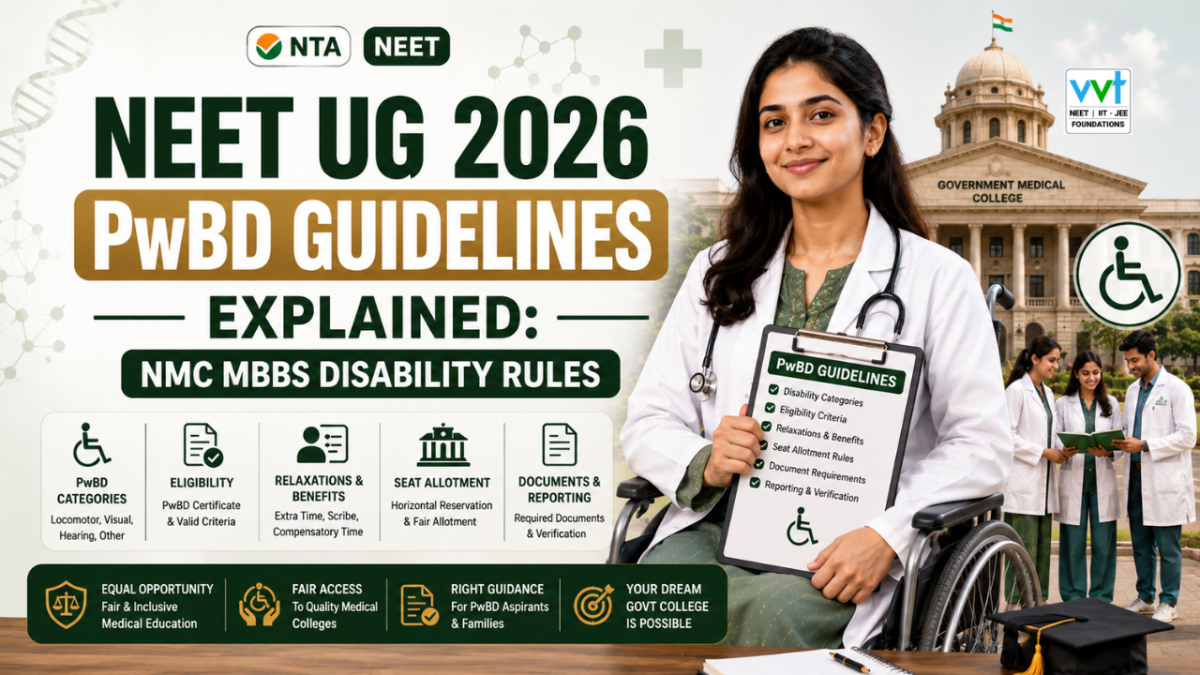
NEET UG 2026 PwBD Guidelines Explained: Everything MBBS Aspirants Need to Know
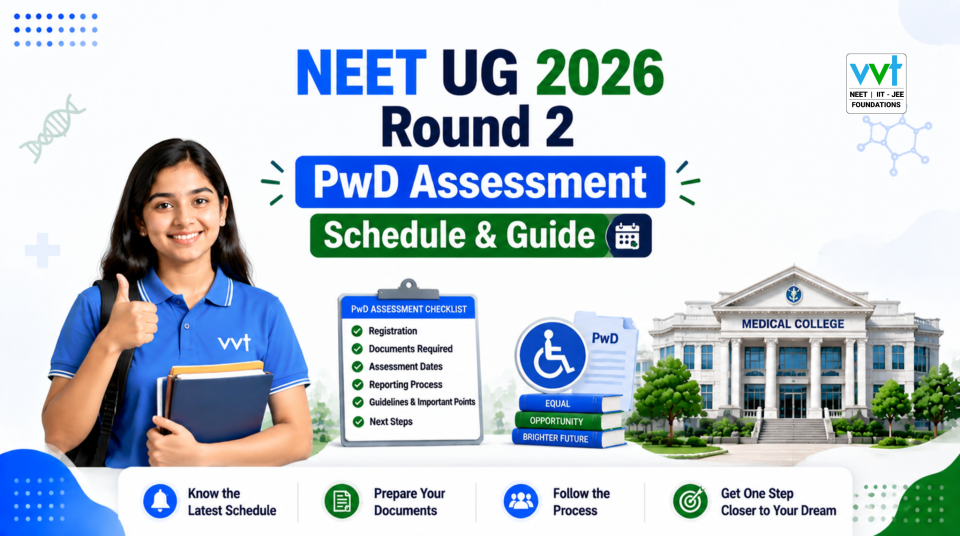
The National Medical Commission (NMC) has introduced a significant update for candidates seeking MBBS admission under the Persons with Benchmark Disabilities (PwBD) category through NEET UG Counselling 2026. The newly released Guidelines on Assessment of Persons with Benchmark Disabilities (PwBD) for Admission to the MBBS Course, 2026 aim to make the admission process more transparent, standardized, and competency based.
Following these guidelines, the Medical Counselling Committee (MCC) has directed all PwBD candidates participating in NEET UG Counselling 2026 to undergo assessment at designated Medical Assessment Boards (MABs) before claiming reservation benefits.
If you are planning to apply under the PwBD category, understanding these updated guidelines is essential. In this detailed guide, VVT Coaching explains the latest rules, eligibility criteria, required documents, assessment process, and everything else you need to know before participating in NEET UG 2026 counselling.
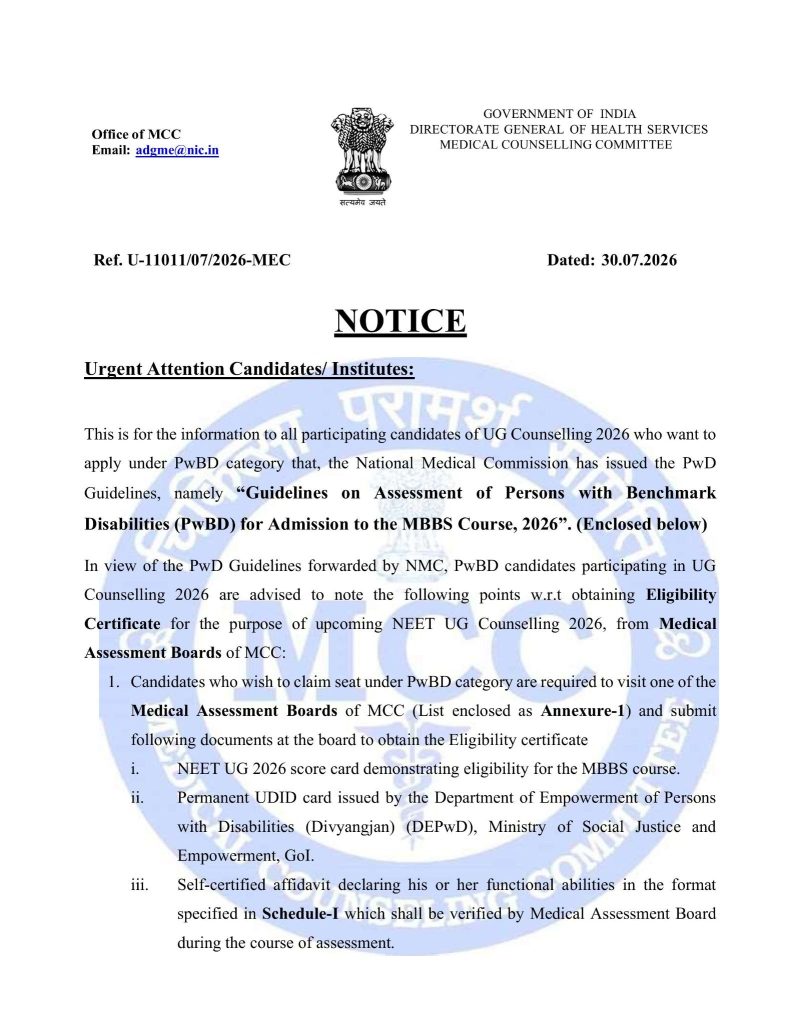
Official MCC Notice informing NEET UG 2026 PwBD candidates about the implementation of the new NMC Guidelines for Assessment of Persons with Benchmark Disabilities (PwBD) for MBBS admissions.
What Are the New NEET UG 2026 PwBD Guidelines?
The newly issued guidelines by the National Medical Commission establish a uniform assessment framework for candidates applying under the PwBD category for MBBS admissions.
Unlike previous years, where disability percentage often became the primary factor during assessment, the new guidelines place greater emphasis on whether a candidate possesses the functional abilities required to successfully complete the MBBS curriculum and practice medicine safely.
The objective is simple:
- Ensure fair assessment for all PwBD candidates.
- Maintain patient safety and professional competency.
- Standardize disability assessment across India.
- Eliminate inconsistencies in medical board evaluations.
This marks one of the most important changes in NEET UG counselling for PwBD candidates.
Why Has NMC Introduced These New Guidelines?
Medical education demands a combination of academic excellence, clinical skills, communication abilities, professional ethics, and patient interaction.
The NMC believes that disability alone should not determine eligibility. Instead, candidates should be assessed on whether they can perform the essential functions expected from an MBBS graduate, with reasonable accommodations wherever applicable.
The revised framework therefore shifts the focus from “percentage of disability” to “functional competency.”
This approach aligns with the principles of inclusive medical education while ensuring that future doctors can safely deliver healthcare services.
Major Highlights of NEET UG 2026 PwBD Guidelines
Some of the biggest changes introduced under the latest guidelines include:
- Standardized assessment process across all Medical Assessment Boards.
- Mandatory functional ability assessment.
- Uniform eligibility criteria for MBBS admission.
- Greater focus on essential competencies rather than disability percentage alone.
- Mandatory Eligibility Certificate from designated Medical Assessment Boards.
- Introduction of self certified functional ability affidavit.
- Mandatory verification of disability related documents before counselling.
These changes aim to ensure consistency and transparency during the counselling process.
Who Can Apply Under the PwBD Category?
Candidates who qualify NEET UG 2026 and possess benchmark disabilities as defined under the Rights of Persons with Disabilities (RPwD) Act may apply under the PwBD reservation category, subject to the assessment conducted by the designated Medical Assessment Board.
However, merely possessing a disability certificate does not automatically guarantee eligibility for MBBS admission.
Every candidate must undergo a competency based assessment to determine whether they meet the essential functional requirements of medical education.
Essential Competencies Required for MBBS Admission
One of the biggest changes introduced by the NMC is the concept of Essential Competencies.
During assessment, Medical Assessment Boards evaluate whether candidates can successfully perform the activities expected during MBBS training.
These include:
Observation Skills
Students should be able to observe patients, identify physical signs, interpret laboratory findings, and understand clinical demonstrations.
Communication Skills
Medical professionals must communicate effectively with patients, relatives, healthcare teams, and faculty members.
Candidates are assessed for their ability to exchange medical information accurately and professionally.
Motor Skills
The assessment examines whether candidates can perform routine clinical procedures, handle medical instruments, and carry out patient examinations safely.
Intellectual and Cognitive Skills
Candidates should demonstrate the ability to analyze clinical information, make logical decisions, solve medical problems, and apply scientific knowledge during patient care.
Behavioural and Professional Skills
Professional ethics, empathy, responsibility, teamwork, and patient centered care form an important part of competency assessment.
Disability Categories Covered Under the Guidelines
The NMC guidelines provide detailed assessment criteria for various benchmark disabilities, including:
- Locomotor Disability
- Visual Impairment
- Hearing Impairment
- Speech and Language Disability
- Autism Spectrum Disorder
- Intellectual Disability
- Specific Learning Disability
- Mental Illness
- Multiple Disabilities
- Other Benchmark Disabilities recognized under the RPwD Act
Each disability category has separate evaluation parameters to determine functional eligibility for MBBS admission.
Medical Assessment Board (MAB): Why Is It Important?
The Medical Assessment Board plays a central role in the new admission process.
Candidates seeking admission under the PwBD category must appear before one of the Medical Assessment Boards designated by the Medical Counselling Committee.
The board carefully evaluates:
- Medical records
- Disability certificate
- Functional abilities
- Essential competencies
- Clinical suitability for MBBS education
After assessment, the board issues an Eligibility Certificate, which is mandatory during counselling.
Without this certificate, candidates cannot claim PwBD reservation benefits.
Documents Required for PwBD Assessment
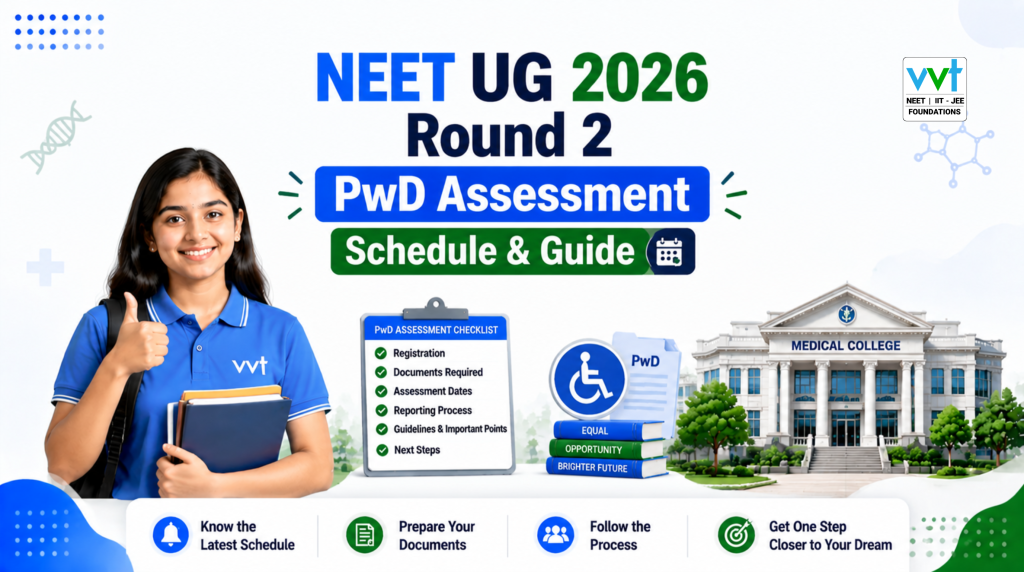
Candidates must carry the following documents while appearing before the Medical Assessment Board:
- NEET UG 2026 Score Card
- Permanent UDID Card
- Valid Disability Certificate
- Self certified Functional Ability Affidavit (Schedule-I)
- Identity Proof
- Passport size Photographs
- Any supporting medical reports, if required
Keeping all documents ready before counselling can help avoid unnecessary delays.
Step by Step PwBD Assessment Process
The assessment process generally involves the following stages:
Step 1: Qualify NEET UG 2026
Candidates must first secure eligibility in the NEET UG examination.
Step 2: Register for MCC Counselling
Complete the online counselling registration under the PwBD category.
Step 3: Visit the Designated Medical Assessment Board
Appear in person with all prescribed documents.
Step 4: Functional Ability Assessment
Doctors evaluate the candidate’s ability to perform essential medical competencies.
Step 5: Verification of Documents
All submitted certificates are verified before eligibility is finalized.
Step 6: Issuance of Eligibility Certificate
Eligible candidates receive the official certificate required during counselling.
How Do the New Guidelines Benefit Students?
Although the assessment process has become more comprehensive, it also offers several advantages:
- Uniform assessment standards across India.
- Reduced subjectivity in disability evaluation.
- Greater transparency during counselling.
- Improved clarity regarding MBBS eligibility.
- Better protection of candidates’ rights through standardized procedures.
The focus on functional competency ensures that deserving candidates receive fair opportunities while maintaining medical education standards.
Conclusion
The NEET UG 2026 PwBD Guidelines represent an important shift towards a more transparent, competency based admission process for MBBS aspirants with benchmark disabilities. Rather than relying solely on disability percentages, the new framework evaluates whether candidates can successfully complete medical education and meet the essential responsibilities of the profession.
For students applying under the PwBD category, early preparation is crucial. Ensure that your documents are complete, understand the Medical Assessment Board process, and stay updated with official announcements from NMC and MCC.
If you need expert guidance throughout the counselling journey, VVT Coaching is committed to providing reliable information, personalized counselling support, and timely updates to help you make confident admission decisions.
Visit: vvtcoaching.com
Call: +91 81221 22333
Scholarships: Up to 100% via VVTSAT!
Also read: Best Government Medical Colleges in Tamil Nadu 2026: Ranking, Fees, Seats & NEET Admission Guide
Also read: NEET 2026 MCC Round 1 Registration Checklist: Fees, Documents, Login Steps & Choice Filling Guide
FAQs
1. What are the NEET UG 2026 PwBD Guidelines?
They are the latest National Medical Commission guidelines that standardize the assessment of Persons with Benchmark Disabilities for MBBS admission through NEET UG 2026 counselling.
2. Is the Medical Assessment Board certificate mandatory?
Yes. Candidates applying under the PwBD category must obtain an Eligibility Certificate from a designated Medical Assessment Board to claim reservation benefits during counselling.
3. What documents are required for the PwBD assessment?
Candidates generally need their NEET UG score card, Permanent UDID Card, valid disability certificate, Schedule-I self-certified affidavit, identity proof, photographs, and supporting medical documents if applicable.
4. Does having a disability certificate guarantee MBBS admission under the PwBD category?
No. The Medical Assessment Board evaluates both the disability and the candidate’s functional ability to perform the essential competencies required for MBBS education.