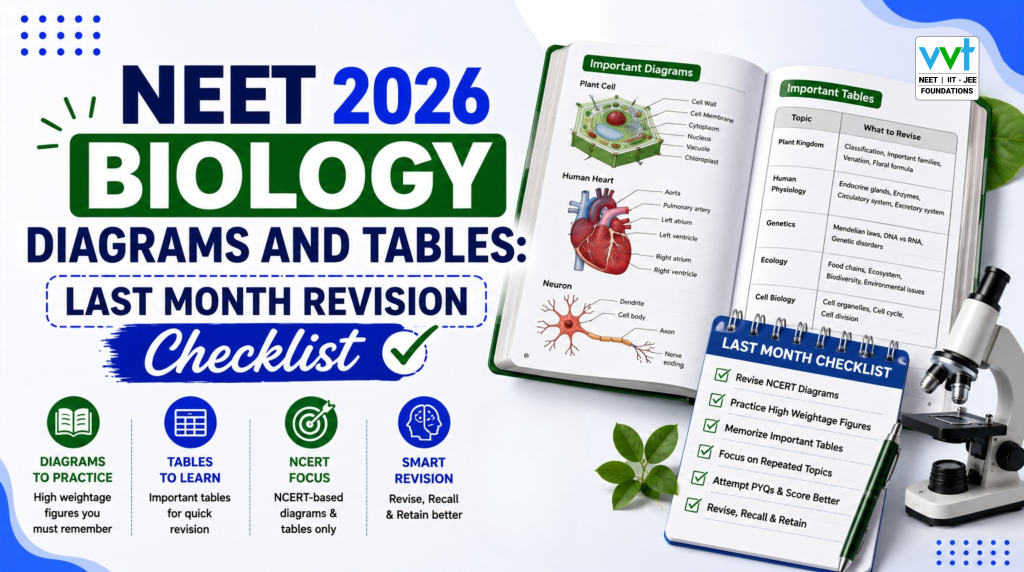

When Will NEET 2026 Result Be Declared?
April 22, 2026
NEET 2026 Expected Cut-Off: What Score Do You Need for Government MBBS?
April 24, 2026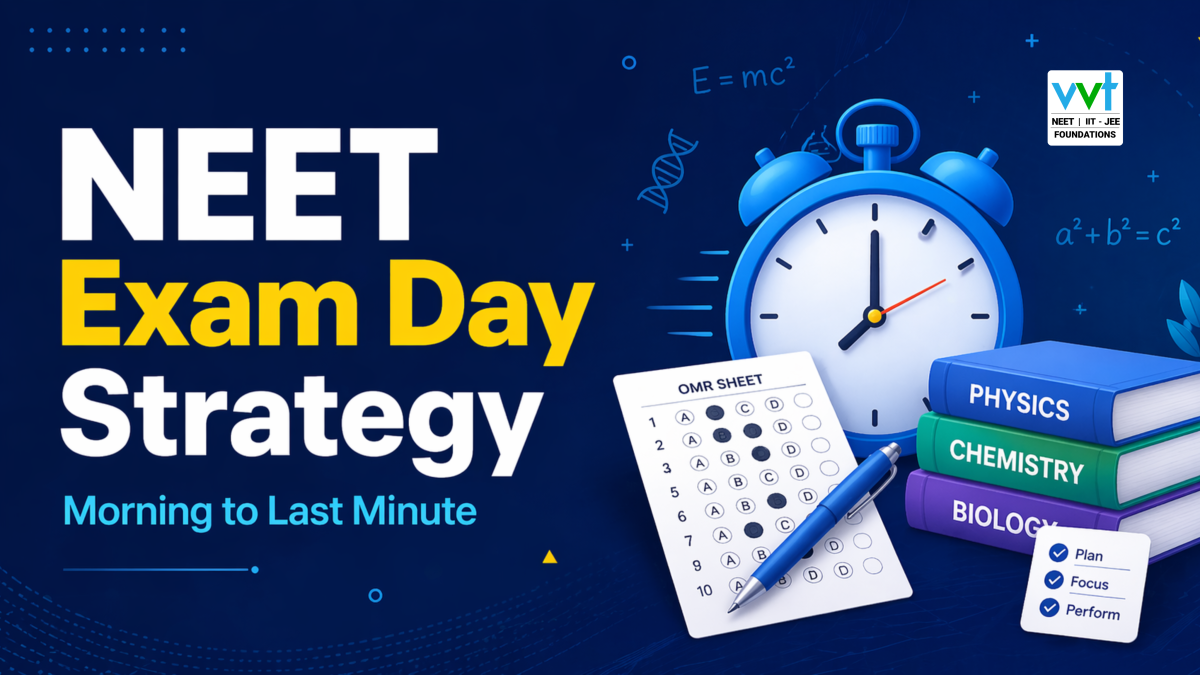
NEET Exam Day Strategy – Morning to Last Minute
VVT Coaching Chennai – Ranked #1 Best NEET & JEE Coaching Centre by Times Now!
NEET exam day does not test only your syllabus. It tests your calm, timing, focus, and decision making too.
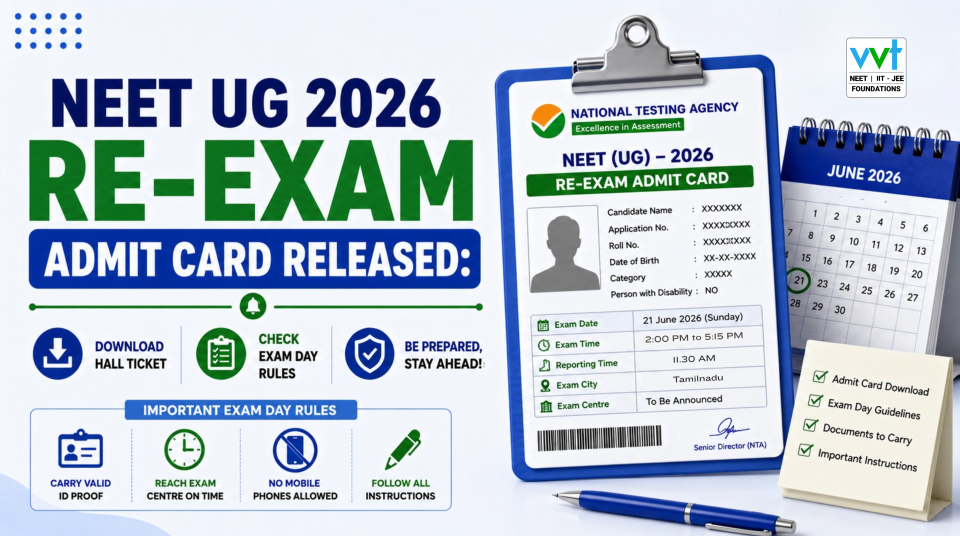
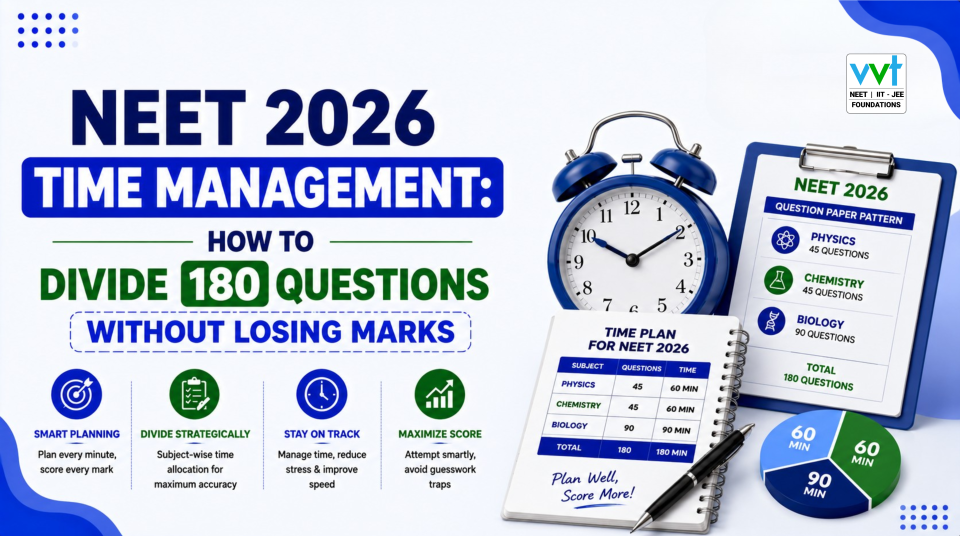
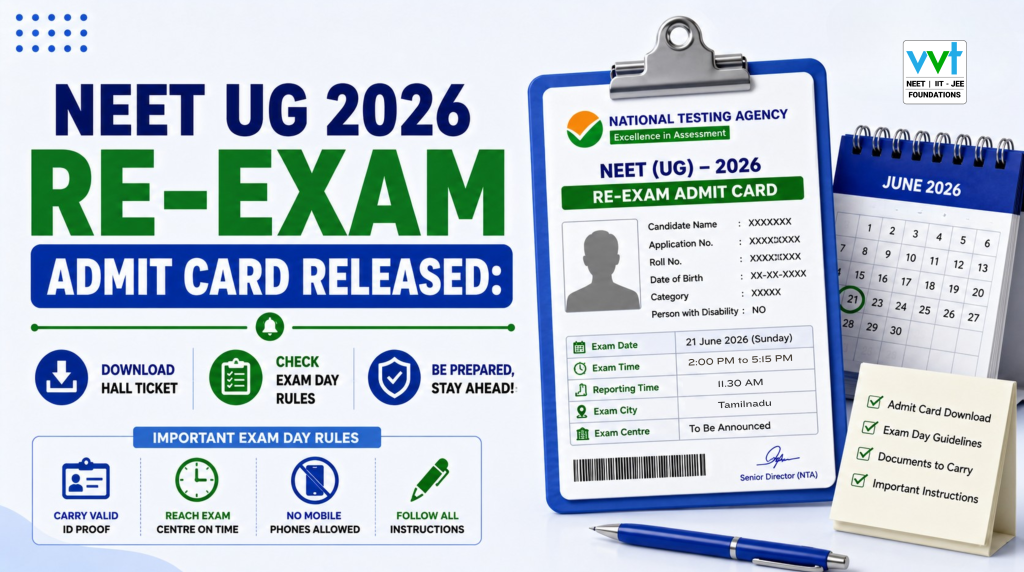
For NEET UG 2026, the official schedule is fixed, the exam is on Sunday, 3 May 2026, from 2:00 PM to 5:00 PM, with 180 questions in 180 minutes. The official bulletin also says reporting/entry time at the centre starts at 11:00 AM, and the last entry is 1:30 PM. No candidate is permitted to enter after 1:30 PM.
That means exam day should not be handled casually. A bad morning can disturb the whole paper. A calm morning can protect months of preparation. At VVT Coaching, the exam day mindset is simple, do not wait for the hall to “decide” how you will perform. Go in with a plan. VVT’s current NEET 2026 exam day guidance also stresses early arrival, proper documents, simple dress, and calm execution rather than last-minute chaos.
The night before matters more than students think
A good exam day starts the previous night.
Do not try to study everything one last time. A well rounded final phase strategy consistently discourages panic revision and last minute overload, as it tends to harm recall and confidence more than it helps. The night before NEET should be used for light revision only formulas, reactions, diagrams, and a few personal weak points , not full chapters and not a mock test.
Also, sleep matters. NEET 2026 is fixed for the afternoon slot, 2:00 PM to 5:00 PM, so your body should already be used to being alert in that window. If you stay up too late trying to “squeeze” one more chapter in, you may carry brain fog into the paper. That is not a smart effort. That is just fatigue wearing the mask of seriousness.

Morning of the exam: keep it simple
Your morning should feel light, not dramatic.
Wake up with enough time to get ready without hurry. Eat a normal, comfortable breakfast. Avoid experimenting with food. Stay away from last-minute discussions with friends about ‘expected paper difficulty.’ And do not start checking ten Telegram groups. The official bulletin itself warns candidates to rely only on the NEET website for authentic information and to be careful about wrong information or false claims regarding the exam.
The best exam mornings are the quiet ones. Students who protect their mind in the morning usually think better in the first hour of the paper.
Before leaving home: what you must carry
The safest way to handle this part is to check everything once and then stop worrying about it.
VVT’s current exam-day guidance says students should carry:
- the printed NEET 2026 admit card
- one valid original photo ID
- at least 2 extra passport-size photographs matching the application image.
The official bulletin also says the candidate must show the admit card on demand for entry into the examination hall, and a candidate without a valid admit card will not be allowed inside. It also notes that the candidate must bring the postcard size photograph and a passport size photograph to be pasted where required.
The practical VVT rule is this, keep everything ready the previous night. Exam morning is not the time to search for ID proof or reprint papers.
Dress code and centre entry: do not create avoidable stress
The official bulletin says heavy clothes and/or long sleeves are not preferable, and candidates in customary dress should report by 12:30 PM for proper frisking. It also says students should cooperate during frisking and report well in advance.
VVT’s exam day guide translates that into the safest practical advice: wear simple, light clothing, use easy footwear, avoid unnecessary metal or accessories, and do not carry barred items such as mobile phones, smart watches, Bluetooth devices, books, notes, or electronic gadgets.
This is one of the easiest places students lose calm before the paper even starts. The best exam day outfit is the one that gets you through entry with zero drama.
Travel to the centre: leave earlier than you think you need to
The official bulletin is very direct here. It says candidates must leave home well in advance considering traffic, location of the centre, weather conditions, and similar factors, and it even says it is appropriate to visit the centre a day before to confirm the location.
VVT’s current exam-day article recommends reaching early, around 10:00 AM to 11:00 AM, so that entry, frisking, and document checks are completed calmly before the cutoff. That is a VVT recommendation, not an NTA-mandated arrival slot, but it is a very sensible one given the official 11:00 AM reporting/entry start and 1:30 PM last entry rules.
The exam hall should never feel like you are arriving at the finish line after already running a race outside.
Once you are seated: do not rush the beginning
The official sequence inside the hall is also laid out: important instructions and admit-card checks happen from 1:30 PM to 1:45 PM, test booklets are distributed at 1:45 PM, candidates write particulars at 1:50 PM, and the test starts at 2:00 PM.
This means the first few minutes after sitting down are not for panic. They are for settling in, listening carefully, checking your booklet and materials, and getting mentally ready.
VVT’s first-30-minutes strategy article pushes the same idea: do not begin the paper emotionally. Begin it deliberately. The first 30 minutes should be used to build rhythm, not prove bravery.
First 30 minutes: build momentum, do not fight the paper
A lot of students damage their own paper here.
They start with a long Physics numerical, get stuck, panic, and carry that stress into Chemistry and Biology. VVT’s published first-30-minutes strategy recommends the opposite: start with familiar, direct questions, collect early marks, and avoid letting one difficult problem hijack your confidence.
That does not mean every student must start with the same subject. It means you should start with the zone that gives you the cleanest confidence and fastest correct attempts. For many students, that is Biology or direct Chemistry. The principle matters more than the exact order:
easy marks first, emotional traps later.

Also read: Best Physics Chapters to Score High in NEET 2026
Also read: Common Physics Topics for NEET 2026: Complete Chapter-Wise Guide
During the paper: protect flow, not ego
The middle phase of the exam is where your paper either stays controlled or slowly slips.
If a question is not opening in a reasonable time, move on. If one section feels difficult, do not carry that feeling into the rest of the paper. VVT’s content on exam hall mistakes and easy mark loss keeps coming back to the same pattern, students often lose marks not because they do not know enough, but because they panic, overthink, or spend too long on one section and disturb the whole paper
A good NEET paper is not one where you “fight” every question. It is one where you keep making clean decisions for three hours.
OMR handling: keep it clean and consistent
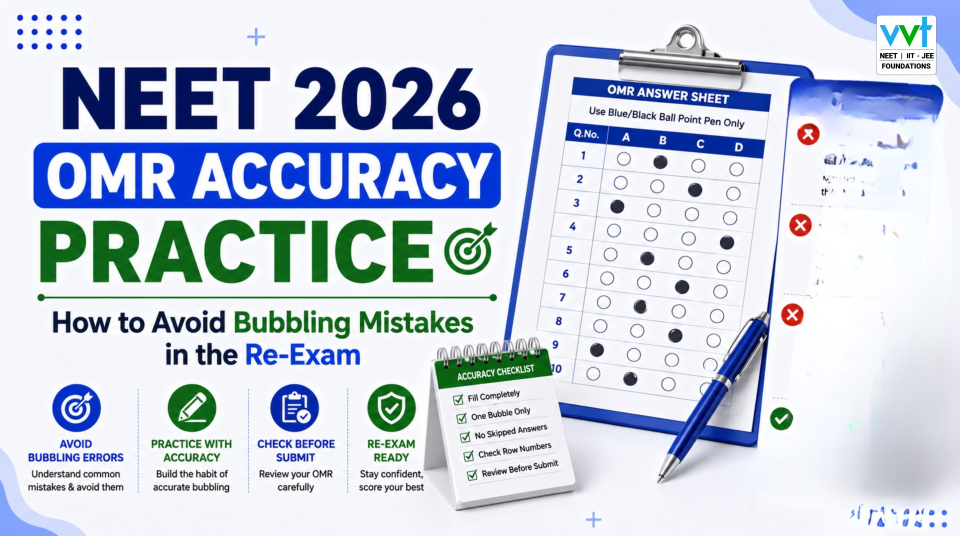
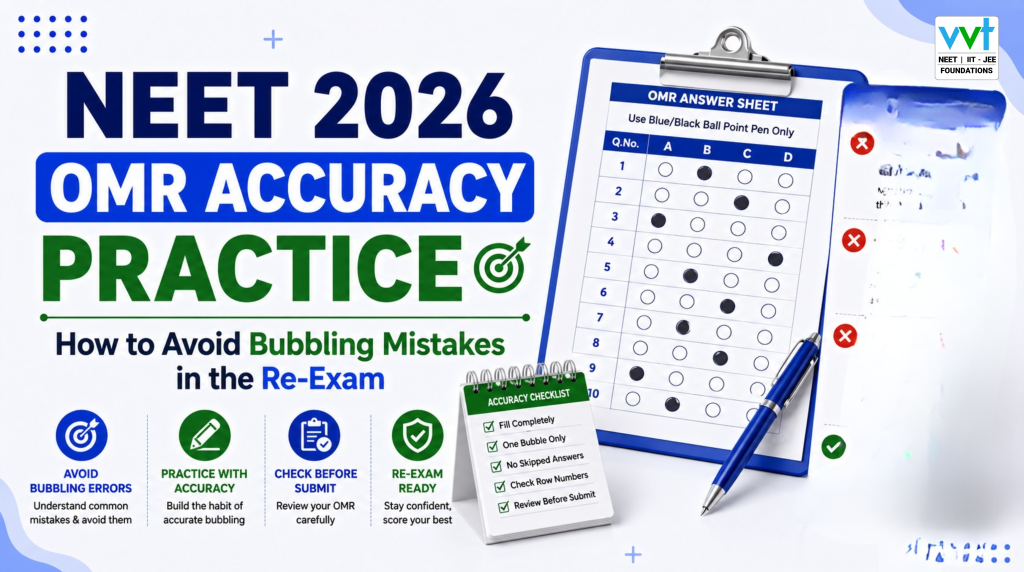
The official bulletin says candidates must not overwrite key details on the OMR sheet, must not erase or obliterate printed information, must not tear or deface the answer sheet, and must hand over the OMR sheet to the invigilator before leaving. It also says no candidate should leave the room without handing over the OMR sheet.
So your OMR method should already be practiced before exam day. Do not invent a new system in the hall. Whether you bubble question by question or in short blocks, the key is consistency and calm. students do not lose marks only because they miss questions, they also lose marks because they mishandle the process of recording answers under pressure.
Last 45 minutes: stop chasing hero attempts
This is where many otherwise good papers get damaged.
Students realise time is moving fast, then begin forcing attempts, over-guessing, or rushing the OMR. The better approach is the opposite, protect the questions you can still answer correctly, stay aware of time, and avoid turning urgency into careless mistakes.
The biggest losses near the end are usually not dramatic. They are small, repeated errors , poor time control, careless bubbling, wrong attempt decisions, and emotional guessing.
The last phase of the paper should feel more disciplined, not more desperate.
Final 10 minutes: calm, not chaos
The official rules make this simple, once the test concludes, candidates must remain seated until the invigilator collects the OMR sheet, and they should not leave without handing it over.
So the final 10 minutes should be used to:
- finish controlled bubbling if needed
- check question number alignment
- avoid random last second guesses
- and stay steady
This is not the time to turn the paper into a gamble. It is the time to protect what you have already built.
After the bell: do not create a new problem
Once the exam ends, your job is simple:
hand over the OMR properly, follow invigilator instructions, and leave the hall without trying to carry the exam with you emotionally.
The official bulletin says candidates should not leave without handing over the OMR sheet, and they are not allowed to take the answer sheet out of the hall.
The VVT way to think about this is:
Once the paper is done, do not start mentally rewriting it in the corridor.
How VVT Coaching Helps Students Stay Calm on Exam Day and Protect Marks from Morning to Last Minute
On NEET exam day, students do not lose marks only because they forgot a concept. They also lose marks because they wake up stressed, rush their routine, carry panic into the centre, mismanage time inside the paper, or let one difficult section affect the rest of the exam.
That is why at VVT Coaching Chennai, preparation is not limited to syllabus coverage alone. We help students prepare for the full exam day journey from the morning routine to the final minutes of the paper.
Because NEET is not only a knowledge test. It is also a test of calm execution.
Error Exams — Fix the patterns that create panic on the real day
Many students make the same mistakes repeatedly in mocks:
- getting trapped in lengthy Physics questions
- misreading Biology statements in a hurry
- making sign or unit mistakes in Chemistry
- skipping familiar questions because of early panic
- losing marks in questions they usually know well
These are exactly the mistakes that can return on the final day if they are not corrected properly.
Instead of giving only more random papers, VVT uses Error Exams built from the student’s own recent mistakes.
These include:
- questions similar to the ones the student got wrong or skipped
- repeated practice on common trap patterns
- short attempt → analysis → re-attempt cycles
- targeted correction until that mistake pattern stops repeating
Result: students enter exam day with fewer repeated errors, better confidence, and more control from the very first section.
AI-Powered Mock Tests — Build better time control before the real paper
One of the biggest exam-day problems is poor time use. Many students spend too long early in the paper. Others rush the last phase. A few do not even realise when the paper starts slipping away.
That is why VVT’s AI-powered mock tests do more than show a score. They help students understand:
- topic-wise and section-wise accuracy
- time spent per question
- where overthinking begins
- where careless errors are costing marks
- whether stamina drops in the later part of the paper
- which subject is disturbing the full-paper balance
This matters on exam day because good performance is not only about knowing answers. It is about using the three hours properly.
Result: students learn how to pace themselves better from the morning mindset to the last minute of the paper.
Personalised Guidance — Create a stable exam-day routine
A student may know the syllabus well and still underperform if the exam day begins in chaos.
That is why personalised mentoring at VVT focuses not just on revision, but also on exam day structure.
Our mentors guide students on:
- how to plan the morning calmly
- what to revise and what not to revise before leaving home
- how to avoid panic on the way to the centre
- how to respond if the first section feels difficult
- what to attempt first based on strengths
- how to avoid emotional swings during the paper
This helps students stay steady through every stage of the day.
Result: students do not enter the exam hall mentally overloaded. They enter with a clearer routine, calmer thoughts, and better decision-making.
Remedy Classes — Repair the small leaks before they become exam-day losses
Many exam day mistakes do not come from major weaknesses. They come from small unfinished gaps that create hesitation under pressure.
These may include:
- confusion between similar concepts
- repeated formula slips
- weak micro-topics
- chapter-specific trap questions
- poor judgment in certain question types
VVT’s Remedy Classes are designed to fix these exact issues quickly and clearly, without forcing students to reopen the whole syllabus.
These sessions are:
- short and focused
- built around one exact weakness at a time
- supported by mock analysis and faculty observation
- followed by quick retesting to confirm that the gap is closed
Result: students walk into NEET with fewer hidden weak spots, which means fewer surprises on exam day.

Get to Know VVT’s Three Friendly Campuses: Always Nearby and Welcoming
VVT has three spots across Chennai, each easy to reach and full of support. No matter where you live, one is close by. Our campuses mix bright classrooms, helpful teachers, and a warm feel to keep you going. Here’s a quick look at each, with a focus on how they help with NEET and staying options.
Adyar Campus: Easy Access and Positive Vibes
Right on busy L.B. Road next to Adyar Ananda Bhavan, this spot is super convenient. Step inside, and you’ll see big, airy rooms where learning feels fun. Staff greet you with smiles, and the energy pushes you to turn weak areas like tough Physics problems into strengths. We also offer hostel facilities here for boys, with clean rooms, meals, and support to make your stay comfortable and focused. No distractions, just a safe place to rest and review after classes.
Adyar Campus (VVT Coaching Centre): “Nibav Buildings”, 4th & 5th Floor, No.23, Old No.11, L.B. Road, Adyar, Chennai – 600020. (Next to Adyar Ananda Bhavan)
Get Directions: Open in google maps!
Anna Nagar Campus: Focus in the City Centre
In Shanthi Colony, Anna Nagar, this campus feels like an extension of home. Good bus links make it simple for city kids. There is no on-site hostel, but nearby options are plentiful for those who need them.
Anna Nagar Campus (VVT Coaching Centre): No.1621, 9th Main Road, Shanthi Colony, Block AI, Anna Nagar, Chennai – 600040.
Get Directions: Open in google maps!
Pallikaranai Girls Campus: Your Safe Place with Full Hostel
This is our special girls-only residential campus in a quiet area. It’s built as a true home away from home, with clean dorms, healthy meals in the canteen, and round-the-clock help.
We offer full hostel facilities here, clean rooms, study areas, and a community of girls supporting each other. It’s perfect if you’re from outside Chennai or just want a focused, safe space.
Pallikaranai (Saraswathi Girls Residential Campus): Plot No. 395 & 396, 1st Main Road, Kamakoti Nagar, Pallikaranai, Chennai – 600100.
Get Directions: Open in google maps
Conclusion
If you want the most practical answer to “NEET Exam Day Strategy – Morning to Last Minute,” it is this:
Wake up calm.
Leave early.
Carry the right documents.
Enter without drama.
Start the paper gently.
Build confidence in the first 30 minutes.
Do not get trapped.
Handle the OMR carefully.
Protect the last phase from panic.
And finish with discipline.
For NEET UG 2026, the official timing, entry window, and hall rules are already clear. The smartest students do not just prepare for the syllabus. They prepare for the day itself.
That is the VVT Coaching way:
not just studying for NEET, but performing properly when it matters most.
Visit: vvtcoaching.com
Call: +91 81221 22333
Scholarships: Up to 100% via VVTSAT!
Also read: How to Fill the NEET 2026 OMR Sheet: Step-by-Step Guide for Students
Also read: NEET 2026 First 30 Minutes Guide: Build Confidence and Manage Time Better
FAQs
What time should I reach the NEET 2026 centre?
The official reporting/entry time starts at 11:00 AM, and the last entry is 1:30 PM. VVT recommends reaching early so entry and verification stay calm.
Can I enter the exam centre after 1:30 PM?
No. The official bulletin clearly states that a candidate who comes after 1:30 PM will not be permitted to enter under any circumstances.
What should I do in the first 30 minutes of NEET?
Build rhythm, collect familiar direct marks, and avoid getting trapped in one long difficult question. VVT’s first-30-minutes strategy strongly supports this kind of controlled start.
What documents should I carry on NEET exam day?
Carry your printed admit card, a valid original photo ID, and extra passport-size photographs. The official bulletin and VVT’s exam-day guide both support this.
What should I wear for NEET 2026?
The official bulletin says heavy clothes and long sleeves are not preferable, and candidates in customary dress should report by 12:30 PM. VVT also recommends simple, light clothing and low-risk footwear.