
NEET 2026 Expected Cut off vs Reality: How Students Should Think After the Exam
May 7, 2026
NEET 2026 Physics Paper Analysis: Difficulty, Topics & Strategy
May 9, 2026
NEET 2026 Chemistry Paper Analysis: Difficulty Level, Topic-Wise Revie
VVT Coaching Chennai – Ranked #1 Best NEET & JEE Coaching Centre by Times Now!
The NEET 2026 Chemistry paper analysis is now available after the successful completion of the NEET UG 2026 exam on May 3, 2026. This year’s Chemistry section included questions from Physical, Organic, and Inorganic Chemistry, following the expected NEET pattern. As students across the country shared their reactions and experts released their first reviews, a clearer picture of the paper has started to emerge.
In this detailed analysis, we break down the overall difficulty level, important question trends, and the kind of reactions students had after the exam.
The short answer: Chemistry looked balanced and moderate
Unlike Physics, which many candidates found lengthy and complex, the Chemistry section of NEET 2026 was generally rated as moderate. Most students described it as scoring and manageable if you had strong NCERT fundamentals and consistent practice.
At VVT Coaching, we emphasise clarity of concepts and strategic preparation. The balanced structure this year rewarded students with solid fundamentals rather than random guessing.

Section Wise Analysis: Physical, Organic & Inorganic Chemistry
NEET Chemistry is divided into three subsections. Here’s how each portion shaped up in 2026
Physical Chemistry – Moderate With Calculations
Physical Chemistry had more numerical and calculation based questions than in some previous years. Topics like Mole Concept, Equilibrium, Thermodynamics, Chemical Kinetics, and Electrochemistry featured questions that required clear steps and careful application of formulas.
This meant:
- Time pressure increased slightly
- Strong practice of numericals was rewarded
- A systematic approach helped improve accuracy
Organic Chemistry – Scoring and Concept Based
Organic Chemistry was among the more manageable parts of the paper. The questions were predominantly based on reactions, reagents, mechanisms, and clear conceptual linkages, instead of random memorisation.
Topics that appeared prominently included:
- Alcohols, Phenols & Ethers
- Amines
- Aldehydes & Ketones
- Biomolecules
Inorganic Chemistry – Easy and High Scoring
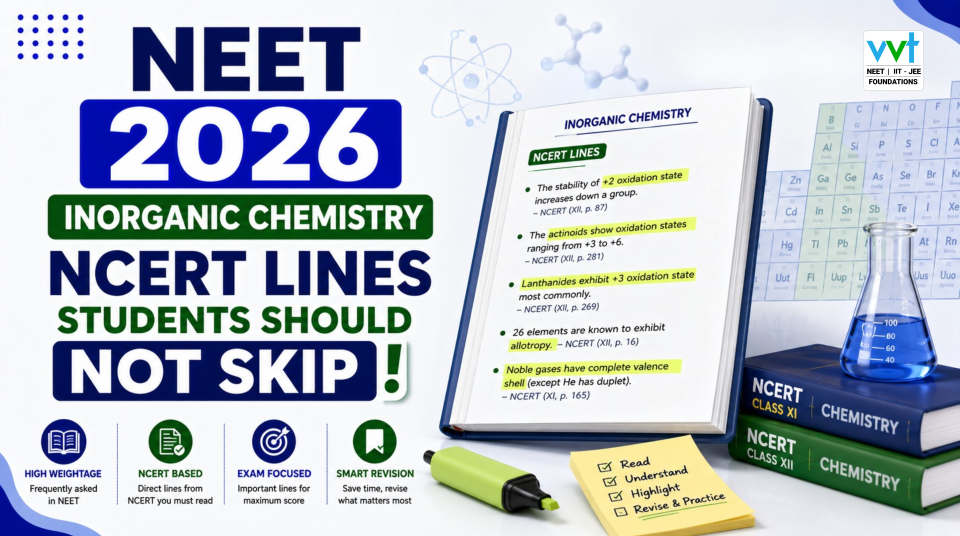
This was the most straightforward section for many students. A large number of questions came directly from NCERT and factual recall areas such as chemical bonding, periodic trends, and coordination compounds.
Inorganic Chemistry rewarded line by line NCERT revision, a core recommendation at VVT Coaching for aspirants aiming for top scores.
Chemistry Class-wise Question Distribution
The NEET 2026 Chemistry section maintained an almost equal balance between Class 11 and Class 12 topics, showing that both years were given nearly the same importance in the paper.
- Class 11 Chemistry contributed 22 questions
- Class 12 Chemistry contributed 23 questions
In percentage terms, the weightage was distributed as follows:
- Class 11: 48.9%
- Class 12: 51.1%
This balanced distribution highlights the importance of preparing both Class 11 and Class 12 Chemistry thoroughly instead of focusing heavily on just one portion of the syllabus.
Chemistry Chapter-wise Question Distribution (Class 11 & Class 12)
| Chemistry Chapter-wise Question Distribution (Class 11 & Class 12) | ||
| Class | Chapter Name | No. of Questions |
| 12 | Alcohols, Phenols and Ethers | 2 |
| 12 | Amines | 3 |
| 12 | Haloalkanes and Haloarenes | 1 |
| 12 | Electrochemistry | 2 |
| 12 | Chemical Kinetics | 3 |
| 12 | Coordination Compounds | 4 |
| 12 | Principles of Qualitative Analysis | 1 |
| 12 | The P-Block Elements (Class 12) | 1 |
| 12 | Solutions | 2 |
| 12 | Atoms | 1 |
| 12 | Biomolecules | 1 |
| 12 | Aldehydes, Ketones and Carboxylic Acids | 1 |
| 11 | Equilibrium | 4 |
| 11 | Some Basic Concepts of Chemistry | 2 |
| 11 | Structure of Atom | 2 |
| 11 | Hydrocarbons | 2 |
| 11 | Chemical Bonding and Molecular Structure | 3 |
| 11 | Organic Chemistry: Some Basic Principles and Techniques | 4 |
| 11 | The P-Block Elements (Class 11) | 1 |
| 11 | Thermodynamics | 3 |
| 11 | Classification of Elements and Periodicity in Properties | 2 |
Key Topics With Noticeable Weightage
Based on student responses and expert breakdowns, the NEET 2026 Chemistry Question Paper focused on the following topics:
Chemical Equilibrium
Coordination Compounds
Chemical Kinetics
Thermodynamics
Organic Reaction Mechanisms
Amines & Carbonyl Compounds
Electrochemistry & Solutions
Chemistry Topic-wise Question Distribution (NEET 2026)
| Chemistry Topic-wise Question Distribution (NEET 2026) | |||
| Class | Chapter Name | Topic Name | No. of Questions |
| 12 | Alcohols, Phenols and Ethers | Alcohols | 1 |
| 12 | Alcohols, Phenols and Ethers | Phenols | 1 |
| 12 | Amines | Preparation of Amines | 2 |
| 12 | Amines | Chemical Reactions | 1 |
| 12 | Haloalkanes and Haloarenes | Preparation Method of Haloalkanes | 1 |
| 12 | Electrochemistry | Nernst Equation | 1 |
| 12 | Electrochemistry | Faraday’s Laws of Electrolysis | 1 |
| 12 | Chemical Kinetics | Order and Molecularity of Reaction | 1 |
| 12 | Chemical Kinetics | Integrated Rate Equations | 1 |
| 12 | Chemical Kinetics | Collision Theory | 1 |
| 12 | Coordination Compounds | Definitions of Coordination Compounds | 2 |
| 12 | Coordination Compounds | Isomerism in Coordination Compounds | 1 |
| 12 | Coordination Compounds | Magnetism | 1 |
| 12 | Principles of Qualitative Analysis | Basic Radicals Analysis | 1 |
| 12 | The P-Block Elements (XII) | Group 15 Elements | 1 |
| 12 | Solutions | Concentration Terms | 1 |
| 12 | Solutions | Ideal and Non-Ideal Solutions | 1 |
| 12 | Aldehydes, Ketones and Carboxylic Acids | Chemical Reactions | 1 |
| 12 | Atoms | Bohr Model of Hydrogen Atom | 1 |
| 12 | Biomolecules | Enzymes | 2 |
| 12 | Biomolecules | Proteins | 2 |
| 12 | Biomolecules | Nucleic Acids | 1 |
| 11 | Some Basic Concepts of Chemistry | Mole Concept | 1 |
| 11 | Structure of Atom | Quantum Numbers | 1 |
| 11 | Chemical Bonding and Molecular Structure | VSEPR Theory | 1 |
| 11 | Chemical Bonding and Molecular Structure | Kossel-Lewis Approach | 1 |
| 11 | Chemical Bonding and Molecular Structure | Formal Charge | 1 |
| 11 | Thermodynamics | Internal Energy | 1 |
| 11 | Equilibrium | Buffer Solution | 1 |
| 11 | Equilibrium | Acid-Base Titration | 1 |
| 11 | Organic Chemistry: Basic Principles | Nomenclature | 1 |
| 11 | Organic Chemistry: Basic Principles | Isomerism | 1 |
| 11 | Hydrocarbons | Aromatic Hydrocarbons | 1 |
| 11 | Hydrocarbons | Chemical Reactions of Alkanes | 1 |
| 11 | Biomolecules | Proteins | 2 |
| 11 | Biomolecules | Enzymes | 2 |

Also read: When Will NEET 2026 Result Be Declared?
Also read: Top Semi Government Medical Colleges in Tamil Nadu: Fees Structure, NEET Cut off & Seats
Scoring Potential – What You Could Expect
From analysis of student attempts and expert insight:
- Organic Chemistry — Easy to Moderate (high scoring)
- Inorganic Chemistry — Easy (very high scoring)
- Physical Chemistry — Moderate (a bit time‑consuming).
Chemical questions were mostly NCERT aligned, and students with strong fundamentals like those trained under VVT Coaching’s systematic curriculum were well positioned to score high.
What Made Chemistry Easier This Year?
Here are the key factors that worked in students’ favour:
Chemistry followed the NCERT based pattern
Organic and Inorganic questions were mostly straightforward
Applicative and conceptual questions rewarded clear fundamentals
Fewer high level tricky questions, compared to Physics
At VVT Coaching, we emphasise NCERT mastery, regular MCQ practice, and topic revision and these were exactly the strengths that helped NEET aspirants tackle Chemistry confidently.
Practical Tips After the Exam
After attempting Chemistry, here’s what VVT Coaching mentors recommend you do next:
1. Review the Chemistry Questions Paper
Compare it with expected answers based on reliable analysis (NCERT‑aligned responses).
2. Match Your Attempt Against Insights
Identify areas where you gained marks and where you lost time.
3. Focus on Answer Checking Accuracy
Do not rely on memory alone cross verify with official or expert validated solutions.
4. Do NOT Panic Based on One Subject
A good performance in Chemistry boosts your overall NEET score significantly, but balance across Biology and Physics matters too.
How VVT Coaching Helps Students Maximise Performance and Avoid Common Chemistry Paper Mistakes
In NEET 2026, the Chemistry paper can be one of the most crucial sections, both in terms of scoring and time management. However, students often lose marks not just because they don’t know the answers but because they mishandle the exam pressure, panic under time constraints, or make careless mistakes. At VVT Coaching Chennai, we go beyond simply covering the syllabus. We train students to tackle the real pressure of the exam hall, particularly in Chemistry, where mistakes are common but often avoidable.
Error Exams – Fix the Common Mistakes in Chemistry Before the Exam
Many students fall into the trap of repeating the same mistakes over and over in Chemistry:
- Misreading questions, especially in Organic Chemistry
- Formula slip ups in Inorganic Chemistry
- Getting stuck on tricky Physics Chemistry integration problems
- Overlooking simple units or signs during calculations in Physical Chemistry
- Panic when it comes to multi step problems
At VVT Coaching, we use Error Exams to help students target these exact mistakes. Instead of just throwing random papers at them, we customise the revision to reflect:
- Questions similar to what students got wrong in mocks
- Patterns of common Chemistry traps (unit conversions, complex equations)
- Short cycles of attempt → analysis → re-attempt
Result: This helps students eliminate recurring mistakes and improve their overall Chemistry performance, ensuring they enter the exam hall with confidence and more control over the questions that previously tripped them up.
AI-Powered Mock Tests – Ensure Proper Time Management and Avoid Overthinking
A major issue in NEET, particularly in the Chemistry paper, is time management. Many students spend too long on a single difficult question, rushing later, or failing to realise where their paper is starting to slip. The result? Unnecessary panic and wasted marks.
VVT’s AI-powered mock tests provide invaluable insights into:
- Topic-wise accuracy in Chemistry
- Time spent per question, especially for tricky calculations
- Overthinking tendencies, particularly in long formula-based questions
- Careless mistakes (such as sign and unit errors)
- Stamina issues, which are common in the latter half of the paper
Result: Students can accurately manage their pace, understand when to move on from difficult questions, and avoid falling into the trap of overthinking, which is particularly damaging in Chemistry.
Personalised Guidance – Help Students Tackle Chemistry’s Tough Sections with Calm
The NEET Chemistry paper has its share of challenging sections, from complex Organic Chemistry reactions to balancing difficult equations in Physical Chemistry. Students often underperform because they feel overwhelmed by these sections, or they panic when the first questions feel tough.
At VVT Coaching, personalised mentoring ensures that students stay calm and manage difficult Chemistry sections effectively. Our mentors guide students on:
- How to approach Organic Chemistry questions without panic
- Which sections to prioritise, especially if time is running low
- How to break down complex reaction mechanisms into simpler steps
- When to move past a difficult question and return to it later
- Preparing for the mental challenge of Chemistry during the exam day
Result: Students walk into the Chemistry section with a clear, calm strategy for tackling tough topics, helping them stay composed and perform better.
Remedy Classes – Fix Specific Chemistry Weaknesses for NEET
Many exam hall mistakes in Chemistry stem from small, unfinished conceptual gaps:
- Confusion with unit conversions
- Overlooking simple formulaic relationships in Organic Chemistry
- Not being able to quickly recall key reaction mechanisms
- Judging questions poorly, especially under time constraints
VVT’s Remedy Classes focus on repairing these small leaks, quickly and efficiently. These classes are designed to address weaknesses like:
- Mistakes with unit conversions or missing steps
- Specific traps in Organic Chemistry or equilibrium problems
- Improving question selection and time allocation
These sessions are short, targeted, and designed to help students gain a firm grasp on troublesome Chemistry areas before exam day.
Result: Students walk into NEET Chemistry with fewer hesitation zones and more confidence in their ability to handle tough questions.

Get to Know VVT’s Three Friendly Campuses: Always Nearby and Welcoming
VVT has three spots across Chennai, each easy to reach and full of support. No matter where you live, one is close by. Our campuses mix bright classrooms, helpful teachers, and a warm feel to keep you going. Here’s a quick look at each, with a focus on how they help with NEET and staying options.
Adyar Campus: Easy Access and Positive Vibes
Right on busy L.B. Road next to Adyar Ananda Bhavan, this spot is super convenient. Step inside, and you’ll see big, airy rooms where learning feels fun. Staff greet you with smiles, and the energy pushes you to turn weak areas like tough Physics problems into strengths.We also offer hostel facilities here for boys, with clean rooms, meals, and support to make your stay comfortable and focused. No distractions, just a safe place to rest and review after classes.
Adyar Campus (VVT Coaching Centre): “Nibav Buildings”, 4th & 5th Floor, No.23, Old No.11, L.B. Road, Adyar, Chennai – 600020. (Next to Adyar Ananda Bhavan)
Get Directions: Open in google maps!
Anna Nagar Campus: Focus in the City Centre
In Shanthi Colony, Anna Nagar, this campus feels like an extension of home. Good bus links make it simple for city kids. There is no on-site hostel, but nearby options are plentiful for those who need them.
Anna Nagar Campus (VVT Coaching Centre): No.1621, 9th Main Road, Shanthi Colony, Block AI, Anna Nagar, Chennai – 600040.
Get Directions: Open in google maps!
Pallikaranai Girls Campus: Your Safe Place with Full Hostel
This is our special girls-only residential campus in a quiet area. It’s built as a true home away from home, with clean dorms, healthy meals in the canteen, and round-the-clock help.
We offer full hostel facilities here, clean rooms, study areas, and a community of girls supporting each other. It’s perfect if you’re from outside Chennai or just want a focused, safe space.
Pallikaranai (Saraswathi Girls Residential Campus): Plot No. 395 & 396, 1st Main Road, Kamakoti Nagar, Pallikaranai, Chennai – 600100.
Get Directions: Open in google maps
Conclusion
If you want the most honest summary of NEET 2026 Chemistry Paper Analysis, it is this:
- Chemistry was overall moderate and balanced.
- It was seen as more manageable than Physics and less emotionally draining for many students.
- The paper appears to have been largely NCERT based, with a healthy mix of direct, concept driven, and some calculation oriented questions.
- Class 11 and Class 12 weightage was nearly balanced, and several standard high return chapters showed up clearly.
- And now that the official provisional answer keys are live, students should shift from guesswork to calmer, cleaner score checking.
At VVT Coaching, the smartest way to understand this section is not to ask only whether Chemistry was easy or hard.
Visit: vvtcoaching.com
Call: +91 81221 22333
Scholarships: Up to 100% via VVTSAT!
Also read: NEET 2026 Answer Key: Download Code Wise PDF, Calculate Score & Know What to Do Next
Also read: Best Government Medical Colleges in Tamil Nadu: Ranking, Fees, and NEET Admission 2026
FAQs
How was the NEET 2026 Chemistry paper overall?
Most early analyses describe it as moderate, balanced, and more manageable than Physics, with a largely NCERT-based feel.
Are the official NEET 2026 provisional answer keys available now?
Yes. The official NEET portal currently shows Provisional Answer Keys for NEET (UG) 2026 in the public notices section
Was NEET 2026 Chemistry NCERT based?
Yes, current early reviews repeatedly describe the Chemistry section as largely NCERT based, especially in Inorganic and many direct concept questions.
Which chapters were important in NEET 2026 Chemistry?
Early breakdowns highlight chapters such as Coordination Compounds, Equilibrium, Amines, Chemical Bonding, Chemical Kinetics, Thermodynamics, Electrochemistry, Hydrocarbons, and Solutions.