
NEET Candidate Login 2026: Portal Access, Password Reset, Important Dates & Step-by-Step Guide
March 13, 2026
What After NEET 2026? Courses, Counselling, Career Paths & Next Steps for Students
March 17, 2026
NEET 2026 Counselling and Reservation: Complete Guide for MBBS, BDS, BAMS, BHMS, BUMS, BSMS & B.Sc Nursing
VVT Coaching Chennai – Ranked #1 Best NEET & JEE Coaching Centre by Times Now!
After the NEET exam, one of the biggest questions students and parents have is:
“How does counselling work, and how does reservation apply for different medical courses?”
This is where many students get confused.
They may know their expected marks, but they are often not clear about:
- which authority conducts counselling for each course
- what is All India Quota and what is State Quota
- how reservation works in MBBS, BDS, AYUSH, and other NEET-based courses
- whether category rules are the same everywhere
- which seats come under MCC, AACCC, or State counselling
The NEET 2026 Information Bulletin makes it clear that NEET UG 2026 is the single entrance test used for admission to undergraduate medical, dental, AYUSH, and certain B.Sc. Nursing courses, but the counselling authority changes depending on the course and seat type.
Also read: NEET Exam Centres in Tamil Nadu 2026: Complete List of Test Cities, City Codes & Smart Selection Guide!
In this guide, we explain:
- counselling under NEET 2026
- quota-wise seat structure
- reservation policy for different courses
- which authority handles which course
- important rules students should not miss
- how VVT Coaching helps students prepare in a way that improves counselling outcomes too
Let’s understand it step by step.
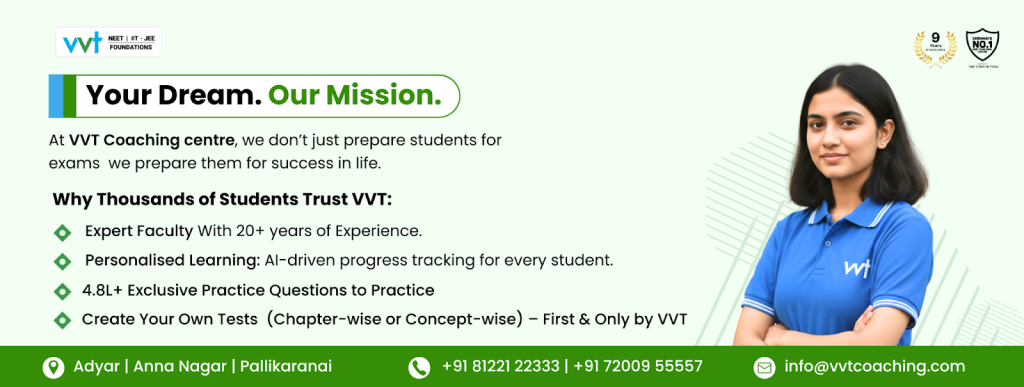
What is counselling under NEET 2026?
Counselling is the process through which NEET-qualified students are allotted seats in medical, dental, AYUSH, and certain nursing institutions based on:
- NEET All India Rank
- category
- quota
- eligibility
- choices filled by the student
- seat availability
The NEET 2026 bulletin states that admissions to undergraduate medical and dental courses, as well as BAMS, BUMS, BSMS, BHMS and B.Sc. Nursing seats covered under NEET, are done through NEET UG 2026, but seat allotment is handled by different counselling authorities. NTA gives the All India Rank, while counselling authorities invite applications and prepare merit lists for allotment.
2026 update students should know first
As of 11 March 2026, NEET UG 2026 is scheduled for 3 May 2026, but the final UG counselling schedule for the 2026 admission cycle is not yet displayed as a fresh 2026 schedule on the live MCC and AACCC portals. Students should therefore follow the current official counselling scheme for understanding the process, while regularly checking the official portals for the final 2026 notifications after the NEET result.
Which courses come under NEET 2026 counselling?
According to the NEET 2026 Information Bulletin, NEET UG is used for admission to:
- MBBS
- BDS
- BAMS
- BUMS
- BSMS
- BHMS
- B.Sc. Nursing (for the covered institutes/seats under the applicable counselling authority)
This means NEET is the entrance exam, but the counselling route depends on the course and institution type.
Also read: How VVT Coaching Uses AI to Identify and Solve Your NEET Preparation Struggles!
Also read: Why Students Lose Easy Marks in NEET (And How to Stop It)!
Main types of seats under NEET counselling
The NEET 2026 bulletin divides the admission structure broadly into:
- All India Quota seats
- State Government quota seats
- Central Institutions / Universities / Deemed University seats
- Private college seats, depending on the course and authority rules
This is why students must not assume that one single counselling process covers every seat in India.
Who conducts counselling for which course?
This is the most important part.
1) MCC counselling
For undergraduate medical and dental admissions, the Medical Counselling Committee (MCC) handles counselling for:
- 15% All India Quota MBBS/BDS seats of states
- 100% MBBS/BDS seats of BHU
- 100% MBBS seats of AIIMS across India
- JIPMER open and internal seats
- AMU open and internal seats
- 85% internal quota/domicile seats of DU / IP University institutions listed in the bulletin
- Jamia dentistry open and internal seats
- 15% AIQ seats of ESIC and insured persons quota seats
- AFMC registration
- 100% B.Sc. Nursing seats of selected central institutes
- 100% seats of Deemed Universities, including 15% NRI seats
2) State counselling authorities
For seats other than 15% All India Quota, the NEET bulletin says admission is handled by the respective State/UT counselling authorities. This includes state quota seats, and the applicable reservation and eligibility rules are those notified by the concerned State or Union Territory.
3) AACCC counselling for AYUSH
For AYUSH courses, AACCC conducts online counselling for:
- 15% AIQ UG seats of BAMS, BSMS, BUMS and BHMS in Government/Government-Aided colleges
- 100% seats of AYUSH Central Universities/National Institutes
- 100% seats of AYUSH Deemed Universities
- related AYUSH UG counselling under its notified scheme for the current session
AACCC’s current UG counselling bulletin states that counselling for AIQ-UG seats of Private ASU&H institutes is conducted by the respective State/UT counselling authority.
What is the difference between All India Quota and State Quota?
All India Quota (AIQ)
AIQ means seats that are filled through the national counselling system based on NEET rank, under the authority designated for that course. For MBBS/BDS, MCC handles the 15% AIQ seats of states and also several central/deemed institutions. For AYUSH, AACCC handles the AIQ seats it has been assigned.
State Quota
State quota seats are filled by the respective State/UT counselling authority. The NEET 2026 bulletin clearly says that admission under state quota seats is subject to the reservation policy and eligibility criteria prevailing in that State/UT.
This is why a student’s counselling strategy can change a lot based on:
- home state
- category
- domicile rules
- target course
- whether the college is central, deemed, private, or state-run
Reservation policy for MBBS, BDS and B.Sc. Nursing under MCC
For admission conducted by MCC/DGHS, the NEET 2026 bulletin lists the reservation policy as:
- GEN-EWS – 10%
- OBC-NCL – 27%
- SC – 15%
- ST – 7.5%
- PwBD – 5% horizontal reservation across GEN, GEN-EWS, OBC-NCL, SC and ST categories
The bulletin also separately states the same Central Government reservation pattern for 15% AIQ / Central Institutes / Universities / AIIMS / JIPMER under NEET UG counselling.
Reservation policy for AYUSH courses under AACCC
AACCC’s current UG counselling bulletin for the latest session shows the Central Government reservation pattern for AYUSH AIQ seats under Government/Government-Aided/National Institutes/Central Universities, and for B.Pharm (Ay.) ITRA, as:
- SC – 15%
- ST – 7.5%
- OBC-NCL – 27%
- GEN-EWS – 10%
- PwBD – 5%
So for AIQ-level AYUSH seats too, the central reservation structure broadly follows the same major category pattern.
Important category rule many students miss
One of the most important official rules is this:
For AIQ / MCC / AACCC counselling, the category benefit depends on the valid category details carried from the NEET application and verified documents. Both MCC and AACCC state that candidate data from the NTA portal is used for counselling, and requests to change or modify those details are generally not entertained during the counselling process.
That means:
- if your category is entered wrongly in the NEET form, it can become a major problem later
- if your certificate is invalid, expired, or not acceptable for that quota, you may lose the benefit
- counselling authorities do not simply “fix it manually” because the student requests it
OBC-NCL rule students should understand properly
Many students think having an OBC certificate is enough.
That is not always true.
For central quota counselling, the NEET 2026 bulletin says:
- OBC-NCL must be in the current Central List
- OBC present only in a State list but not in the Central list is not eligible for OBC reservation in AIQ
- candidates in the creamy layer of OBC are not eligible for OBC reservation and are treated as unreserved/general for those seats
AACCC’s current bulletin states the same principle for AYUSH AIQ counselling.
This is one of the biggest areas where students get confused during counselling.
Reservation under State Quota is different
For State quota seats, reservation is not decided by MCC or AACCC.
The NEET 2026 bulletin clearly says that for state quota seats, the reservation policy of the concerned State Government / Union Territory applies.
This means:
- Tamil Nadu rules may differ from Karnataka rules
- state-specific categories and sub-quotas may apply
- domicile rules may matter
- private colleges under state counselling may follow the state’s notified structure
So students should never depend only on national-level articles for state counselling decisions.
How counselling usually happens after NEET
The exact 2026 schedule is not yet out, but the official counselling schemes show the standard flow:
- registration on the relevant counselling portal
- payment of counselling fee / security deposit where applicable
- choice filling and locking
- seat allotment result
- reporting to the allotted college
- further rounds / upgradation / stray vacancy rounds depending on the authority and scheme
AACCC’s current UG bulletin explicitly shows multiple rounds including Round 1, Round 2, Round 3 and stray vacancy rounds in its scheme for the latest session.
Special points students should remember
NTA gives rank, not seat allotment
NTA conducts NEET and prepares the All India Rank. Counselling and seat allotment are done by MCC, AACCC, or the respective State authorities.
MCC and AACCC cannot freely change your NTA details
The details entered during NEET registration are used for counselling. Both authorities state that they do not entertain category/detail modification requests in normal course.
Category benefit is document-based
Reservation is given only after verification of valid documents. False or incorrect information can lead to cancellation of admission.
Seat blocking rules matter
Students should carefully understand round-wise rules such as free exit, forfeiture, resignation, upgradation, joining deadlines, and ineligibility conditions, because these directly affect later counselling options.
So students must not casually register everywhere without understanding the exit, upgradation, and joining rules.
Course-wise counselling summary
| Course | Main counselling authority |
| MBBS | MCC for 15% AIQ and central/deemed institutions; State/UT authorities for state quota seats |
| BDS | MCC for AIQ/central/deemed structures listed; State/UT authorities for state quota seats |
| BAMS / BSMS / BUMS / BHMS | AACCC for AIQ Govt./Govt.-Aided/CU/NI/Deemed seats; State/UT authorities for many state and private seats |
| B.Sc. Nursing | MCC for selected central institutes under its notified counselling structure |
| AFMC MBBS route | MCC registration, further process by AFMC |
How VVT Coaching helps students use this information properly
Understanding counselling and reservation is important.
But using it correctly is what actually protects a student’s chances.
Many students lose opportunities not only because of marks, but because of:
- poor target planning
- confusion about category benefit
- not knowing whether their score is safe for AIQ or state quota
- weak awareness of how counselling works after the exam
- lack of clarity on which score band fits which course and seat type
This is where the right coaching system matters.
1) Personalised guidance matters because counselling is not the same for every student!
Every NEET student has a different path.
One student may depend heavily on state quota.
One student may aim mainly for AIQ.
Some students may explore AYUSH options along with MBBS or BDS.
Others may simply need a small score improvement to move into a better counselling band.
That is why VVT Coaching focuses on:
- weekly score tracking
- realistic target setting
- priority-based revision
- guided weak-area correction
- personalised mentoring
This helps students prepare with a clear destination instead of studying blindly.
2) AI-powered mock analysis helps students understand their real counselling position!
Many students only look at one number after a test.
But one score alone does not tell them:
- whether their Biology is strong enough
- whether Physics is dragging the rank down
- whether they are losing marks due to time pressure
- whether they are likely to miss a target score band because of repeated errors
At VVT Coaching, mock tests are used as correction tools through:
- subject-wise accuracy analysis
- chapter-wise performance breakdown
- topic-level weak zone tracking
- time-based performance insight
This gives students a much more realistic view of where they stand before counselling season begins.
3) Remedy classes help students push into better score bands!
A lot of counselling outcomes change because of relatively small score differences.
Sometimes 20–30 marks can improve options meaningfully depending on category, state, and course preference.
That is why VVT Coaching uses remedy classes to fix:
- exact question-type weaknesses
- repeated Biology retention gaps
- Physics calculation mistakes
- Chemistry traps and confusion areas
Instead of re-teaching everything, the focus stays on fixing the exact leak in marks.
4) Error exams help prevent score loss that affects final options!
A student may know the syllabus but still lose rank because the same errors repeat:
- wrong option elimination
- unit mistakes
- NCERT line confusion
- panic guesses in timed exams
VVT Coaching uses error exams and fix-up systems to stop those repeat mistakes. That matters because better accuracy often means better final score bands and better score bands mean better counselling choices.
So while counselling happens after NEET, the foundations for a better counselling outcome are built much earlier during preparation.
Get to Know VVT’s Three Friendly Campuses: Always Nearby and Welcoming
VVT has three spots across Chennai, each easy to reach and full of support. No matter where you live, one is close by. Our campuses mix bright classrooms, helpful teachers, and a warm feel to keep you going. Here’s a quick look at each, with a focus on how they help with NEET and staying options.
Adyar Campus: Easy Access and Positive Vibes
Right on busy L.B. Road next to Adyar Ananda Bhavan, this spot is super convenient. Step inside, and you’ll see big, airy rooms where learning feels fun. Staff greet you with smiles, and the energy pushes you to turn weak areas like tough Physics problems into strengths.We also offer hostel facilities here for boys, with clean rooms, meals, and support to make your stay comfortable and focused. No distractions, just a safe place to rest and review after classes.
Adyar Campus (VVT Coaching Centre): “Nibav Buildings”, 4th & 5th Floor, No.23, Old No.11, L.B. Road, Adyar, Chennai – 600020. (Next to Adyar Ananda Bhavan)
Get Directions: Open in google maps!
Anna Nagar Campus: Focus in the City Centre
In Shanthi Colony, Anna Nagar, this campus feels like an extension of home. Good bus links make it simple for city kids. There is no on-site hostel, but nearby options are plentiful for those who need them.
Anna Nagar Campus (VVT Coaching Centre): No.1621, 9th Main Road, Shanthi Colony, Block AI, Anna Nagar, Chennai – 600040.
Get Directions: Open in google maps!
Pallikaranai Girls Campus: Your Safe Place with Full Hostel
This is our special girls-only residential campus in a quiet area. It’s built as a true home away from home, with clean dorms, healthy meals in the canteen, and round-the-clock help.
We offer full hostel facilities here, clean rooms, study areas, and a community of girls supporting each other. It’s perfect if you’re from outside Chennai or just want a focused, safe space.
Pallikaranai (Saraswathi Girls Residential Campus): Plot No. 395 & 396, 1st Main Road, Kamakoti Nagar, Pallikaranai, Chennai – 600100.
Get Directions: Open in google maps
Final words
NEET counselling is not just about marks.
It is about understanding:
- your course options
- the correct counselling authority
- AIQ vs state quota
- category rules
- reservation policy
- document validity
- and the strategy needed to use your rank properly
That is why students should start learning counselling basics before the result itself.
At VVT Coaching, we believe NEET success is not only about studying hard. It is also about preparing smartly, understanding your real target, fixing weak areas early, and entering counselling season with clarity.
A student who knows both how to score and how counselling works always has an advantage.
Visit: vvtcoaching.com
Call: +91 81221 22333
Scholarships: Up to 100% via VVTSAT!
Also read: How VVT Coaching Uses AI to Identify and Solve Your NEET Preparation Struggles!
Also read: Why Students Lose Easy Marks in NEET (And How to Stop It)!
FAQs
1. Is the NEET 2026 counselling schedule released?
Not yet. As of 11 March 2026, the live MCC and AACCC portals are still displaying earlier-session counselling material, so students should keep checking the official portals after the NEET 2026 result for the final 2026 counselling notifications.
2. Who conducts MBBS counselling under NEET?
MCC conducts counselling for 15% AIQ MBBS seats and several central/deemed categories listed in the bulletin, while State/UT authorities conduct counselling for seats other than 15% AIQ under their jurisdiction.
3. Who conducts AYUSH counselling under NEET?
AACCC conducts AIQ AYUSH counselling for the seats under its notified scheme, while state authorities handle many state quota and private AYUSH seats.
4. What is the reservation under AIQ/central counselling?
For MCC AIQ/central structures, the reservation pattern includes SC 15%, ST 7.5%, OBC-NCL 27%, EWS 10%, and PwBD 5% horizontal reservation.
5. Is State Quota reservation the same across India?
No. The NEET 2026 bulletin says state quota reservation follows the policy of the concerned State/UT.
6. Can OBC state-list candidates claim AIQ OBC reservation?
Not automatically. For central quota reservation, OBC-NCL must be in the Central List; state-list-only OBC categories are not eligible for that AIQ OBC benefit.
7. Can categories be changed easily during counselling?
Usually no. MCC and AACCC both state that counselling data is taken from the NTA portal and modification requests are not entertained in the normal process.
Also read: NEET 2026 Eligibility for MBBS & BDS: NTA Rules, Age Limit, Marks & Qualification!