
NEET 2026 Instructions for Parents & Guardians
February 16, 2026
How to Analyse a NEET Mock Test Properly
February 19, 2026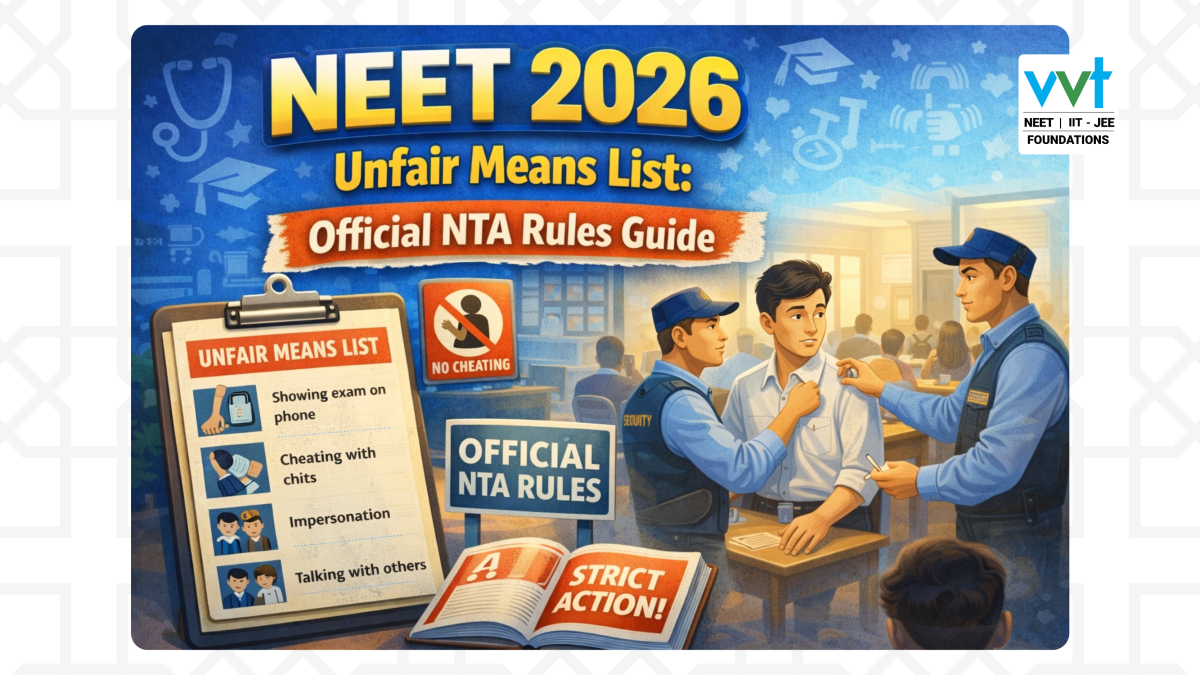
NEET 2026 Unfair Means List: Official NTA Guidelines & What Students Must Avoid
VVT Coaching Chennai – Ranked #1 Best NEET & JEE Coaching Centre by Times Now!
NEET 2026 is one of India’s most competitive medical entrance exams, and while your preparation is the key to success, how you conduct yourself during the exam is equally critical. The National Testing Agency (NTA) has a strict set of rules governing unfair means, commonly called malpractice behaviors, which can lead to disqualification, cancellation of candidature, or even long‑term bans.
Whether you’re a first‑time aspirant or a repeat candidate, both students and parents must understand these rules clearly. Avoiding unfair means is not just about following rules, it’s part of protecting your rank, confidence, and future.
Below is a complete guide to the official list of unfair means in NEET 2026, the consequences, and best practices to ensure a clean, stress‑free exam day.

Official List of Unfair Means in NEET Exam
| Unfair Means | Description |
| Possession of mobile phones or electronic devices in exam hall | Carrying any electronic equipment that can communicate, store or transfer information is strictly prohibited. |
| Copying from unauthorized materials | Using books, guides, notes or handwritten sheets inside the exam hall to copy answers. |
| Impersonation | Someone else appearing on behalf of the candidate or any attempt to deceive exam authorities. |
| Giving unfair advantage | Getting/Sharing answers with other candidates and using any unfair advantage during the NEET exam. |
| Exchange of question paper | Showing or passing question paper content to others. |
| Tampering with answer sheet | Writing or making changes after the allotted time or using unauthorized markings. |
| Using unauthorized tools or aids | Any device such as a calculator, smart watch, Bluetooth devices, etc. |
| Violation of exam hall instructions | Disobeying invigilator instructions, entering exam hall after time, or creating disturbances. |
Also read: How to Apply for NEET 2026 Application Form (Step-by-Step Guide + Expert Advice)!
What Qualifies as ‘Unfair Means’ in NEET 2026
The above table lists official examples of unfair means, but let’s break them down with realistic scenarios so you can easily recognize them:
1) Carrying Electronic Devices
Even if you only intended to keep it in your bag, a mobile phone, watch, calculator, wireless devices, or smart gadgets are considered malpractice if found in the exam hall.
Best Practice: Leave all electronic items outside before entering the exam centre.
2) Copying or Using Unauthorized Materials
Books, notes, cheat sheets, written formulas, anything brought in with the intention of copying answers is unfair.
In simple words: NEET exam hall should only have:
- Admit card
- Valid ID proof
- Required stationery
- Water bottle (clear/transparent)
Nothing else.
3) Impersonation
This is one of the most serious offenses, if someone else tries to take the exam in your name, the result is cancellation of candidature and possible legal action.
Never let anyone else sit for your exam whether related or not.
4) Exchanging Information During the Exam
Talking to neighbors, sharing answers, signaling, all fall under unfair means. Even if done without saying a word, the intention to share or receive answers is considered malpractice.
Best Practice: Sit quietly, focus on your paper, and trust your preparation.
5) Tampering With Answer Sheets
Making late changes after time is over, erasing with intent to change answers, or scribbling unauthorized marks all will lead to rejection of the answer sheet.
6) Using Unauthorized Aids or Tools
NEET is a paper‑pen or CBT (computer‑based test) exam where mathematical calculators, wearable tech, or digital aids are not permitted.
7) Disobeying Exam Hall Instructions
This includes:
- Not following invigilator directions
- Entering after the gate closing time
- Making noise in the hall
- Disturbing other students
Even unintentional misconduct can be classified as a violation.

What Happens If a Candidate Uses Unfair Means?
NEET follows a zero tolerance policy on malpractice.
If a candidate is found using unfair means, they can face:
- Cancellation of NEET 2026 candidature
- Disqualification from results
- Ban from future exams (sometimes for several years)
- Cancellation of all scores obtained earlier (if malpractice is detected later)
Parents and students should understand that no marks, rank, or rank list is worth losing your eligibility for future attempts. That’s why staying within guidelines is critical.
Also read: Self Study Time Table for NEET Preparation 2026!
Why Understanding These Rules Is Important (For Students & Parents)
Many aspirants lose not because they lack knowledge, but because of small rule violations that could have been avoided.
Parents are key support systems – you can help by:
- Reviewing the NEET conduct rules with your child
- Planning travel and logistics to avoid last‑minute panic
- Ensuring all banned items are left at home
- Creating a calm mental atmosphere so the student doesn’t feel pressured to “seek shortcuts”
Being rule‑aware is the first step to ethical exam success.
NEET 2026 Exam Hall Best Practices
To make sure your child has a flawless exam day experience:
Reach the Centre Early
Keep at least 60–90 minutes before the reporting time to avoid stress.
Carry Only Permitted Items
Only carry:
- Admit card
- Valid photo ID
- Two passport‑size photographs
- Ballpoint pen (if allowed)
- Clear water bottle
Nothing else.
Conclusion
The NEET 2026 Unfair Means List and Official Guidelines are not meant to intimidate, they are meant to protect the integrity of the exam and ensure a fair competition for all aspirants.
Preparing well, staying aware of rules, and avoiding shortcuts not only saves you from penalties but also builds confidence and long‑term success habits.
At VVT Coaching, we help you combine smart preparation with strict rule compliance so you perform to your true potential ethically, skillfully, and confidently.
Prepare honestly. Respect the process. Score with confidence.
Visit: vvtcoaching.com
Call: +91 81221 22333
Scholarships: Up to 100% via VVTSAT!

FAQs — NEET 2026 Unfair Means
Q1. What is considered unfair means in NEET 2026?
Carrying banned gadgets, copying, impersonation, using cheat sheets, and violating exam hall rules are all unfair means.
Q2. What happens if a candidate is caught with a mobile phone?
The candidature is cancelled, and the candidate may be banned from future attempts.
Q3. Can a candidate change answers after time is over?
No. Answer sheet tampering or late changes are treated as malpractice.
Q4. Are calculators allowed in the NEET exam?
No. Calculators, smart devices, and electronic aids are strictly prohibited.
Q5. How can parents help prevent unfair means of practice?
By educating candidates about rules, ensuring clean exam day conduct, and avoiding any attempt to influence others.
Also read: NEET 2026 Expected Difficulty Level: Exam Analysis & Cut Off Trend!