
How to Complete NEET 2026 Syllabus on Time: A Practical Weekly Plan + Mock Strategy (VVT Method)
January 11, 2026
How to Choose the Best NEET Coaching Centre: A Practical Checklist for Parents & Students
January 14, 2026
NEET Chemistry Final Syllabus 2026 Out: Unit-Wise Topics + Smart Preparation Plan
VVT Coaching Chennai – Ranked #1 Best NEET&JEE Coaching Centre by Times Now!
Chemistry is the section that can quietly push your NEET score up,if you prepare it the right way.
For NEET 2026 aspirants, the biggest advantage is clarity: the Chemistry syllabus is available in a structured, unit-wise format aligned with the rationalised Class 11 and Class 12 framework. When you know exactly what to study, you stop wasting hours on low-return topics and start building a plan that finishes the syllabus on time without burnout.
This blog gives you the NEET Chemistry syllabus and then shows you how to convert it into marks using the VVT method: NCERT focus + weekly testing + error correction + revision cycles.
What’s Important About NEET Chemistry Syllabus 2026
Chemistry preparation becomes easy when you stop treating it like one long subject and instead split it into three scoring engines:
- Physical Chemistry: numericals + repeated practice
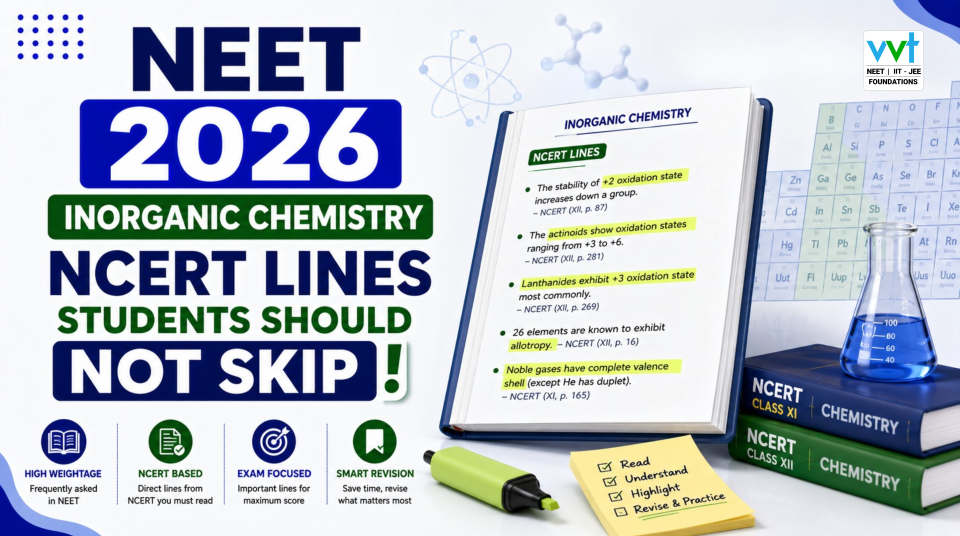
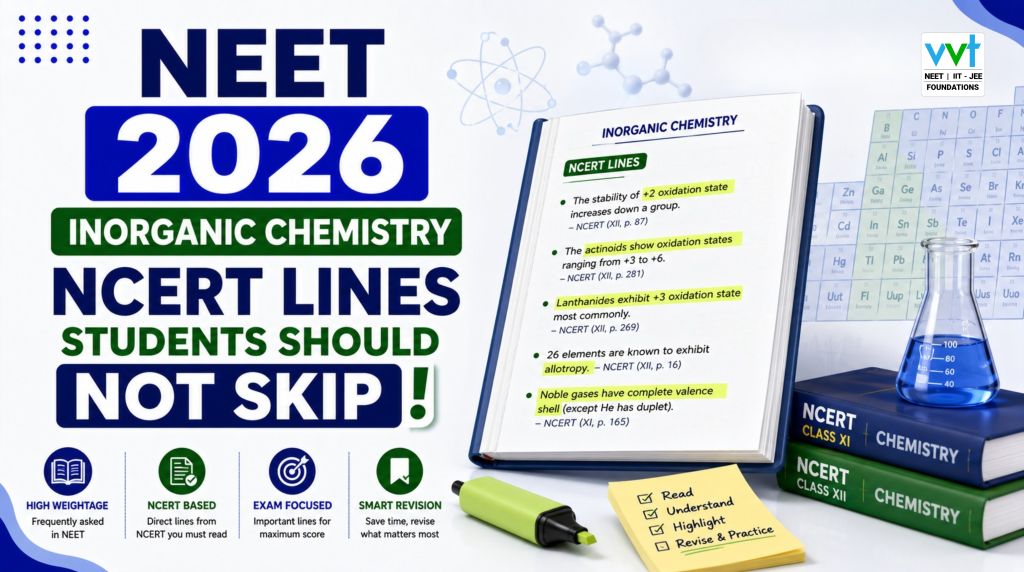
- Inorganic Chemistry: NCERT lines + revision cycles
- Organic Chemistry: GOC clarity + reaction logic + timed MCQs
That’s the difference between “I studied Chemistry” and “I can score Chemistry.”
NEET Chemistry Syllabus 2026 For Class 11
| Chapter Name | Topics |
| Some Basic Concepts of Chemistry | Mole Concept, Determination of Formula of Compound, Stoichiometric Calculations, Concentration Terms, Relation Between Molarity and Normality |
| Redox Reactions | Oxidation Number, Redox Reactions, Balancing of Redox Reactions, Electrochemical Cell |
| Structure of Atom | Subatomic Particles, Concept of Atomic Number and Mass Number, Bohr’s Model of an Atom, Particle Nature of Electromagnetic Radiation, Photoelectric Effect, Quantum Mechanical Model, Quantum Numbers, Electronic Configuration of Atoms |
| Thermodynamics | P-V Work, Heat Capacity, Thermochemistry, Second Law of Thermodynamics |
| Equilibrium | Applications of Equilibrium Constant, Equilibrium Constant, Factors Affecting State of Equilibrium, Expressing Hydrogen Ion Concentration, Buffer Solution, Solubility of Sparingly Soluble Salts |
| Organic Chemistry – Some Basic Principles and Techniques | Naming the Organic Compounds, Isomerism in Organic Compounds, Electronic Displacements in Covalent Compounds, Reaction Intermediates, Hybridisation |
| Hydrocarbons | Conformations of Hydrocarbons, Isomerism in Alkenes, Stability of Alkene, Chemical Reactions of Alkenes, Chemical Reactions of Alkynes, Aromatic Hydrocarbons, Chemical Reactions of Aromatic Hydrocarbons |
| Classification of Elements and Periodicity in Properties | Modern Periodic Table, Periodic Trends in Properties of Elements |
| Chemical Bonding and Molecular Structure | General Introduction, Polarity of Bonds, Covalent Character in Ionic Bonds, Geometry or Shapes of Molecules, Concept of Orbital Overlap in Covalent Bonds, Molecular Orbital Theory (MOT), Hydrogen Bond |
| Principles Related To Practical Organic Chemistry | Analysis of Organic Compounds, Volumetric Analysis, Qualitative Salt Analysis, Enthalpy |
| The p-Block Elements Part 1 | Group-13 Elements, Group-14 Elements |
NEET Chemistry Syllabus 2026 For Class 12
| Chapter Name | Topics |
| Solutions | Solubility of Gases in Liquids, Vapour Pressure of Liquid Solutions, Colligative Properties, Abnormal Molar Masses |
| Chemical Kinetics | Dependence of Reaction Rate on Concentration, Integrated Rate Expressions, Dependence of Reaction Rate on Temperature |
| Electrochemistry | Electrolytic Conduction, Variation of Conductivity and Molar Conductivity with Concentration, Kohlrausch’s Law, Electrochemical or Galvanic Cell, Electrochemical Series, Dependence of Cell and Electrode Potentials on Concentration, Electrolytic Cells and Electrolysis, Fuel Cells |
| Haloalkanes and Haloarenes | Chemical Properties of Haloalkanes, Chemical Properties of Haloarenes, Polyhalogen Compounds |
| Alcohols, Phenols and Ethers | Alcohols: Reactions Involving Cleavage of (O-H) Bond, Alcohols: Reactions Involving Cleavage of (C-O) Bond, Alcohols: Reactions Involving Cleavage of Both Alkyl & Hydroxyl Groups, Phenols: Reactions of Phenolic Group, Phenols: Reactions of Benzene Ring, Phenols: Special Reactions, Distinction Between Alcohols and Phenols |
| Aldehydes, Ketones and Carboxylic Acids | Aldehydes & Ketones: Nucleophilic Addition Reactions, Aldehydes & Ketones: Oxidation Reactions, Aldehydes & Ketones: Reduction Reactions, Aldehydes & Ketones: Reaction with Base, Carboxylic Acids |
| Amines | Preparation Methods, Chemical Properties, Ring Substitution in Aromatic Amines, Distinction Between Amines |
| Biomolecules | Glucose and Fructose, Glucose: Reaction Due to Open Chain Structure, Disaccharides, Proteins, Nucleic Acids |
| Coordination Compounds | Ligands, Werner’s Theory, Coordination Compounds, Isomerism in Coordination Compounds, Bonding in Coordination Compounds |
| The d- and f- Block Elements | Introduction, General Properties of Transition Elements, Compounds of Transition Metals, Inner Transition Elements (Lanthanoids), Inner Transition Elements (Actinoids) |
| The p-Block Elements Part 2 | Group-15 Elements, Group-16 Elements, Group-17 Elements, Group-18 Elements |
Section-wise NEET Physical Chemistry Syllabus 2026
| Topic | Sub-Topics |
| Basic Concepts of Chemistry | Atomic structure, Elements, and Classification of Elements |
| States of Matter: Gases and Liquids | Kinetic theory, Real gases, Liquid State |
| Thermodynamics | Thermodynamic system, Work, Heat, First Law of Thermodynamics, Enthalpy, Second Law of Thermodynamics, Gibbs Energy, Entropy, Gibbs-Helmholtz equation, Spontaneity and Equilibrium, Clausius inequality, Thermochemistry |
| Chemical Equilibrium | Law of mass action, Le Chatelier’s principle, Ionization of acids and bases, Buffer solutions, Solubility product, Common ion effect, pH scale, Hydrolysis of salts |
| Redox Reactions | Balancing of redox reactions, Electrochemical series, Nernst equation, EMF of a cell, Fuel cells, Corrosion, Electrolysis |
| Chemical Kinetics | Rate of reaction, Factors influencing the rate of a reaction, Arrhenius equation, Collision theory, Catalysis |
| Classification of Elements and Periodicity | Periodic table, Trends in properties of elements, Electronic configuration, Ionization energy, Electronegativity |
| p-Block Elements | Boron family, Carbon family, Nitrogen family, Oxygen family, Halogens, Noble gases |
| d- and f- Block Elements | Transition metals, Inner transition metals |
| Coordination Compounds | Nomenclature, Isomerism, Bonding in coordination compounds, Werner’s theory, Valence bond theory, Crystal field theory |
| Purification and Characterization of Organic Compounds | Crystallization, sublimation, distillation, differential extraction, chromatography (principles + applications); qualitative and quantitative analysis (basic) |
How VVT Coaching Helps You Master NEET Chemistry 2026 (Not Just “Finish the Syllabus”)
1) Personalised Guidance for NEET Aspirants!
Many students say “Chemistry is my weak subject,” but the real reason differs for each student:
- some lose marks in Physical due to calculation mistakes
- some forget Inorganic because they revise it only once
- some get stuck in Organic because GOC is not strong
That’s why VVT doesn’t give one generic plan to everyone.
At VVT Coaching, each student gets mentor-led support to:
- track weekly Chemistry score growth (not just “I studied this chapter”)
- plan revision by priority (high-return chapters first)
- set a realistic weekly target for Physical/Organic/Inorganic balance
- fix weak topics without panic using step-by-step correction
- stay consistent till NEET day with accountability
Because in NEET, Chemistry is often the subject where students can gain marks fastest if the plan is personalised and followed consistently.
2) AI-Powered Mock Tests & Smart Analytics!
A normal test tells you only one thing: “Score: 132/180.”
But Chemistry improvement needs deeper clarity:
- Are you losing marks due to weak concepts or silly mistakes?
- Which chapters are wasting time during the exam?
- Which topics look “done” but still fail in MCQs?
VVT’s AI-driven analytics show:
- chapter-wise accuracy (where marks are leaking)
- topic-wise weak areas (what to fix next)
- time spent per question (where speed is killing marks)
- repeated mistake patterns (the exact reason your score stays stuck)
So you stop guessing and start improving with proof.
Because in NEET Chemistry, accuracy + speed + recall decides rank.
3) Remedy Classes (Targeted Fix Sessions, Not Full Re-Teaching)!
Many students waste weeks re-reading entire chapters and still don’t improve.
That’s because the issue is usually “micro” not “full syllabus.”
For example:
- one student repeatedly fails equilibrium numericals
- another makes the same mistakes in electrochemistry formulas
- another gets trapped in organic reaction type questions
- another loses easy marks in coordination compounds NCERT lines
Instead of repeating everything, VVT Remedy Classes focus only on:
- the exact concepts where marks leak
- the exact question types where you lose time
- the specific chapter portions you repeatedly get wrong
Each remedy session is followed by mini-tests to confirm improvement.
So your weak topics get fixed faster and they stay fixed.
4) Error Exams & Weekly Fix-Ups (Where Most Score Jumps Happen)!
This is the biggest Chemistry score booster.
Most students don’t lose marks because they don’t study.
They lose marks because the same errors repeat:
- the same wrong option elimination
- the same unit mistake in Physical Chemistry
- the same NCERT line confusion in Inorganic
- the same reaction trap in Organic
VVT’s personalised Error Exams convert your wrong/skipped questions into custom practice tests so:
- the same mistakes stop repeating
- your weak patterns become your strongest points
- confidence becomes automatic under time pressure
- your accuracy increases without adding new syllabus pressure
This is one of the fastest ways to push your Chemistry score up because it attacks the exact reasons you’re losing marks.
5) NCERT Lock Strategy (The NEET Chemistry Shortcut That’s Actually Legal)
Most students “read NCERT” once and feel done.
But NEET Chemistry, especially Inorganic and many Organic questions, rewards repeat reading + line-based recall.
VVT trains students with an NCERT lock system:
- chapter-wise NCERT revision cycles
- NCERT-based MCQ drills
- “NCERT trap points” lists (the lines students commonly misread)
- quick revision sheets for last 30 days
So students don’t just study NCERT, they score from NCERT.
6) 3-Part Chemistry Engine (Physical + Organic + Inorganic Balance Plan)
The biggest mistake is studying only one Chemistry part for weeks.
VVT maintains a smart balance:
- Physical for predictable marks through numericals
- Organic for steady scoring through GOC + practice
- Inorganic for high-return recall through NCERT repetition
This prevents sudden score drops and keeps Chemistry stable across mocks.
The Weekly Chemistry Routine (So You Finish on Time)
If your syllabus completion keeps getting delayed, use this weekly structure:
- 3 days: Physical chemistry numericals + formula revision
- 2 days: Organic concepts + reaction practice
- 2 days: Inorganic NCERT + quick MCQs
- Every Sunday: Chemistry test + mistake analysis
This routine makes Chemistry predictable and prevents last-minute overload.
Get to Know VVT’s Three Friendly Campuses: Always Nearby and Welcoming
VVT has three spots across Chennai, each easy to reach and full of support. No matter where you live, one is close by. Our campuses mix bright classrooms, helpful teachers, and a warm feel to keep you going. Here’s a quick look at each, with a focus on how they help with NEET and staying options.
Adyar Campus: Easy Access and Positive Vibes
Right on busy L.B. Road next to Adyar Ananda Bhavan, this spot is super convenient. Step inside, and you’ll see big, airy rooms where learning feels fun. Staff greet you with smiles, and the energy pushes you to turn weak areas like tough Physics problems into strengths.We also offer hostel facilities here for boys, with clean rooms, meals, and support to make your stay comfortable and focused. No distractions, just a safe place to rest and review after classes.
Adyar Campus (VVT Coaching Centre): “Nibav Buildings”, 4th & 5th Floor, No.23, Old No.11, L.B. Road, Adyar, Chennai – 600020. (Next to Adyar Ananda Bhavan)
Get Directions: Open in google maps!
Anna Nagar Campus: Focus in the City Centre
In Shanthi Colony, Anna Nagar, this campus feels like an extension of home. Good bus links make it simple for city kids. There is no on-site hostel, but nearby options are plentiful for those who need them.
Anna Nagar Campus (VVT Coaching Centre): No.1621, 9th Main Road, Shanthi Colony, Block AI, Anna Nagar, Chennai – 600040.
Get Directions: Open in google maps!
Pallikaranai Girls Campus: Your Safe Place with Full Hostel
This is our special girls-only residential campus in a quiet area. It’s built as a true home away from home, with clean dorms, healthy meals in the canteen, and round-the-clock help.
We offer full hostel facilities here, clean rooms, study areas, and a community of girls supporting each other. It’s perfect if you’re from outside Chennai or just want a focused, safe space.
Pallikaranai (Saraswathi Girls Residential Campus): Plot No. 395 & 396, 1st Main Road, Kamakoti Nagar, Pallikaranai, Chennai – 600100.
Get Directions: Open in google maps!
Conclusion
NEET Chemistry 2026 becomes easy when you follow a simple rule: study once, revise thrice, and test weekly. If you use the syllabus as a roadmap (not just a list), you can complete Chemistry on time and make it your score booster.
If you want a guided plan with mock analytics, error correction, and mentor support, VVT Coaching is ready.
Visit: vvtcoaching.com
Call: +91 81221 22333
Scholarships: Up to 100% via VVTSAT!

FAQs — NEET Chemistry Final Syllabus 2026
Q1) Is the NEET Chemistry syllabus 2026 the same for all students?
Yes. The NEET Chemistry syllabus 2026 is common for everyone, and your prep should follow the official Class 11 + Class 12 topic list. The smart move is to study only what’s included, then revise it repeatedly.
Q2) Which part of Chemistry is the fastest to improve for NEET—Physical, Organic, or Inorganic?
For most students, Inorganic + selected Physical gives the quickest score jump because it’s highly NCERT-driven and formula-based. Organic improves fast too but only after your GOC basics are strong.
Q3) How should I balance Physical, Organic, and Inorganic while finishing the syllabus on time?
Don’t study one section for weeks. Use a weekly split:
- 3 days Physical numericals + formulas
- 2 days Organic (GOC + reaction logic + MCQs)
- 2 days Inorganic (NCERT line-by-line + MCQs)
This keeps Chemistry stable and prevents sudden score drops in mocks.
Q4) I keep forgetting Inorganic Chemistry. What’s the best revision method?
Inorganic is a revision game. The best method is: NCERT repeat cycles + short notes + weekly tests. If you revise Inorganic only once, you’ll forget. If you revise it every week, it becomes easy marks.
Q5) How do I improve Chemistry marks quickly if I’m already giving mocks?
Stop taking mocks without correction. After every mock, do:
- categorize mistakes (concept, NCERT line confusion, calculation slip, silly error)
re-test wrong/skipped questions as an “Error Exam”
This error-fix cycle is the fastest way to increase Chemistry score without adding new syllabus pressure.