
NEET 2026 MCC Round 1 Registration Checklist: Fees, Documents, Login Steps & Choice Filling Guide
July 27, 2026
NEET UG 2026 Counselling New Rules: Seat Upgrade, NRI Quota & Online Resignation Explained
July 29, 2026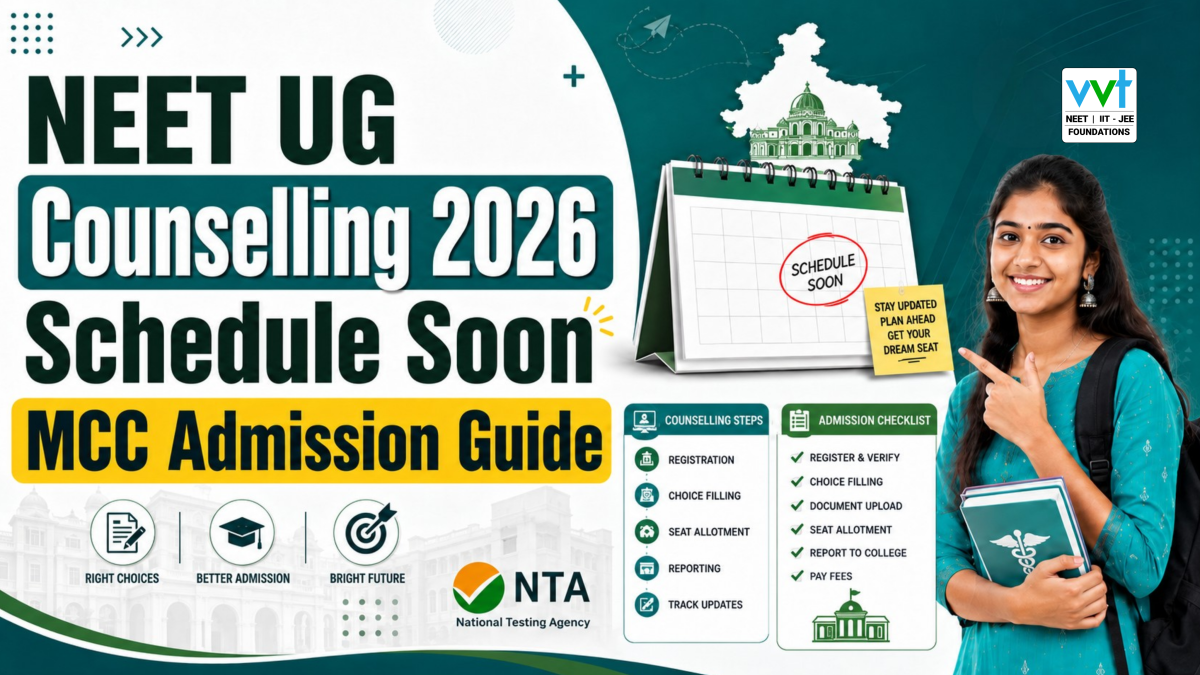
NEET UG Counselling 2026 Schedule Expected Soon: MCC MBBS/BDS Admission Guide by VVT Coaching
Latest Update on NEET UG Counselling 2026
The NEET UG Counselling 2026 schedule is expected to be released soon by the Medical Counselling Committee. As of 28 July 2026, MCC’s UG counselling portal is active for the 2026 session, but the official UG schedule section is not yet showing the final round wise timetable. The MCC page currently shows “No post to display” under the UG e-services schedule area, so students should avoid relying on unofficial dates until MCC publishes the schedule.
Once released, the counselling schedule will guide students on registration, fee payment, choice filling, choice locking, seat allotment, reporting and further rounds. For MBBS and BDS aspirants, this is the most important phase after the NEET result because admission is not based only on marks; it depends on rank, category, seat availability, reservation rules, college preference order and timely participation.
At VVT Coaching, our advice is simple: do not wait for the schedule to start preparing. Keep your documents ready, shortlist colleges in advance and understand the difference between All India Quota counselling and State counselling before registration opens.
Where Will the NEET UG Counselling 2026 Schedule Be Released?
Students should track the official MCC website for All India counselling updates. MCC conducts online counselling for 15% All India Quota seats for UG courses, along with other notified seats, under the Directorate General of Health Services, Ministry of Health and Family Welfare.
For NEET scorecard and result related links, students should refer to the official NTA/NEET portal. NTA’s role is to conduct NEET, declare the result and provide All India Rank to DGHS for counselling purposes.
This difference is very important:
NTA / NEET portal: Result, scorecard, answer key, exam notices
MCC portal: AIQ counselling, registration, choice filling, seat allotment
State counselling portals: 85% state quota and state level private/self financing seats
For Tamil Nadu students, this means MCC counselling and Tamil Nadu state counselling are two separate processes. The Tamil Nadu Selection Committee has already listed MBBS/BDS application and prospectus links for Government Quota, Management Quota, Minority and NRI quota seats for the 2026–27 session.
Why the 2026 Counselling Round Is Important
NEET UG 2026 counselling is expected to be highly competitive because many students will be targeting government MBBS seats, AIIMS, JIPMER, central universities, deemed universities and top private medical colleges.
The seat matrix is also a major factor this year. According to the NMC seat matrix reported for the 2026–27 academic year, there are 1,36,939 MBBS seats across 823 medical colleges, excluding Institutes of National Importance. Out of these, 63,296 seats are in government medical colleges and 73,643 seats are in private medical colleges.
This increase in seats gives more opportunities, but students should not assume that cut-offs will automatically drop everywhere. Cut-off movement depends on state, category, quota, fee structure, college demand and choice filling behaviour.
A student with a strong rank can still lose a better college because of poor choice filling. Similarly, a student with an average rank can improve their chance by applying in the right quota, filling enough choices and understanding previous allotment trends.
Expected NEET UG Counselling 2026 Process
Once MCC releases the official schedule, the counselling process is expected to move through the following stages.
1. Online Registration
Candidates must register on the official MCC counselling portal once the registration window opens. During this step, students will enter basic details, NEET roll number, application number, personal details and other required information.
Students should be careful while entering details because any mismatch may create issues later during document verification or college reporting.
2. Counselling Fee and Security Deposit Payment
After registration, candidates usually have to pay the counselling fee and, where applicable, a refundable security deposit. The fee amount may vary depending on the type of institution and candidate category.
Students targeting deemed universities should be especially careful because the security deposit and fee structure may be different from regular government AIQ counselling.
3. Choice Filling
Choice filling is the most important step in counselling. Students must select colleges and courses in the correct preference order.
This is where many students make mistakes. Some keep only “safe” colleges and lose better options. Some fill too few choices and reduce their chances. Some copy a random list from YouTube or Telegram without checking their own rank, category, quota, fee affordability and location preference.
At VVT Coaching, we recommend preparing three layers before choice filling:
Dream colleges: Colleges slightly above your expected rank range
Realistic colleges: Colleges close to your rank and category trend
Safe options: Colleges where your chances are comparatively stronger
This method keeps the choice list ambitious but practical.
Also read: NEET 2026 Choice Filling Strategy: How to Arrange Colleges Safely for Round 1
4. Choice Locking
After filling choices, candidates must lock them before the deadline. If the student forgets to lock choices, the system may handle saved choices as per MCC rules, but it is always safer to manually lock and download the confirmation.
Before locking, check:
College name
Course name
Quota
Order of preference
Fees
State/location
Bond/service rules
Hostel and reporting requirements
Once locked, choices usually cannot be edited for that round.
5. Seat Allotment Result
MCC will process the choices based on NEET rank, category, reservation rules, seat availability and the order of preferences submitted by the candidate.
If a seat is allotted, the candidate must download the allotment letter and follow the reporting instructions within the given timeline.
6. Reporting to the Allotted College
Candidates allotted a seat must report to the respective institute with original documents and required photocopies. Admission is confirmed only after successful reporting, document verification and fee payment as per the institution’s rules.
Missing the reporting deadline can lead to loss of the allotted seat, so students should keep travel plans and documents ready in advance.
7. Further Rounds and Upgradation
If a student is not satisfied with the allotted seat, they may be eligible to participate in further rounds depending on MCC rules. Round 2, mop up and stray vacancy rounds may follow if seats remain vacant.
Students should not make emotional decisions after Round 1. A seat may be upgraded later, but the decision must be taken based on rules, risk level, rank trend and financial comfort.
Documents Required for NEET UG Counselling 2026
Students should keep the following documents ready before the counselling schedule is released:
NEET UG 2026 scorecard
NEET UG admit card
Class 10 certificate
Class 12 marksheet
Class 12 certificate
Valid photo ID proof
Passport size photographs
Category certificate, if applicable
OBC-NCL / EWS certificate, if applicable
PwD certificate, if applicable
Domicile certificate for state counselling, if required
NRI or minority documents, if applying under those quotas
Transfer certificate and conduct certificate, if required by the college
Allotment letter after seat allotment
Fee payment proof
Keep both original documents and multiple photocopy sets. Also save scanned copies in Google Drive or email so that you can access them quickly during registration or reporting.
AIQ Counselling vs State Counselling: What Students Must Understand
Many NEET students confuse MCC counselling with state counselling. Both are important, but they are not the same.
MCC conducts counselling for central level seats such as 15% All India Quota and other MCC notified seats. State counselling authorities conduct admission for state quota seats and state-specific private/self-financing seats.
For example, a Tamil Nadu student may apply for:
MCC counselling for AIQ/deemed/central seats
Tamil Nadu counselling for state quota, management quota, minority or NRI seats, depending on eligibility
This is why students should not wait for only one counselling notification. Missing a state counselling deadline can close an important admission route, even if the student is eligible through NEET.
What Should Students Do Before MCC Releases the Schedule?
The waiting period before counselling is not a free period. It is the best time to prepare.
Students should:
Check NEET scorecard and rank details
Prepare category and quota documents
Study previous year cut-off trends
Make a realistic college preference list
Understand government, private and deemed university fee structures
Discuss financial limits with parents
Track MCC and state counselling websites daily
Avoid unofficial WhatsApp or Telegram rumours
Keep login credentials safe
Take screenshots or PDFs of every submitted form
A good counselling strategy starts before registration opens.
Common Mistakes to Avoid in NEET UG Counselling 2026
Filling Too Few Choices
Some students fill only top colleges and then miss allotment. Even if your rank is strong, fill a balanced list.
Copying Someone Else’s Choice List
Your friend’s list may not work for you. Rank, category, state, budget, quota and preferences differ from student to student.
Ignoring Fees
Before adding deemed universities or private colleges, check tuition fee, hostel fee, miscellaneous charges and yearly payment structure.
Missing State Counselling
A student may be eligible for both MCC and state counselling. Do not focus only on AIQ if your state quota gives better chances.
Waiting Until the Last Day
Registration portals may become slow near deadlines. Complete important steps early and download confirmation pages.
Not Checking Bond Rules
Some states or colleges may have service bonds, discontinuation bonds or penalty clauses. Read the prospectus before final choice locking.
VVT Coaching’s Counselling Advice for NEET 2026 Students
NEET counselling is not just a form filling process. It is a rank based decision process where every choice matters.
At VVT Coaching, we guide students to look beyond college names. A good counselling decision should consider:
Rank and category
Previous allotment trends
Government vs private vs deemed options
State quota eligibility
Fees and affordability
Location preference
Bond rules
Clinical exposure
College reputation
Long term comfort for the student and family
The goal is not just to get any seat. The goal is to get the best possible seat for your rank, budget and career plan.
Conclusion
The MCC NEET UG Counselling 2026 schedule is expected soon. The final official dates must be checked only on the MCC website. MCC will conduct counselling for 15% AIQ and other central level notified seats, while state authorities will separately conduct state quota counselling.
Students should prepare documents, shortlist colleges and understand the counselling process before registration starts. Choice filling is one of the most important steps, and students should avoid copying random lists without checking their own rank, category, quota and fee comfort.
VVT Coaching recommends tracking both MCC counselling and state counselling updates so that no admission opportunity is missed.
Visit: vvtcoaching.com
Call: +91 81221 22333
Scholarships: Up to 100% via VVTSAT!
Also read: Best Government Medical Colleges in Tamil Nadu 2026: Ranking, Fees, Seats & NEET Admission Guide
Also read: NEET 2026 MCC Round 1 Registration Checklist: Fees, Documents, Login Steps & Choice Filling Guide

FAQs
1. Is the NEET UG Counselling 2026 schedule released?
As of 28 July 2026, the final MCC NEET UG Counselling 2026 schedule has not been displayed in the UG schedule section of the MCC portal. Students should keep checking the official MCC website for the round-wise timetable.
2. What is the difference between AIQ and state quota?
AIQ refers to All India Quota seats handled through MCC counselling. State quota seats are handled by the respective state counselling authorities. Eligibility, reservation rules and application process may differ.
3. What documents are required for NEET UG counselling?
Students generally need the NEET scorecard, admit card, Class 10 and 12 certificates, ID proof, photographs, category certificate if applicable, domicile certificate for state counselling if required and other documents mentioned in the official prospectus.
4. How important is choice filling in NEET counselling?
Choice filling is extremely important. Seat allotment depends not only on rank but also on the order of preferences, category, seat availability and counselling rules.