
NEET 2026 Result Expected Date: Scorecard & Next Steps
July 4, 2026
NEET 2026 Final Answer Key: When Will NTA Release the Revised Official Key?
July 6, 2026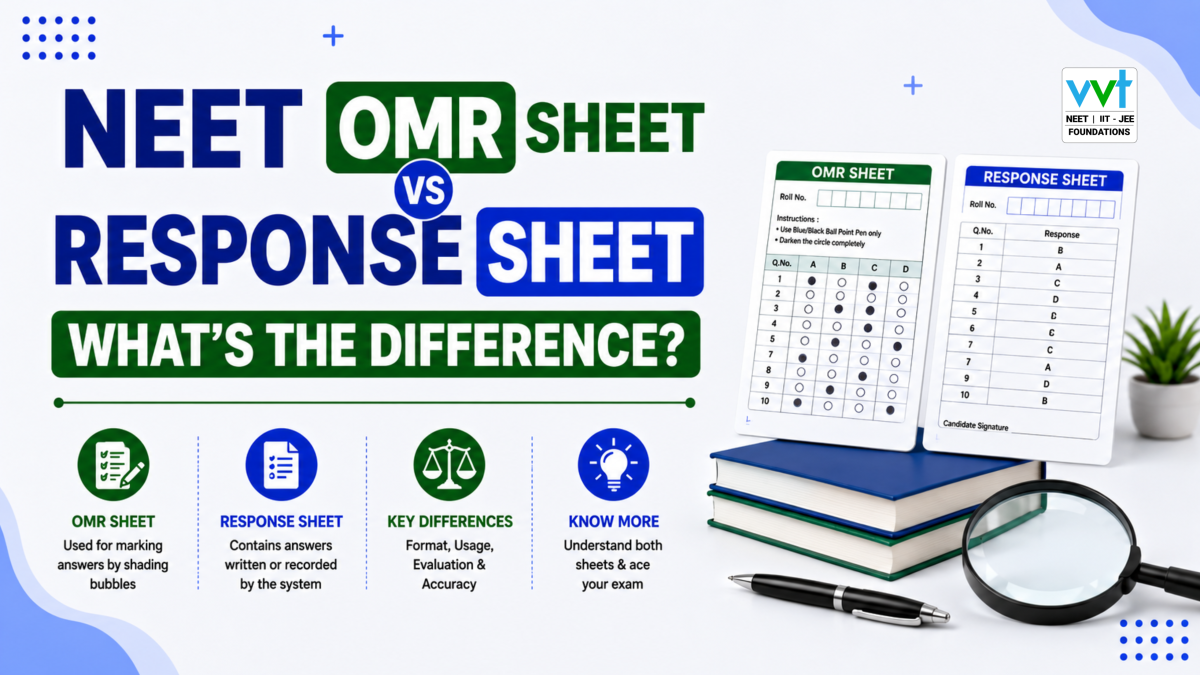
NEET OMR Sheet vs Response Sheet: What’s the Difference?
The NEET OMR sheet is the physical answer sheet where you darken bubbles during the exam. The NEET response sheet or recorded response is the digital version of the answers read by the machine from your OMR sheet. In simple words, the OMR sheet shows what you marked, while the response sheet shows what the system recorded from those markings.
For NEET students, understanding this difference is important because your final score depends on how the system reads your marked answers. After the exam, NTA displays the scanned OMR sheet and machine-recorded responses on the official NEET website. Students can check these details carefully and raise a representation if they find any issue in OMR grading.
OMR Sheet and Response Sheet Are Related, But Not Exactly the Same
Many students use both terms as if they mean the same thing. That is understandable because both are connected to your NEET answers.
But there is a small difference.
The OMR sheet is the original answer sheet filled by the student in the exam hall. It contains bubbles, question numbers, booklet details, signatures, and other candidate details.
The response sheet is the machine read record of your answers. It shows what answer was captured for each question after scanning the OMR sheet.
So, if you marked option B for Question 25, the scanned OMR image should show that bubble. The response sheet should also show that the machine recorded option B. If both match, there is usually no issue. If they do not match, that is when students become worried and may need to check the official challenge process.
Why Students Are Searching This Now
After NEET, students become anxious about three things:
- Did I mark the OMR correctly?
- Did the machine record my answer correctly?
- How much score can I expect before the result?
For NEET UG 2026, the official NEET website listed public notices related to the answer key challenge and provisional answer keys for the re-examination. The NTA public notice dated 25 June 2026 also mentioned that the answer key challenge process started while OMR scanning was still in progress, with the objective of transparency and early result declaration.
That is why students should not depend on random screenshots, Telegram answer keys, or unofficial PDFs. Always check the official candidate login and official notices before making any decision.
What Is the NEET OMR Sheet?
The NEET OMR sheet is the answer sheet given to students in the examination hall. Since NEET is conducted in pen and paper mode, students do not type answers on a computer. They darken bubbles against the correct option using the permitted pen as per exam instructions.
NTA’s NEET UG 2026 information bulletin states that NEET is conducted in pen and paper mode. This is why OMR accuracy matters so much.
What details are shown in the OMR sheet?
A NEET OMR sheet usually includes:
- Candidate details
- Roll number/application details
- Test booklet code
- Question numbers
- Option bubbles
- Candidate signature
- Invigilator related fields where applicable
- Marked answers
After the exam, NTA may display a scanned image of the OMR sheet. This helps students verify whether the bubbles shown in the scanned sheet match what they remember marking.
Why the OMR sheet matters after the exam
The OMR sheet is important because it is the base document for recording your answers. If you marked an answer lightly, marked two options, erased or overwrote something, or filled the wrong booklet information, it can create problems.
NTA also treats tampering, erasing printed information, overwriting key details, or making false claims related to OMR responses as serious examination related issues. So students must handle the OMR sheet carefully during the exam and check the displayed copy calmly after the exam.
What Is the NEET Response Sheet?
The NEET response sheet means the recorded responses generated after scanning the OMR answer sheet. It is not a separate answer sheet that you filled. It is the digital record created from your OMR markings.
In computer based exams, the response sheet usually means the answers selected on screen. But in NEET, because the exam is offline, the response sheet is connected to the scanned OMR and machine reading.
Is the response sheet different in NEET because it is pen and paper?
Yes. NEET is not like a computer based test where you click options on screen. In NEET, your physical OMR is scanned. The machine reads the darkened bubbles and records the response.
That recorded response is what students usually call the NEET response sheet.
How recorded responses are created
The basic process is:
- Students fill the OMR sheet in the exam hall.
- OMR sheets are collected and scanned.
- The machine reads the darkened bubbles.
- Recorded responses are generated.
- NTA displays scanned OMR images and recorded responses on the official website.
- Students can check and raise concerns within the given time window.
After the exam, NTA uploads the scanned OMR image and machine-recorded responses on the official NEET website. Students should visit the website, download their OMR image, and check whether the recorded responses match their marked answers.
NEET OMR Sheet vs Response Sheet: Main Difference
| Point | NEET OMR Sheet | NEET Response Sheet |
| Meaning | Physical answer sheet filled by the student | Digital record of answers read by the machine |
| Format | Scanned image/PDF of marked bubbles | Question wise recorded options |
| Created by | Student during exam | Machine after scanning |
| Used for | Verifying what was marked | Checking what answer was captured |
| Main Concern | Bubble clarity, wrong marking, double marking | Whether the machine recorded the correct option |
| Challenge Use | Used when recorded answer differs from marked bubble | Used to compare with OMR and answer key |
The easiest way to understand it is this:
OMR sheet = what you marked.
Response sheet = what the system reads.
Answer key = what NTA says is correct.
OMR Sheet vs Response Sheet vs Answer Key
Students often confuse these three terms. Let us separate them clearly.
NEET OMR Sheet
This shows your marked bubbles. It is useful to confirm whether your actual marking is visible correctly.
NEET Response Sheet
This shows the responses recorded by the system after scanning. It helps you verify whether the machine captured your marked answer correctly.
NEET Answer Key
This contains the correct answers according to NTA. Candidates should challenge the provisional answer key only within the official deadline. After that, subject experts review the objections. If they find any challenge correct, NTA updates the answer key, applies the correction for all students, and prepares the final result using the revised answer key.
So, do not compare only your memory with the answer key. Compare in this order:
- Your scanned OMR
- Your recorded response
- Official provisional answer key
- Final answer key when released
How to Calculate NEET Score Using OMR and Answer Key
NEET UG 2026 has 180 compulsory questions for 720 marks, with Physics, Chemistry, and Biology. The official marking scheme is +4 for the correct answer, -1 for an incorrect answer, and 0 for unanswered questions.
Use this formula:
Expected NEET Score = (Correct Answers × 4) – (Wrong Answers × 1)
Example:
If you got 150 correct and 25 wrong:
150 × 4 = 600
25 × 1 = 25
Expected score = 600 – 25 = 575
This is only an expected score until the final answer key and result are released. If any answer key challenge is accepted, marks may change according to the final key.
Conclusion
The difference between NEET OMR sheet and response sheet is simple but very important.
The OMR sheet shows what you marked in the exam. The response sheet shows what the machine recorded from your OMR. The answer key shows the correct answers according to NTA. Your expected score should be calculated only after comparing all three carefully.
Do not panic after seeing social media updates or unofficial answer keys. Download your official documents, check them patiently, calculate your score correctly, and take the next step with clarity.
For students and parents, the goal is not just to know the score. The real goal is to make the right decision after the score counselling, college choice, repeater plan, or preparation strategy.
VVT Coaching is here to guide students through every stage of the NEET journey with structured coaching, mock tests, academic mentoring, and counselling support.
Visit: vvtcoaching.com
Call: +91 81221 22333
Scholarships: Up to 100% via VVTSAT!
Also read: NEET Response Sheet 2026: OMR Sheet, Score Calculation & Next Steps
Also read: NEET OMR Sheet 2026: Expected Release Date & Download Guide
FAQs
1. What is the difference between NEET OMR sheet and response sheet?
The NEET OMR sheet is the physical answer sheet filled by the student. The response sheet is the machine recorded version of the answers read from the OMR sheet.
2. Is the NEET OMR sheet the same as the response sheet?
They are closely related, but not exactly the same. The OMR sheet shows your marked bubbles, while the response sheet shows what the system recorded after scanning.
3. Where can I check my NEET OMR sheet?
Students should check the official NEET/NTA website through the candidate login when NTA activates the OMR or response sheet link.
4. How do I calculate marks from the NEET response sheet?
Count correct and wrong answers using the official answer key. Use the formula: correct answers × 4 minus wrong answers × 1.