
NEET 2026 Answer Key: Code 50, 60, 70 & 80 PDF
June 24, 2026
NEET 2026 Official Answer Key by NTA Released: Download Provisional Key
June 26, 2026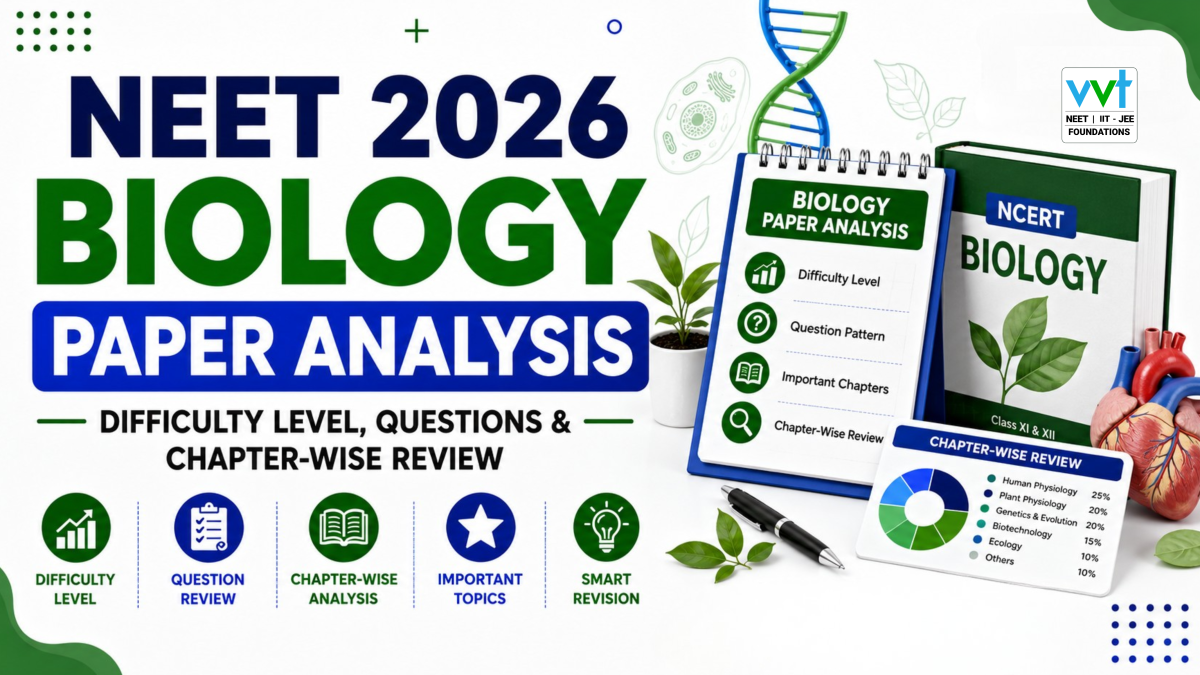
NEET 2026 Biology Paper Analysis (21 June Re-Exam) : Difficulty Level, Questions & Chapter-Wise Review
For many NEET students, Biology is the subject that decides whether the final score feels safe or stressful.
Physics may take time. Chemistry may test formulas, reactions and facts. But Biology carries the biggest weight in NEET. With 90 questions and 360 marks, Biology alone contributes half of the total paper. That is why even small mistakes in Biology can affect the final score in a big way.
The NEET UG 2026 re-exam was conducted on 21 June 2026, and based on early student reactions and subject wise review, the Biology section was generally considered easy to moderate. Most students felt that the questions were manageable if they had revised NCERT properly, especially diagrams, examples, definitions, statement-based lines and repeated concepts.
At VVT Coaching, our view is simple: the Biology paper once again proved that NEET does not reward only memory. It rewards careful NCERT reading, repeated revision, strong concept clarity and mistake free execution.
This detailed Biology paper analysis will help students understand the difficulty level, question pattern, important chapters, Botany and Zoology balance, and most importantly, what future NEET aspirants should learn from the 2026 re-exam.
NEET 2026 Biology paper: overall difficulty level
The Biology section in the NEET 2026 re-exam was mostly viewed as easy to moderate.
This does not mean every question was direct or effortless. Some questions required careful reading, and a few statement based questions tested whether students had understood the NCERT line properly. But overall, Biology was more scoring compared to the pressure students usually face in Physics.
The paper favoured students who had:
- revised NCERT line by line,
- practised statement based MCQs,
- remembered diagrams and examples,
- understood basic concepts instead of only memorising,
- and avoided silly mistakes in easy questions.
Students who depended only on short notes or one time revision may have found some questions tricky. But students with repeated NCERT revision had a clear advantage.
NEET 2026 Biology paper overview
| Particular | Details |
| Exam | NEET UG 2026 Re-Exam |
| Exam Date | 21 June 2026 |
| Biology Marks | 360 marks |
| Total Biology Questions | 90 questions |
| Broad Sections | Botany and Zoology |
| Overall Difficulty | Easy to Moderate |
| Main Nature of Questions | NCERT based, concept based and statement oriented |
| Best Scoring Advantage | Strong NCERT revision |
The key message is clear: Biology was not designed to surprise students with unknown content. It was designed to test whether students had prepared the expected NCERT based concepts with accuracy.
Botany analysis: NCERT lines, examples and plant based concepts mattered
Botany was largely manageable for students who had revised NCERT properly.
Many questions were based on familiar chapters and standard NEET concepts. The section included areas like cell biology, photosynthesis, biological classification, plant reproduction, plant growth, morphology, ecology and plant kingdom.
Students who had revised only broad theory may have made mistakes in example based and statement based questions. Botany often looks easy while reading, but the options in NEET can create confusion if the student does not remember exact NCERT wording.
Important Botany areas noticed in the paper
| Botany Area | Why It Was Important |
| Cell: The Unit of Life | Conceptual and factual questions were possible from NCERT basics |
| Photosynthesis in Higher Plants | Process based understanding and key NCERT points mattered |
| Biological Classification | Examples, features and classification based memory helped |
| Sexual Reproduction in Flowering Plants | Diagrams, process flow and terminology were important |
| Plant Growth and Development | Hormones, growth patterns and NCERT facts mattered |
| Morphology of Flowering Plants | Examples and structural details were useful |
| Ecology related chapters | NCERT definitions and examples were important |
Zoology analysis: scoring, but careful reading was needed
Zoology was also considered easy to moderate. Many students felt comfortable because several questions were familiar and NCERT based.
However, Zoology can be tricky because chapters like Human Physiology, Genetics, Evolution, Reproduction and Human Welfare often contain statement based questions. A student may know the chapter but still lose marks if they rush through the options.
Important Zoology areas students should focus on
| Zoology Area | Why It Matters |
| Human Physiology | Conceptual clarity and process understanding are essential |
| Genetics and Inheritance | Logic-based questions can test more than memory |
| Molecular Basis of Inheritance | NCERT terms, processes and sequence-based understanding matter |
| Reproductive Health and Human Reproduction | Direct and application-based questions are possible |
| Biology in Human Welfare | Diseases, immunity, microbes and examples are important |
| Evolution | Concept clarity and NCERT examples help |
| Biotechnology | Process steps and applications are scoring if revised properly |
Chapter wise Biology paper analysis
Based on the available post exam analysis, several Biology questions came from familiar NCERT areas. Some chapters appeared more strongly than others, especially from cell biology, plant physiology, classification, reproduction and ecology.
| Chapter / Topic Area | Approximate Importance in Paper | Student Takeaway |
| Cell: The Unit of Life | High | Revise organelles, structures and NCERT details carefully |
| Photosynthesis in Higher Plants | High | Process based clarity is important |
| Biological Classification | Moderate to High | Examples and classification features should not be skipped |
| Sexual Reproduction in Flowering Plants | Moderate to High | Diagrams and process flow are important |
| Organisms and Populations | Moderate to High | Ecology definitions and examples matter |
| Morphology of Flowering Plants | Moderate | NCERT examples can decide marks |
| Plant Growth and Development | Moderate | Plant hormones and growth concepts should be revised |
| The Living World | Moderate | Basic taxonomy and definitions remain useful |
| Principles of Inheritance and Variation | Moderate | Genetics concepts must be practised, not just read |
| Plant Kingdom | Moderate | Comparison-based revision helps |
| Cell Cycle and Cell Division | Moderate | Process sequence and phases are important |
| Ecosystem | Moderate | NCERT lines and terms are scoring |
| Molecular Basis of Inheritance | Moderate | DNA/RNA processes need careful revision |
| Respiration in Plants | Low to Moderate | Do not ignore cycles and key steps |
| Microbes in Human Welfare | Low to Moderate | Examples and applications are important |
| Biodiversity and Conservation | Low to Moderate | NCERT facts and definitions should be revised |
This table should not be used as a fixed prediction for future exams. NEET chapter distribution changes every year. But it clearly shows one thing: NCERT based Biology revision continues to be the safest and most reliable strategy.
Class 11 vs Class 12 Biology: what students should understand
The Biology section generally tests concepts from both Class 11 and Class 12.
Many students make the mistake of giving more attention to Class 12 because chapters like Genetics, Reproduction, Biotechnology and Human Welfare feel more familiar during final preparation. But Class 11 Biology is equally important, especially chapters like Cell Biology, Plant Physiology, Human Physiology, Biological Classification, Plant Kingdom and Animal Kingdom.
For NEET 2026 Biology, students who revised both Class 11 and Class 12 consistently were in a better position.
Class 11 Biology focus
- The Living World
- Biological Classification
- Plant Kingdom
- Animal Kingdom
- Morphology and Anatomy
- Cell Biology
- Biomolecules
- Cell Cycle
- Plant Physiology
- Human Physiology
Class 12 Biology focus
- Reproduction
- Genetics
- Molecular Basis of Inheritance
- Evolution
- Human Welfare
- Biotechnology
- Ecology
Was NEET 2026 Biology fully NCERT based?
The Biology section was largely NCERT oriented.
That means students who had revised NCERT textbooks carefully had a clear advantage. But “NCERT based” does not always mean “direct one line question.” Sometimes the question is based on NCERT concepts but framed in a slightly twisted way.
For example, a question may test:
- correct and incorrect statements,
- matching examples,
- Diagram based understanding,
- process sequence,
- Exception based facts,
- NCERT terminology,
- or application of a basic concept.
So students should not think NCERT revision means only reading highlighted lines. NEET Biology requires active NCERT revision.
A smart NCERT revision method includes:
- Reading the line carefully.
- Closing the book and recalling the point.
- Solving MCQs from the same topic.
- Marking mistakes.
- Revising the same line again after a gap.
This is how NCERT becomes scoring.
Conclusion
The NEET 2026 Biology paper once again proved that NCERT is the heart of Biology preparation.
The section was largely easy to moderate and scoring for students who had revised carefully. But it also tested accuracy, memory, statement reading and conceptual clarity.
Students who treated Biology as a serious scoring subject benefited. Students who revised casually may have lost marks in small but painful ways.
At VVT Coaching Chennai, our message is clear:
Biology is not won by last minute reading. Biology is won by repeated NCERT revision, smart testing, error correction and calm execution.
If you are preparing for NEET, remember this lesson from the 2026 Biology paper:
Read NCERT deeply.
Practise MCQs regularly.
Revise diagrams and examples.
Track your mistakes.
Correct them before they repeat.
The NEET 2026 Biology paper analysis shows that students with strong NCERT revision, regular PYQ practice, and clear understanding of diagrams were able to handle the section with better confidence.
Visit: vvtcoaching.com
Call: +91 81221 22333
Scholarships: Up to 100% via VVTSAT!
Also read: Best Way to Attempt NEET Paper in 2026: Time Management and Smart Strategy
FAQs
What was the difficulty level of NEET 2026 Biology?
The Biology section in NEET 2026 was generally considered easy to moderate. Most questions were manageable for students who had revised NCERT properly.
Was NEET 2026 Biology NCERT based?
Yes, the Biology section was largely NCERT oriented. Many questions were based on concepts, examples, diagrams and statement patterns from NCERT.
Was Botany or Zoology tougher in NEET 2026?
Both Botany and Zoology were broadly considered easy to moderate. Some students found statement based questions slightly tricky, especially where exact NCERT reading was required.
How should students prepare Biology after seeing the NEET 2026 paper analysis?
Students should revise NCERT line by line, practise statement based MCQs, revise diagrams and examples, maintain an error notebook and analyse mock tests properly.