

NEET 2026 Physics Paper Analysis
June 22, 2026
NEET 2026 Answer Key: Code 50, 60, 70 & 80 PDF
June 24, 2026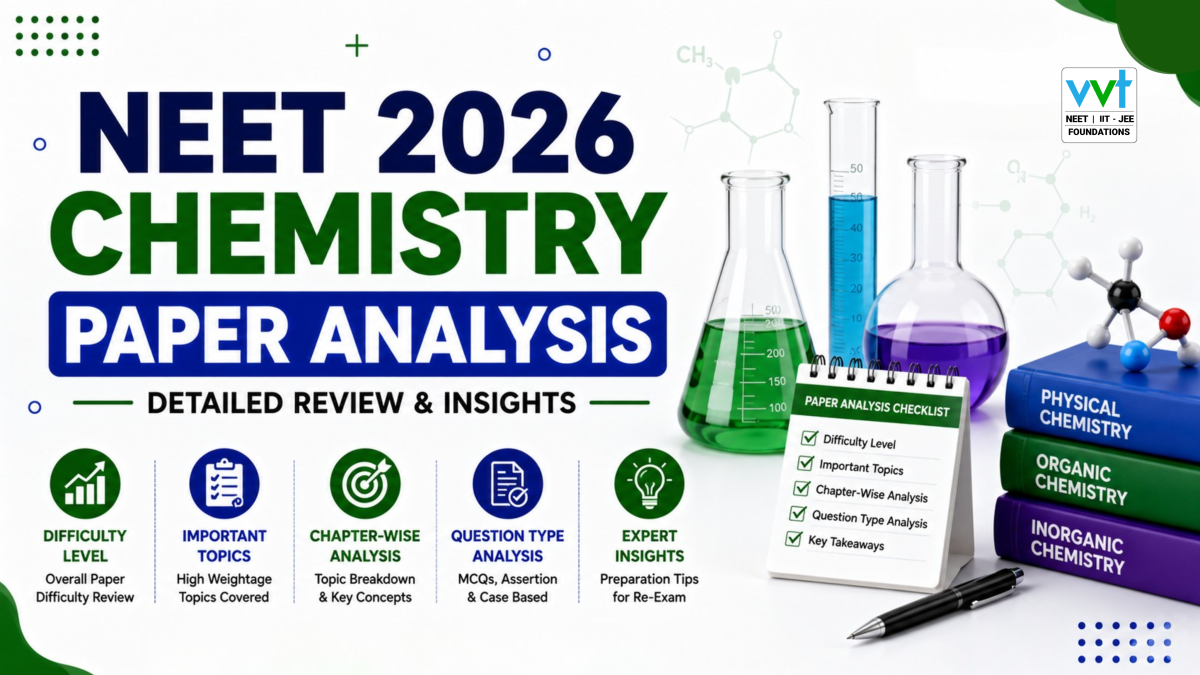
NEET 2026 Chemistry Paper Analysis(21 June Re-Exam) : Difficulty Level, Topic-Wise Review
NEET 2026 Chemistry paper analysis makes it clear that Chemistry was a scoring section for students who revised smartly and practised regularly.
For many students, Physics was time consuming and Biology had lengthy statement based questions. Chemistry felt more balanced, but it still needed accuracy. Students who were clear with formulas, reactions, and NCERT facts were able to attempt the section with more confidence.
The NEET UG 2026 re-exam was scheduled for 21 June 2026, and Chemistry again became one of the most discussed sections after the paper. Students wanted to know whether the section was easy, moderate or tough, which chapters carried more weight, and how much NCERT preparation helped.
Based on available paper analysis observations, the NEET 2026 Chemistry section was generally rated moderate to moderately difficult. It was not a paper that rewarded only memorisation. It tested NCERT knowledge, conceptual clarity, numerical control and reaction understanding.
At VVT Coaching, our expert view is simple:
Chemistry was scoring for students who had revised NCERT properly, practised standard numerical models, and understood Organic and Inorganic concepts instead of only memorising them.
Overall Difficulty Level: Was NEET 2026 Chemistry Easy or Tough?
The Chemistry paper was best described as moderate with a few tricky areas.
It was not fully direct. It was also not impossible. The section had a balanced mix of:
- direct NCERT based questions,
- Concept based questions,
- Formula based numerical questions,
- Reaction based Organic questions,
- Statement type questions,
- and application based Inorganic questions.
Many students felt Chemistry was more manageable than Physics, but not as straightforward as they expected. The main reason was that some questions required more than memory. Students had to apply concepts carefully.
Section Wise NEET 2026 Chemistry Analysis
Chemistry can be divided into three major parts:
- Physical Chemistry
- Organic Chemistry
- Inorganic Chemistry
The 2026 Chemistry paper gave reasonable attention to all three areas, but some chapters stood out more than others.
Physical Chemistry Analysis
Physical Chemistry was moderate for most students, but some questions required careful calculation and proper formula selection.
Important areas included:
- Some Basic Concepts of Chemistry
- Thermodynamics
- Electrochemistry
- Chemical Kinetics
- Solutions
- Redox Reactions
- Equilibrium type concepts
The questions were not only direct formula substitution. In a few cases, students had to understand the condition given in the question before choosing the formula.
What made Physical Chemistry tricky?
Students lost marks mainly because of:
- wrong formula selection,
- calculation mistakes,
- unit confusion,
- rushing numerical questions,
- and spending too much time on one problem.
Organic Chemistry Analysis
Organic Chemistry in NEET 2026 was manageable for students who had strong basics.
The paper tested:
- General Organic Chemistry concepts,
- reaction understanding,
- functional group transformations,
- named reactions,
- Reagent based conversions,
- Biomolecules,
- Amines,
- Aldehydes, Ketones and Carboxylic Acids,
- Hydrocarbons,
- Alcohols, Phenols and Ethers.
The questions were not only memory based. Students had to understand how a reagent behaves, what product is formed, and why a reaction follows a certain pathway.
What made Organic Chemistry important?
Organic Chemistry becomes scoring when students understand the flow of reactions. Students who memorised reactions separately may have felt confused. But students who revised through reaction maps and functional group conversions were more comfortable.
For example, students should not revise Organic as isolated reactions. They should see connections like:
Alcohols → Aldehydes → Acids
Haloalkanes → Alcohols → Ethers
Aldehydes/Ketones → Oximes/Hydrazones/Cyanohydrins
This type of connected revision helps students handle application based questions better.
Inorganic Chemistry Analysis
Inorganic Chemistry played an important role in the 2026 Chemistry paper.
Important areas included:
- Coordination Compounds
- d and f Block Elements
- Chemical Bonding
- Periodic Properties
- p-Block concepts
- NCERT factual lines
- compound-based questions
Coordination Compounds stood out as one of the most important areas. Students who had revised nomenclature, isomerism, bonding, magnetic behaviour and colour related concepts were better prepared.
Why Inorganic Chemistry was scoring
Inorganic Chemistry rewards students who revise NCERT repeatedly. Many questions can be solved quickly if the student remembers the correct NCERT fact or trend.
But Inorganic can also become risky because small details matter. A student may know the chapter generally and still lose marks because of one exception, one colour, one oxidation state or one incorrect trend.
Chapter Wise Chemistry Review
Based on available paper analysis observations, the following Chemistry chapters were important in NEET 2026:
| Chapter / Topic | Importance in Paper | Student Takeaway |
| Coordination Compounds | Very high | Must revise nomenclature, isomerism, bonding and CFSE basics |
| d and f Block Elements | High | Oxidation states, colours, magnetic behaviour and trends matter |
| Biomolecules | High | NCERT-based factual revision is important |
| Amines | High | Basicity, diazonium salts and reactions should be clear |
| Aldehydes, Ketones and Carboxylic Acids | High | Named reactions and conversions are important |
| Thermodynamics | High | Formula clarity and concept application needed |
| Hydrocarbons | Moderate to high | Reaction patterns and aromatic concepts matter |
| Some Basic Concepts of Chemistry | Moderate to high | Mole concept and stoichiometry remain useful |
| Chemical Bonding | Moderate | Shapes, hybridisation and bonding concepts should be strong |
| Electrochemistry | Moderate | Nernst equation and cell concepts need practice |
| Chemical Kinetics | Moderate | Rate law, order and half life questions are important |
| Solutions | Moderate | Colligative properties and formula-based questions matter |
| Redox Reactions | Moderate | Oxidation number and balancing concepts should be revised |
This does not mean students can ignore other chapters. NEET can test any topic from the official syllabus. But these areas clearly show the kind of Chemistry preparation students need: NCERT depth, formula clarity and conceptual application.
Class 11 vs Class 12 Chemistry: Which Was More Important?
The Chemistry paper had questions from both Class 11 and Class 12.
However, Class 12 Chemistry appeared slightly more dominant because of chapters like:
- Coordination Compounds
- d and f Block Elements
- Biomolecules
- Amines
- Aldehydes, Ketones and Carboxylic Acids
- Electrochemistry
- Chemical Kinetics
Class 11 still remained important through:
- Some Basic Concepts of Chemistry
- Chemical Bonding
- Thermodynamics
- Redox Reactions
- Periodic Classification
- Hydrocarbons
So students should not think Class 11 Chemistry can be ignored. Many Class 12 topics are easier only when Class 11 basics are clear.
Question Pattern: What Type of Chemistry Questions Were Asked?
The Chemistry paper included different question types, such as:
- direct MCQs,
- Statement based questions,
- Assertion reason style questions,
- Match type questions,
- numerical questions,
- Reaction based Organic questions,
- NCERT factual questions.
This shows that NEET Chemistry is moving beyond simple memory. Students need to read questions carefully and avoid overconfidence.
A direct looking Chemistry question can still be tricky if it uses words like:
- incorrect,
- not true,
- except,
- most appropriate,
- correct sequence,
- major product,
- increasing order,
- decreasing order.
Many mistakes happen not because students do not know Chemistry, but because they rush the question.
Student Reaction: How Did Students Feel About Chemistry?
Most student reactions suggested that Chemistry was not extremely tough, but it was not completely easy either.
Inorganic Chemistry felt manageable for students who revised NCERT properly. Physical Chemistry was easier for those who practised formula-based numericals, while Organic Chemistry became more comfortable when students had strong GOC basics and regular reaction practice.
But students who depended only on last minute memorisation found the paper slightly challenging, especially in Coordination Chemistry, Thermodynamics, Electrochemistry and Organic reaction-based questions.
The key message is clear:
Chemistry was scoring, but only for students who revised with understanding.
Conclusion
The NEET 2026 Chemistry paper was a balanced but thoughtful section. It was not purely memory based and not impossibly tough. It tested the exact skills NEET students must build:
- NCERT command,
- formula accuracy,
- conceptual clarity,
- reaction understanding,
- calm reading,
- and negative marking control.
Students who had prepared Chemistry with repeated revision and mock analysis found the paper manageable. Students who revised casually or depended only on memorisation found some parts tricky.
At VVT Coaching Chennai, our message is clear:
Chemistry can become your score stabiliser if you prepare it with structure, not fear.
Your revision should not depend on only one method. Read the concept, understand it, practise questions, take tests, and then spend enough time analysing your mistakes.
Read, practise, analyse, correct and retest.
That is how Chemistry marks improve.
And that is exactly how VVT Coaching helps NEET students move from confusion to confidence.
Visit: vvtcoaching.com
Call: +91 81221 22333
Scholarships: Up to 100% via VVTSAT!

FAQs
How was the NEET 2026 Chemistry paper?
The NEET 2026 Chemistry paper was generally moderate to moderately difficult. It included a mix of NCERT based questions, conceptual questions, numerical problems and reaction based Organic Chemistry questions.
Which chapters were important in NEET 2026 Chemistry?
Important chapters included Coordination Compounds, d and f Block Elements, Biomolecules, Amines, Aldehydes Ketones and Carboxylic Acids, Thermodynamics, Hydrocarbons, Some Basic Concepts of Chemistry, Chemical Bonding, Electrochemistry and Chemical Kinetics.
Was Inorganic Chemistry important in NEET 2026?
Yes. Inorganic Chemistry was important, especially Coordination Compounds, d and f Block Elements, Chemical Bonding and Periodic Properties. NCERT-based revision helped students handle this section better.
How should students prepare Chemistry for future NEET exams?
Students should revise Physical Chemistry through formulas and numericals, Organic Chemistry through GOC and reaction maps, and Inorganic Chemistry through NCERT lines, tables and repeated recall.