
NEET 2026 Physics Revision Strategy: Important Formulas & High-Weightage Chapters
May 28, 2026
NEET UG 2026 Fee Refund Deadline Extended: New Last Date, Eligibility & Complete Process
May 30, 2026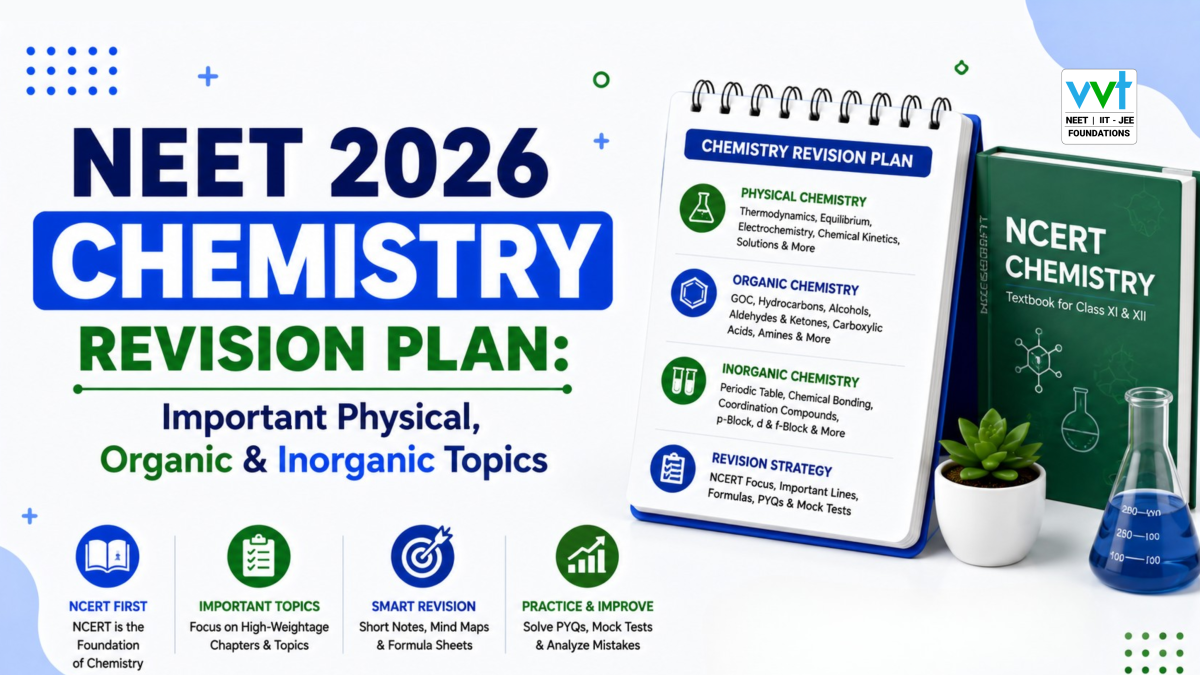
NEET 2026 Chemistry Revision Plan: Important Physical, Organic & Inorganic Topics
VVT Coaching Chennai – Ranked #1 Best NEET & JEE Coaching Centre by Times Now!
Chemistry is one of the most powerful scoring subjects in NEET.
Many students fear Physics because of calculations. Biology becomes lengthy because of NCERT line based revision. But Chemistry sits in the middle. If revised properly, it can become the subject that stabilises your total score.
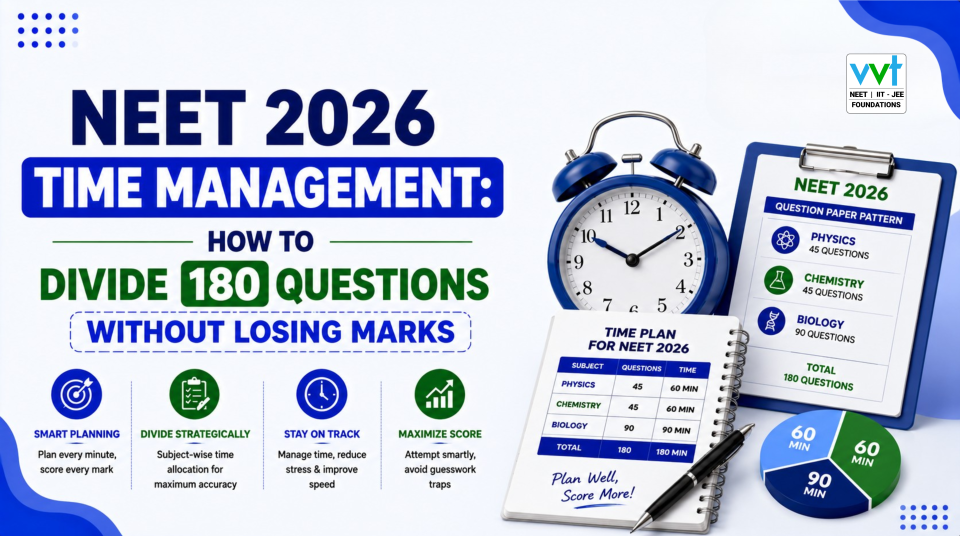
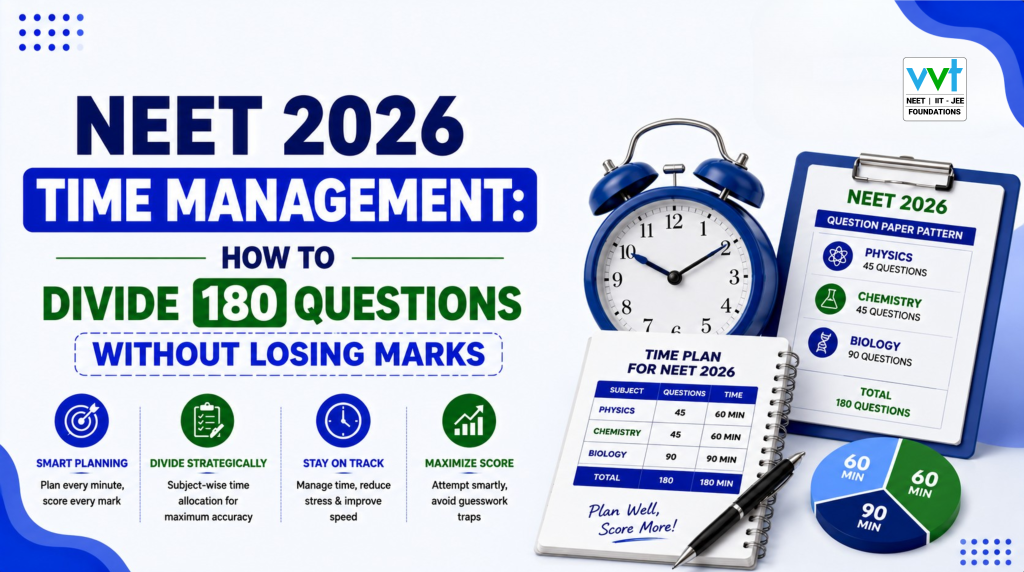
For NEET UG 2026, Chemistry carries 45 questions for 180 marks. The full paper has 180 compulsory questions for 720 marks, and the marking scheme is +4 for a correct answer, -1 for an incorrect answer, and 0 for unanswered questions.
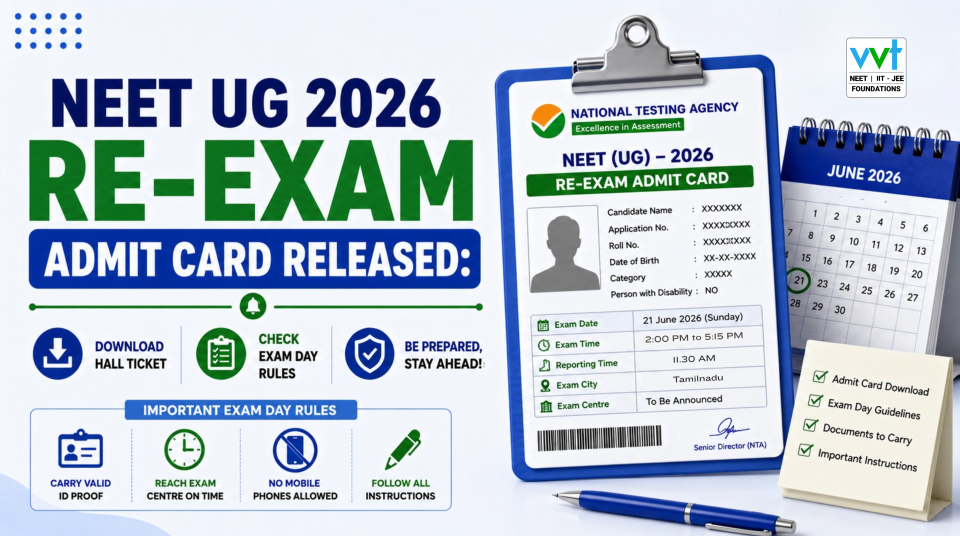
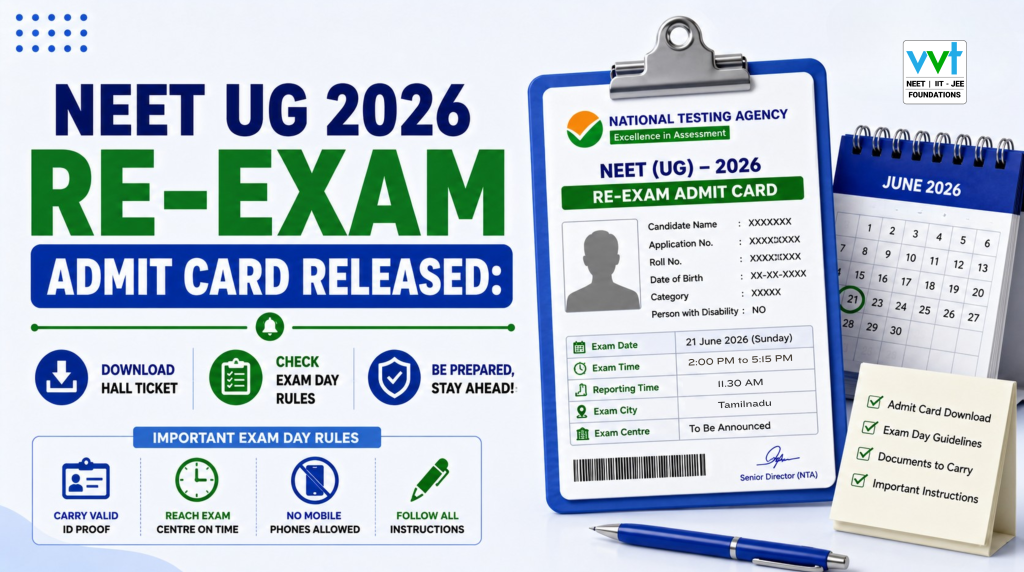
For students preparing for RE-NEET 2026, the official NTA FAQ confirms that the re-examination will be held on 21 June 2026, Sunday, from 2:00 PM to 5:15 PM, including time for formalities.
So the question now is not simply:
“How do I revise Chemistry?”
The better question is:
“How do I revise Physical, Organic and Inorganic Chemistry in a way that actually improves marks?”

Why Chemistry needs a separate revision plan
Chemistry is not one subject in revision. It behaves like three different subjects.
Physical Chemistry needs formulas, units, calculation speed and repeated numerical practice.
Organic Chemistry needs GOC clarity, mechanism understanding, reagent memory and conversion practice.
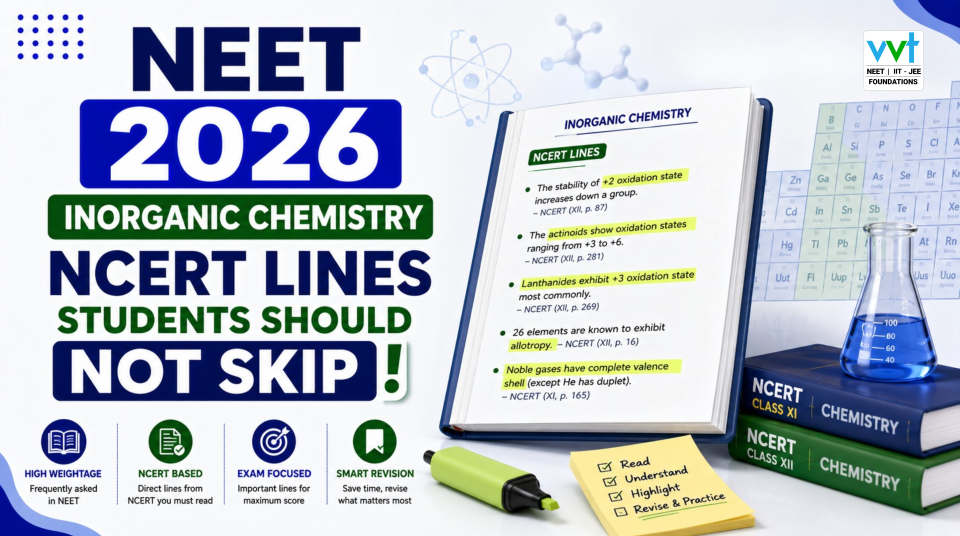
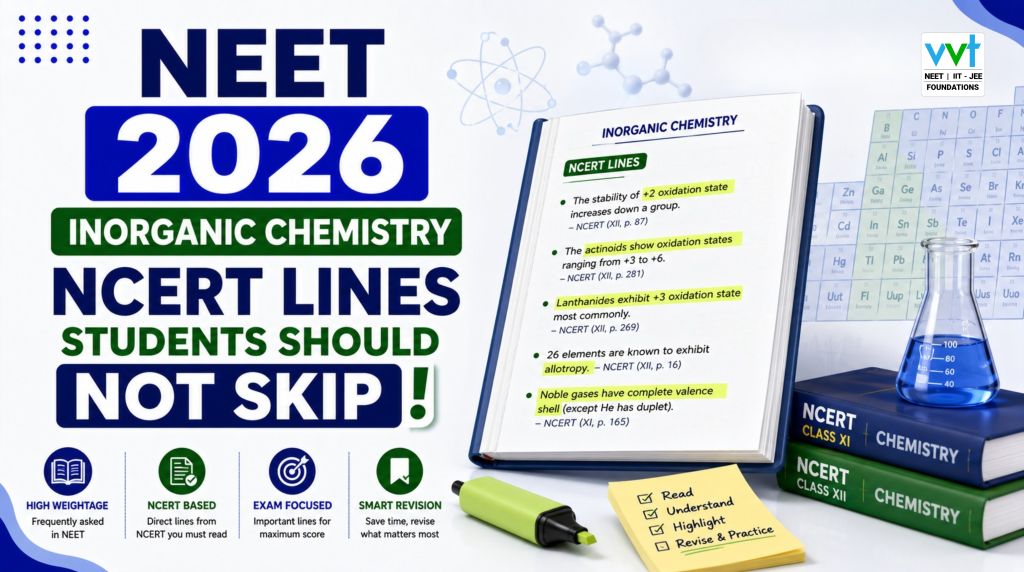
Inorganic Chemistry needs NCERT reading, periodic trends, exceptions, reactions and facts.
That is why revising Chemistry as one big block becomes messy.
A student who says, “I studied Chemistry for 5 hours,” may still not improve if those 5 hours were not divided properly. One student may need more Physical Chemistry practice. Another may lose marks in Organic conversions. Others may forget Inorganic exceptions.
So the right Chemistry revision plan should answer three things:
- What should I revise in Physical Chemistry?
- What should I revise in Organic Chemistry?
- What should I revise in Inorganic Chemistry?
NEET 2026 Chemistry revision: what should your goal be?
Your Chemistry goal should not be only syllabus completion.
Your real goal should be:
Increase accuracy, reduce negative marks, and convert known chapters into guaranteed marks.
This matters because many students lose Chemistry marks through small mistakes:
- wrong formula substitution,
- wrong unit conversion,
- confusion between reagents,
- missing NCERT exceptions,
- overthinking direct questions,
- and spending too much time on one Physical Chemistry numerical.
Chemistry becomes scoring only when revision is followed by MCQ practice and error correction.
Important Physical Chemistry topics for NEET 2026
Physical Chemistry is formula based and practice heavy. Students should not revise it only by reading theory. Every topic must end with numerical practice.
High priority Physical Chemistry topics
| Topic | What to Revise | Smart Revision Tip |
| Some Basic Concepts of Chemistry | Mole concept, concentration terms, stoichiometry | Practise direct numerical problems daily |
| Atomic Structure | Bohr model, quantum numbers, electronic configuration | Revise formulas and common conceptual traps |
| Chemical Thermodynamics | Enthalpy, entropy, Gibbs free energy, spontaneity | Make a compact formula sheet |
| Equilibrium | Ionic equilibrium, pH, buffer, solubility product | Practise step by step numerical models |
| Redox Reactions | Oxidation number, balancing, equivalent concept | Revise common oxidation state changes |
| Electrochemistry | Nernst equation, conductance, cell potential | Practise formula substitution carefully |
| Chemical Kinetics | Rate law, order, half life, Arrhenius equation | Learn graph based and formula based questions |
| Solutions | Raoult’s law, colligative properties | Revise formula conditions and units |
How to revise Physical Chemistry properly
Do not read Physical Chemistry like theory.
Use this method:
- Revise formulas for one topic.
- Write the formulas without looking.
- Solve 15–25 MCQs.
- Mark wrong questions.
- Identify whether the mistake was formula, calculation, unit or concept.
- Re-solve the same type the next day.
Physical Chemistry improves only when formulas become usable under time pressure.
Important Organic Chemistry topics for NEET 2026
Organic Chemistry is not just memorisation. It becomes scoring when students understand reaction flow.
If your GOC is weak, many later chapters feel confusing. So Organic revision should begin with basics and then move into reactions.
High priority Organic Chemistry topics
| Topic | What to Revise | Smart Revision Tip |
| General Organic Chemistry | Inductive effect, resonance, hyperconjugation, acidity/basicity | Revise before all other Organic topics |
| Isomerism | Structural and stereoisomerism basics | Practise identification questions |
| Hydrocarbons | Alkanes, alkenes, alkynes, aromatic compounds | Revise reaction patterns |
| Haloalkanes and Haloarenes | SN1, SN2, elimination, reactions | Compare mechanisms clearly |
| Alcohols, Phenols and Ethers | Preparation, properties, reactions | Make reagent to product flowcharts |
| Aldehydes, Ketones and Carboxylic Acids | Named reactions, conversions, tests | Practise conversions daily |
| Amines | Basicity, preparation, diazonium salts | Revise comparison based questions |
| Biomolecules | Carbohydrates, proteins, vitamins, nucleic acids | NCERT based factual revision |
How to revise Organic Chemistry properly
Organic Chemistry revision should not be only “reading reactions.”
Use this method:
- Make a reaction flowchart for each functional group.
- Revise reagent → effect → product.
- Practise named reactions separately.
- Solve conversion questions.
- Maintain a list of reactions you confuse.
- Revise GOC every few days.
For example, do not just memorise a reagent. Ask:
How does this reagent work? Which functional group does it affect? What type of product is most commonly formed?
That is how Organic starts becoming predictable.
Important Inorganic Chemistry topics for NEET 2026
Inorganic Chemistry is often underestimated.
Students think it is only memory, so they delay it. But in NEET, Inorganic Chemistry can give direct marks if NCERT is revised properly.
High priority Inorganic Chemistry topics
| Topic | What to Revise | Smart Revision Tip |
| Periodic Table and Periodicity | Trends, atomic size, ionisation energy, electronegativity | Revise exceptions carefully |
| Chemical Bonding | VSEPR, hybridisation, MOT, bond order, shapes | Practise shape and comparison questions |
| Coordination Compounds | Nomenclature, isomerism, bonding, CFSE | Very important for direct and concept questions |
| p-Block Elements | Properties, compounds, trends | Revise NCERT lines and reactions |
| d- and f-Block Elements | Electronic configuration, oxidation states, colours, magnetic properties | Make comparison tables |
| Salt Analysis / Practical Chemistry | Tests, reagents, observations | Revise as short factual points |
How to revise Inorganic Chemistry properly
Inorganic Chemistry needs repeated short revision.
Use this method:
- Read NCERT actively.
- Mark exceptions.
- Make short comparison tables.
- Revise reactions and colours.
- Practise statement based questions.
- Revisit the same topic after 48 hours.
Inorganic is not mastered in one long sitting. It improves through repetition.

Also read: NEET 2026 Re-Exam Preparation Plan: How to Use the Extra Time Wisely
Also read: Will NEET 2026 Re-Exam Follow a New Syllabus? Official Update & Student Guide
NEET 2026 Chemistry chapter priority table
There is no official NTA chapter wise weightage list. NTA publishes the syllabus and paper pattern, not guaranteed chapter weightage. So the table below should be used as a revision priority guide, not as a fixed prediction.
| Priority | Physical Chemistry | Organic Chemistry | Inorganic Chemistry |
| Very High | Mole Concept, Thermodynamics, Equilibrium, Electrochemistry | GOC, Hydrocarbons, Aldehydes/Ketones/Carboxylic Acids | Chemical Bonding, Coordination Compounds |
| High | Chemical Kinetics, Solutions, Redox | Haloalkanes, Alcohols/Phenols/Ethers, Amines | Periodic Table, p-Block, d- and f-Block |
| Quick Revision | Atomic Structure, States of Matter-type basics if applicable | Biomolecules, Polymers if included in your syllabus reference | Practical Chemistry, NCERT factual tables |
30 day Chemistry revision plan for NEET 2026
Since the RE-NEET 2026 exam is scheduled for 21 June 2026, students should revise Chemistry in short, focused cycles instead of reading everything randomly.
| Phase | Days | Chemistry Goal | What to Do |
| Phase 1 | Days 1–7 | Formula and NCERT reset | Physical formulas, Inorganic NCERT, GOC basics |
| Phase 2 | Days 8–15 | Build scoring blocks | Organic reactions, Coordination, Equilibrium, Electrochemistry |
| Phase 3 | Days 16–23 | Test and correct | Timed Chemistry section tests + error analysis |
| Phase 4 | Days 24–30 | Final polish | Formula sheet, reaction sheet, NCERT exceptions, mock mistakes |
This plan works because Chemistry needs both memory and practice. Reading alone is not enough. Solving alone without revision is also not enough.
Physical Chemistry revision tips
Physical Chemistry becomes easier when students stop treating every question as new.
Most NEET level Physical Chemistry questions follow models. So revise by model:
- Mole based calculation model,
- pH/buffer model,
- thermodynamics formula model,
- electrochemistry cell potential model,
- kinetics half life model,
- solutions colligative property model.
After every wrong answer, ask:
Was the mistake formula, unit, calculation or concept wrong?
This one question will improve your revision quality.
Common Chemistry mistakes students must avoid
Students often lose Chemistry marks because of avoidable errors:
- revising Physical Chemistry formulas without solving numericals,
- memorising Organic reactions without understanding reagent effect,
- ignoring GOC,
- reading Inorganic only once,
- skipping NCERT examples,
- taking Chemistry mocks without analysing mistakes,
- spending too long on one calculation,
- guessing in confusing reaction questions.
How VVT Coaching Helps Students Revise NEET Chemistry Smarter and Protect Marks
For many NEET students, Chemistry feels like the most scoring subject, but it can also become the section where marks quietly slip away. Formula revision alone does not prevent calculation mistakes in Physical Chemistry. Organic Chemistry reactions are often memorised without understanding the mechanism behind them, while Inorganic Chemistry revision can become confusing when similar NCERT facts are not clearly differentiated.
That is why at VVT Coaching Chennai, Chemistry revision is not treated as simple memorisation. We help students revise Chemistry with a clear focus on Physical Chemistry problem solving, Organic Chemistry concept clarity, Inorganic Chemistry NCERT recall, and mistake correction.
Error Exams — Fix the Chemistry mistakes that keep repeating
Many students lose Chemistry marks in the same patterns again and again:
- making calculation mistakes in Physical Chemistry
- forgetting formulas in Mole Concept, Thermodynamics, Equilibrium, or Electrochemistry
- confusing reagents and mechanisms in Organic Chemistry
- mixing up NCERT facts in Inorganic Chemistry
- overthinking direct questions and losing easy marks
Instead of giving only random practice papers, VVT uses Error Exams based on the student’s own recent mock-test mistakes.
These exams include:
- questions similar to the ones students got wrong or skipped
- repeated practice on common Chemistry trap patterns
- Formula application questions in Physical Chemistry
- reaction and mechanism based questions in Organic Chemistry
- NCERT line based revision questions in Inorganic Chemistry
Result: students do not just revise Chemistry again. They correct the exact mistakes that were reducing their score.
AI-Powered Mock Tests — Show which Chemistry area needs more revision
In Chemistry, every student has a different problem. Physical Chemistry calculations are a common weak area, while Organic conversions continue to cause score loss for many students. Others find it difficult to retain Inorganic Chemistry facts despite repeated NCERT reading.
VVT’s AI-powered mock tests help students identify:
- Topic wise accuracy in Physical, Organic, and Inorganic Chemistry
- time spent per Chemistry question
- chapters where careless mistakes are happening
- areas where formulas are known but applied incorrectly
- Organic reaction types that create confusion
- Inorganic topics where NCERT recall is weak
This helps students revise Chemistry based on performance, not guesswork.
Result: students know whether they should focus more on Physical Chemistry numericals, Organic Chemistry mechanisms, or Inorganic Chemistry NCERT facts instead of revising everything equally.
Personalised Guidance — Build a balanced Chemistry revision plan
Not every student needs the same Chemistry revision plan.
Physical Chemistry requires additional practice for many students, while Organic Chemistry often demands better reaction mapping. Inorganic Chemistry usually improves through repeated NCERT revision, and some students must work on speed because they spend excessive time verifying familiar answers.
At VVT, mentors help students:
- divide Chemistry revision into Physical, Organic, and Inorganic blocks
- revise high-scoring chapters first
- practise formulas with standard numericals
- revise Organic reactions through logic and patterns
- strengthen Inorganic Chemistry using NCERT-focused recall
- avoid spending too much time on low-return areas
Result: students get a Chemistry revision plan that improves accuracy, speed, and confidence before NEET.
Remedy Classes — Fix small Chemistry gaps quickly
Many Chemistry mistakes come from small gaps, not complete chapter weakness.
These may include:
- weak formula recall in Physical Chemistry
- mistakes in units, signs, or calculations
- confusion between similar reactions or reagents
- poor understanding of Organic reaction flow
- forgetting NCERT based Inorganic facts
- difficulty choosing the correct answer under pressure
VVT’s Remedy Classes focus on these exact weak areas.
These sessions are:
- short and focused
- based on actual mock test mistakes
- designed around one micro topic at a time
- followed by quick retesting to confirm improvement
Result: students reduce hesitation in Chemistry and become faster at solving questions accurately.

Get to Know VVT’s Three Friendly Campuses: Always Nearby and Welcoming
VVT has three spots across Chennai, each easy to reach and full of support. No matter where you live, one is close by. Our campuses mix bright classrooms, helpful teachers, and a warm feel to keep you going. Here’s a quick look at each, with a focus on how they help with NEET and staying options.
Adyar Campus: Easy Access and Positive Vibes
Right on busy L.B. Road next to Adyar Ananda Bhavan, this spot is super convenient. Step inside, and you’ll see big, airy rooms where learning feels fun. Staff greet you with smiles, and the energy pushes you to turn weak areas like tough Physics problems into strengths.We also offer hostel facilities here for boys, with clean rooms, meals, and support to make your stay comfortable and focused. No distractions, just a safe place to rest and review after classes.
Adyar Campus (VVT Coaching Centre): “Nibav Buildings”, 4th & 5th Floor, No.23, Old No.11, L.B. Road, Adyar, Chennai – 600020. (Next to Adyar Ananda Bhavan)
Get Directions: Open in google maps!
Anna Nagar Campus: Focus in the City Centre
In Shanthi Colony, Anna Nagar, this campus feels like an extension of home. Good bus links make it simple for city kids. There is no on-site hostel, but nearby options are plentiful for those who need them.
Anna Nagar Campus (VVT Coaching Centre): No.1621, 9th Main Road, Shanthi Colony, Block AI, Anna Nagar, Chennai – 600040.
Get Directions: Open in google maps!
Pallikaranai Girls Campus: Your Safe Place with Full Hostel
This is our special girls-only residential campus in a quiet area. It’s built as a true home away from home, with clean dorms, healthy meals in the canteen, and round-the-clock help.
We offer full hostel facilities here, clean rooms, study areas, and a community of girls supporting each other. It’s perfect if you’re from outside Chennai or just want a focused, safe space.
Pallikaranai (Saraswathi Girls Residential Campus): Plot No. 395 & 396, 1st Main Road, Kamakoti Nagar, Pallikaranai, Chennai – 600100.
Get Directions: Open in google maps
Conclusion
Chemistry can become your score stabiliser in NEET 2026 but only if you revise it correctly.
Do not revise Chemistry as one big subject.
Split it into Physical, Organic and Inorganic.
Revise formulas.
Practise numericals.
Make reaction flowcharts.
Read NCERT for Inorganic.
Solve MCQs every day.
Correct repeated mistakes.
The official NEET 2026 pattern gives Chemistry 45 questions for 180 marks, so even a small improvement in Chemistry accuracy can make a strong difference in your total score.
At VVT Coaching Chennai, our message is simple:
Chemistry score improves when revision becomes structured, tested and mistake free.
That is how students turn Chemistry from a confusing subject into a reliable scoring section.
Visit: vvtcoaching.com
Call: +91 81221 22333
Scholarships: Up to 100% via VVTSAT!
Also read: How VVT Coaching Uses AI to Identify and Solve Your NEET Preparation Struggles
Also read: Best Way to Attempt NEET Paper in 2026: Time Management and Smart Strategy
FAQs
How should I revise Chemistry for NEET 2026?
Revise Chemistry in three parts: Physical Chemistry for formulas and numericals, Organic Chemistry for reactions and mechanisms, and Inorganic Chemistry for NCERT facts, trends and exceptions.
Which Chemistry topics are most important for NEET 2026?
Important topics include Mole Concept, Thermodynamics, Equilibrium, Electrochemistry, Chemical Kinetics, GOC, Hydrocarbons, Aldehydes/Ketones/Carboxylic Acids, Amines, Chemical Bonding, Coordination Compounds, Periodic Table, p-Block and d-Block.
Is NCERT enough for Inorganic Chemistry in NEET?
NCERT is the most important base for Inorganic Chemistry. Students should revise NCERT lines, tables, examples, reactions, trends and exceptions repeatedly.
Can a NEET 2026 Chemistry revision plan improve my score quickly?
Yes. A structured NEET 2026 Chemistry revision plan helps students improve retention, accuracy, and confidence before the exam
What is the best NEET 2026 Chemistry revision plan?
The best NEET 2026 Chemistry revision plan focuses on NCERT revision, formula practice, reaction mapping, and mock-test analysis