
NEET 2026 Exam Day Checklist: What to Carry and What Not to Carry
April 30, 2026
NEET 2026 Last 24 Hours Plan: Final Revision, Sleep, and Exam Day Strategy
May 2, 2026
Best Way to Attempt NEET Paper in 2026: Time Management and Smart Strategy
VVT Coaching Chennai – Ranked #1 Best NEET & JEE Coaching Centre by Times Now!
For most students, NEET preparation feels clear until the final question is asked:
“But how should I actually attempt the paper on exam day?”
That question matters more than students realise. NEET UG 2026 is officially scheduled for 3 May 2026, from 2:00 PM to 5:00 PM, with 180 compulsory questions to be answered in 180 minutes. Reporting starts at 11:00 AM, and the last entry to the exam centre is 1:30 PM. That means the paper is not just about knowledge. It is also about pace, judgment, and emotional control under pressure.
At VVT Coaching, this is the exact difference between “studied a lot” and “performed well.” VVT’s current NEET 2026 exam day and strategy content keeps repeating one very practical idea, students lose marks not only because they do not know answers, but because they start badly, get trapped in the wrong questions, mismanage time, and let one tough patch disturb the rest of the paper.
So if you want the shortest truth about attempting NEET effectively, it is this:
Do not try to conquer the paper.
Try to control it.
First, understand what “attempting effectively” really means
Attempting the NEET paper effectively does not mean trying to solve every question in order. It also does not mean beginning with the hardest subject to prove confidence. A good paper attempt is one that protects:
- early confidence,
- overall time balance,
- answer accuracy,
- and emotional stability across the full three hours.
accuracy and speed both matter, but blind speed is dangerous because negative marking can quietly pull the score down.
The best way to begin the paper
The first 30 minutes of NEET are not the time to prove bravery.
They are the time to build rhythm.
start with familiar, direct questions so the paper begins with control, not panic.
For most students, that means:
- do not start with a long Physics calculation unless you are very sure,
- do not sit on one stubborn question too early,
- and do not let the first difficult question decide the mood of the paper.
A strong NEET paper usually starts with:
clear attempts, early confidence, and low friction marks.
Which subject should you attempt first?
There is no official NTA rule saying you must start with Biology, Chemistry, or Physics. The official pattern only defines the total paper and total time, not subject order. So subject order is purely a strategy choice.
In practice, many students perform best when they begin with the section where they are most confident and can score quickly. For some, this is Biology, while for others, it may be straightforward parts of Chemistry. Effective exam strategies generally support a flexible, selection based approach rather than following a fixed order. Starting with sections that offer quick gains helps build confidence early and reduces the chances of getting stuck or overwhelmed.
So the better rule is not:
“Start with subject X.”
The better rule is:
“Start where your cleanest marks come first.”
Use the three layer question approach
One of the most effective ways to attempt NEET is to mentally divide questions into three layers:
1. Direct and familiar
These are the questions you should collect first. They protect score and confidence.
2. Moderate but doable
These should be attempted in the second pass, once rhythm is established.
3. Lengthy, confusing, or high risk
These should be touched last, not because they are unimportant, but because they are expensive in time and emotional energy.
This layered method is especially useful because it stops the most common exam hall mistake, spending too long too early on a question that does not deserve that much time.
Accuracy vs speed: what matters more?
Both matter, but accuracy must lead.
speed helps you attempt more, but accuracy protects you from negative marking. In NEET, a rushed wrong attempt is often worse than a calm skip.
VVT’s approach fits this perfectly. Its public exam-hall and easy-marks style guidance keeps pushing students toward better decision-making, not reckless attempting. That means:
- attempt with confidence first,
- return to doubtful questions later,
- and avoid turning panic into blind guessing.
A good NEET attempt is not one where you touch the most questions.
It is one where your attempts stayed meaningful.
How to manage time across the paper
The official exam gives you 180 minutes for 180 questions, but it does not tell you how to distribute those minutes subject wise. That is your strategy job.
A practical paper management style is:
- protect the first 30 minutes from panic,
- do not let Physics consume too much time too early,
- use Chemistry as a score stabiliser where possible,
- and keep Biology from becoming carelessly rushed just because it “looks easier.”
Physics is treated as a high risk time consuming section if handled badly, while Chemistry is often positioned as a stabiliser and Biology as a high return score engine.
So effective paper attempting means balancing the full paper, not emotionally over investing in one section.
What to do when a section feels difficult
This is where many papers start slipping.
A student finds the opening Physics set difficult and then carries that stress into Chemistry. Or one Biology block feels tricky, and suddenly they stop trusting themselves in the rest of the paper. one difficult section should not be allowed to emotionally damage the whole exam.
The best response is simple:
- do not judge the full paper from one bad patch,
- mark and move,
- reset your breathing,
- and collect your next easy marks quickly.
A difficult section is a test problem.
Panic about it is a second problem.
Do not create both.
OMR handling is part of paper strategy
Students often talk about “attempt strategy” as if it is only about solving questions.
It is not.
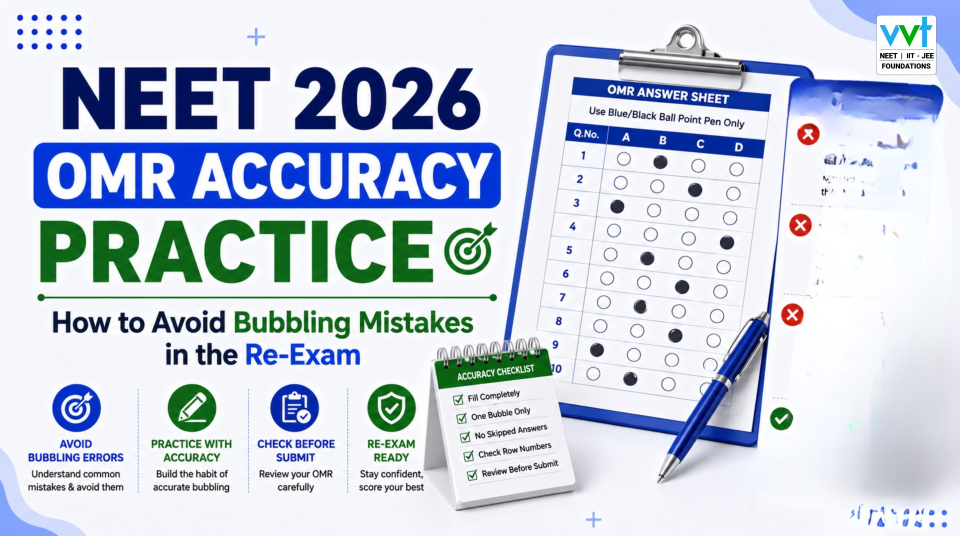
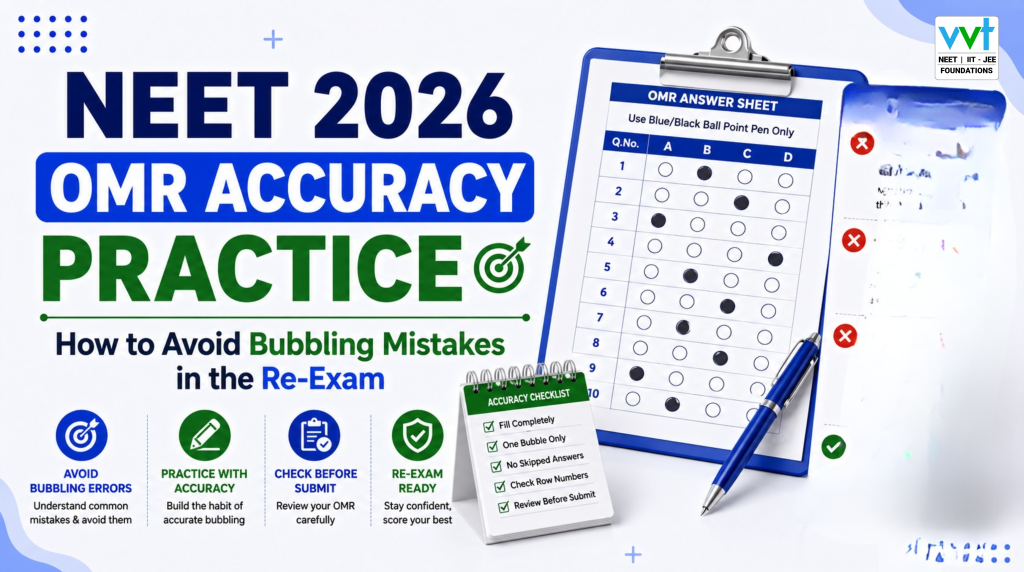
How you mark the OMR sheet is part of how you attempt the paper. VVT’s exam day content repeatedly highlights that students lose marks not only through missed concepts, but also through hurried OMR decisions and rushed end phase bubbling.
So your OMR method should already be practiced before exam day. Whatever method you use, the real rule is:
do not let the final phase become chaotic because the marking process was ignored earlier.
What to do in the last 30–40 minutes
This is the part of the exam where students often become emotional.
They suddenly feel time pressure, start forcing doubtful attempts, and stop making clean decisions. That usually hurts more than it helps. The last phase should become more disciplined, not more desperate.
A better last phase method is:
- return to marked questions calmly,
- attempt only those where your thinking is now clearer,
- protect OMR correctness,
- and avoid random hero attempts in the last few minutes.
What students should practice before the real exam
You cannot suddenly attempt NEET effectively on exam day if you never practiced the paper as a paper.
So before NEET 2026, students should practice:
- at least a few full paper attempts in real timing,
- first-30-minutes control,
- subject transition discipline,
- and a fixed OMR method.
That is how the attempted strategy becomes real.
How VVT Coaching helps students attempt the paper better
This is where VVT Coaching adds value beyond ordinary “tips.”
At VVT, effective paper attempting is not treated as guesswork. Their public NEET content already breaks the exam day challenge into the exact parts students struggle with:
- first 30 minutes,
- Exam centre rules,
- what to carry,
- subject pacing,
- and mistake reduction under pressure.
That gives VVT a very practical authority on this topic. The message is not:
“Be confident.”
The message is:
“Use a system that protects confidence.”
That is a much more useful thing for students.
How VVT Coaching Helps Students Attempt the NEET Paper More Effectively and Protect Marks
Attempting the NEET paper effectively is not only about knowing answers. It is also about knowing how to move through the paper with control.
Many students enter the exam hall with decent preparation but still lose marks because they panic, spend too long on one question, rush OMR bubbling, or let one difficult section affect the rest of the paper. That is why at VVT Coaching Chennai, preparation is not limited to syllabus coverage alone. We train students to handle the full paper strategically.
Because in NEET, students do not lose marks only because they do not know the answer. They also lose marks because they:
- get trapped in lengthy questions
- mismanage time across sections
- make careless errors under pressure
- force doubtful questions too early
- or lose confidence after one difficult patch
Error Exams – Fix the repeated mistakes that spoil paper flow
A major reason students fail to attempt the NEET paper effectively is that the same mistake patterns keep repeating in mocks.
These often include:
- getting stuck in lengthy Physics questions
- misreading Biology statements
- making sign, unit, or formula mistakes in Chemistry
- skipping familiar questions due to panic
- losing marks in questions they usually know well
Instead of giving only more random papers, VVT uses Error Exams built from the student’s own recent mistakes.
These include:
- questions similar to the ones the student got wrong or skipped
- repeated practice on common trap patterns
- short attempt → analysis → re-attempt cycles
- targeted correction until that exact mistake stops repeating
Result: students do not just practise more. They practise more intelligently, which improves paper flow, reduces avoidable negatives, and helps them attempt the actual exam with better control.
AI-Powered Mock Tests – Show students how the paper is really slipping
Many students think they are attempting the paper well, but their marks show otherwise. The problem is that they often do not know where the paper is breaking.
That is why VVT’s AI-powered mock tests do more than show a score. They help students understand:
- topic-wise and section-wise accuracy
- time spent per question
- where overthinking is happening
- where careless errors are costing marks
- whether stamina drops in the later phase of the paper
- which subject is disturbing the overall time balance
This matters because an effective paper attempt is not about speed alone. It is about using time in the right places.
Result: students learn how to avoid wasting time, when to move on, and how to keep the paper balanced from start to finish.
Personalised Guidance – Build a clear paper-attempt strategy
Not every student should attempt the NEET paper in the same way.
Many students should begin with Biology to build momentum. Others need to secure Chemistry quickly. For some, the key is making sure Physics does not consume too much time early.
That is why VVT does not push one fixed strategy for everyone.
Through personalised guidance, mentors help students:
- decide what to attempt first based on strengths
- build a first-pass and second-pass method
- know when to skip and return later
- avoid emotional reactions after one difficult section
- protect confidence throughout the paper
This is important because many students lose marks not from lack of knowledge, but from poor paper management.
Result: students enter the exam hall with a clear attempt plan instead of reacting randomly in real time.
Remedy Classes – Repair the small weak spots that disturb the full exam
Sometimes students do not struggle with the full paper. They struggle because a few small weak points create hesitation at the wrong time.
These may include:
- confusion between similar concepts
- repeated formula slips
- weak micro-topics
- chapter-specific trap questions
- poor question judgment in certain areas
VVT’s Remedy Classes are designed to solve these exact issues quickly and clearly, without forcing students to reopen the whole syllabus.
These sessions are:
- short and focused
- built around one exact weakness at a time
- supported by mock analysis and faculty observation
- followed by quick retesting to confirm the fix worked
Result: students walk into NEET with fewer hesitation zones, which makes the overall paper easier to handle.
Why this matters for attempting the NEET paper effectively in 2026
The biggest paper-attempt mistakes are usually not dramatic. They are the small repeated errors that slowly damage the final score:
- poor time control
- careless bubbling
- panic after one tough section
- wrong attempt decisions
- emotional guessing
- lack of calm before and during the paper
At VVT Coaching Chennai, the goal is simple: not just to help students study harder, but to help them attempt the NEET paper better.
Because in NEET, effective paper attempt happens when effort is supported by:
- correct analysis
- better timing
- smarter correction
- stronger question selection
- and calm execution inside the exam hall
That is how VVT Coaching helps students convert preparation into protected marks and attempt the NEET 2026 paper more effectively.

Get to Know VVT’s Three Friendly Campuses: Always Nearby and Welcoming
VVT has three spots across Chennai, each easy to reach and full of support. No matter where you live, one is close by. Our campuses mix bright classrooms, helpful teachers, and a warm feel to keep you going. Here’s a quick look at each, with a focus on how they help with NEET and staying options.
Adyar Campus: Easy Access and Positive Vibes
Right on busy L.B. Road next to Adyar Ananda Bhavan, this spot is super convenient. Step inside, and you’ll see big, airy rooms where learning feels fun. Staff greet you with smiles, and the energy pushes you to turn weak areas like tough Physics problems into strengths.We also offer hostel facilities here for boys, with clean rooms, meals, and support to make your stay comfortable and focused. No distractions, just a safe place to rest and review after classes.
Adyar Campus (VVT Coaching Centre): “Nibav Buildings”, 4th & 5th Floor, No.23, Old No.11, L.B. Road, Adyar, Chennai – 600020. (Next to Adyar Ananda Bhavan)
Get Directions: Open in google maps!
Anna Nagar Campus: Focus in the City Centre
In Shanthi Colony, Anna Nagar, this campus feels like an extension of home. Good bus links make it simple for city kids. There is no on-site hostel, but nearby options are plentiful for those who need them.
Anna Nagar Campus (VVT Coaching Centre): No.1621, 9th Main Road, Shanthi Colony, Block AI, Anna Nagar, Chennai – 600040.
Get Directions: Open in google maps!
Pallikaranai Girls Campus: Your Safe Place with Full Hostel
This is our special girls-only residential campus in a quiet area. It’s built as a true home away from home, with clean dorms, healthy meals in the canteen, and round-the-clock help.
We offer full hostel facilities here, clean rooms, study areas, and a community of girls supporting each other. It’s perfect if you’re from outside Chennai or just want a focused, safe space.
Pallikaranai (Saraswathi Girls Residential Campus): Plot No. 395 & 396, 1st Main Road, Kamakoti Nagar, Pallikaranai, Chennai – 600100.
Get Directions: Open in google maps
Conclusion
If you want the simplest answer to how to attempt the NEET paper effectively, it is this:
Start with control.
Collect familiar marks early.
Do not let one difficult question steal your paper.
Balance speed with accuracy.
Treat OMR handling as part of the strategy.
And never let panic make decisions for you.
For NEET UG 2026, the official structure is already fixed: 180 questions, 180 minutes, 3 May 2026, 2:00 PM to 5:00 PM. The students who do best are usually not the ones who know the most in theory. They are the ones who know how to turn their preparation into a stable three-hour performance.
That is the VVT Coaching way to look at paper attempting:
not as luck, but as trained exam behavior
Visit: vvtcoaching.com
Call: +91 81221 22333
Scholarships: Up to 100% via VVTSAT!
Also read: How to Fill the NEET 2026 OMR Sheet: Step-by-Step Guide for Students
Also read: NEET 2026 First 30 Minutes Guide: Build Confidence and Manage Time Better
FAQs
What is the best way to attempt the NEET 2026 paper?
The most effective approach is to start with familiar, direct questions, avoid early time sinks, protect accuracy, and use a layered strategy for easy, moderate, and difficult questions.
Should I solve NEET questions in order?
Not necessarily. There is no official NTA rule requiring one strict subject order. Strategy wise, many students perform better by collecting fast, confident marks first.
What should I do in the first 30 minutes of NEET?
Build rhythm, attempt direct familiar questions, and avoid getting trapped in long or confusing problems too early.
How can VVT Coaching help students attempt the NEET paper better?
VVT’s public NEET 2026 content already supports students with exam day rules, first 30-minutes strategy, pacing guidance, and common mistake correction, which helps students convert preparation into better paper handling.