
NEET 2026 Thumb Impression Rules: Size, Format, Both Hands & NTA Guidelines
April 11, 2026
NEET 2026 Cut Off for Government Colleges: Expected Marks, AIQ & State Quota Guide
April 13, 2026
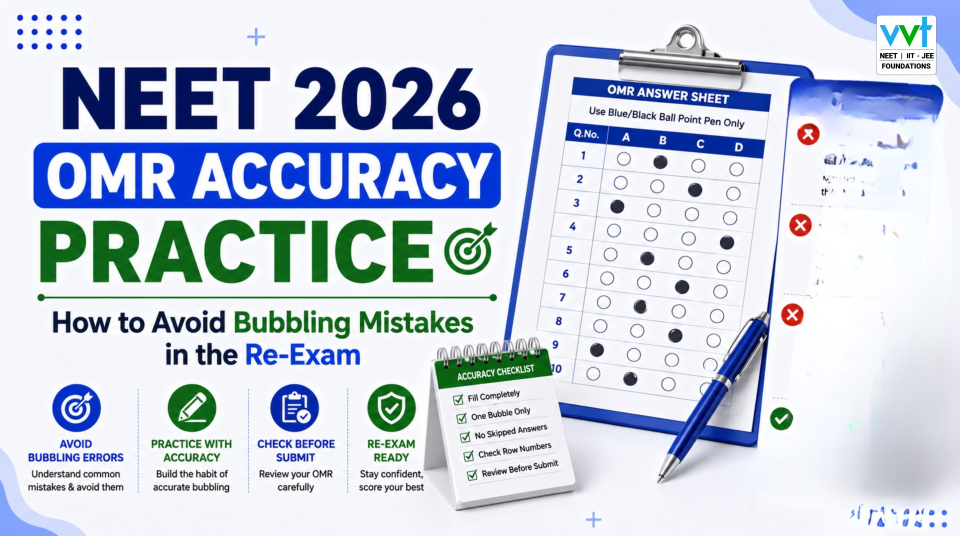
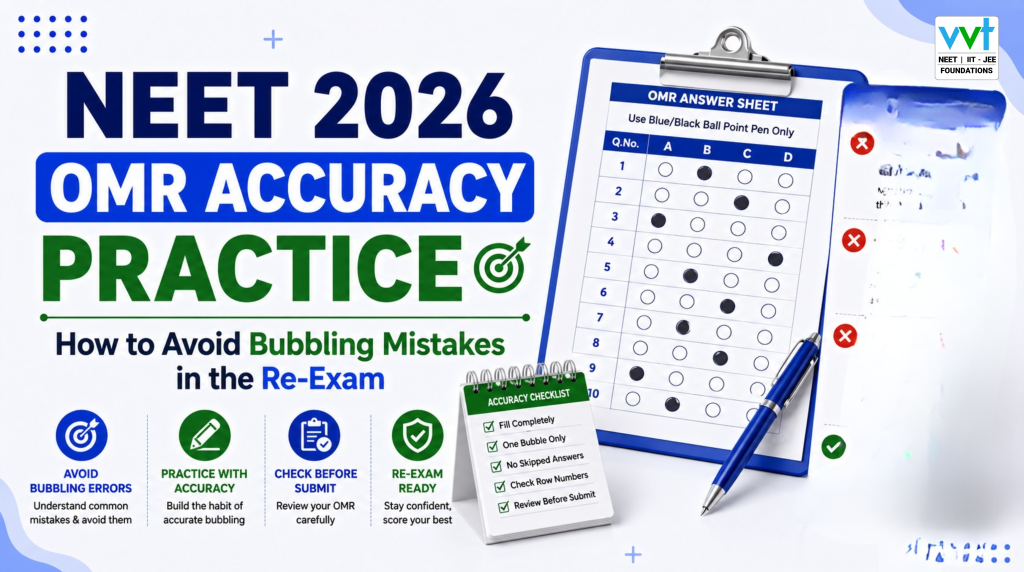
How to Fill the NEET 2026 OMR Sheet: Step-by-Step Guide for Students
VVT Coaching Chennai – Ranked #1 Best NEET & JEE Coaching Centre by Times Now!
For many NEET students, the biggest fear on exam day is not only the paper. It is the possibility of making a careless mistake on the OMR answer sheet. That fear is valid, because NEET is still an offline pen-and-paper exam, and even strong students can lose marks through panic, wrong bubbling, overwriting, or incorrect handling of exam formalities. The official NEET UG 2026 Information Bulletin confirms that the exam will be held on 3 May 2026, will last 180 minutes, and will be conducted in pen-and-paper mode for 180 compulsory questions.
That is exactly why students must understand the OMR process clearly before exam day.
The official Announcement does not present the topic in the same “sample-guide” style as education blogs do, but it does give the rules that matter most candidates must not overwrite important details on the OMR sheet, must not erase or obliterate printed information, must sign the attendance sheet twice, must put their thumb impression on the attendance sheet, must check the test booklet pages, must hand over the answer sheet properly, and must not take the OMR sheet out of the hall. After the exam, NTA will display scanned OMR answer sheets and recorded responses on the official website and allow challenges to OMR grading for a fee of ₹200 per question.
So the real goal of this blog is simple:
not just to explain what the NEET OMR sheet is, but to help students fill it correctly, avoid avoidable mistakes, and walk into the exam hall with more control.

What is the NEET 2026 OMR sheet?
In simple terms, the OMR sheet is your official answer sheet in the NEET exam. It is the document on which your marked responses are recorded and later scanned by NTA. The official announcement repeatedly refers to it as the OMR Answer Sheet, including in the exam-hall rules, unfair-means section, and post-exam display section.
The bulletin also makes it clear that important information connected to your exam identity is linked to the answer-sheet process. It specifically warns against incorrect information or overwriting of the Roll No., Test Booklet No., own name, father’s name, mother’s name, and own signature on the OMR Answer Sheet. That tells students something very important: the OMR sheet is not just for answers. It is also a formal exam document that must be handled carefully.
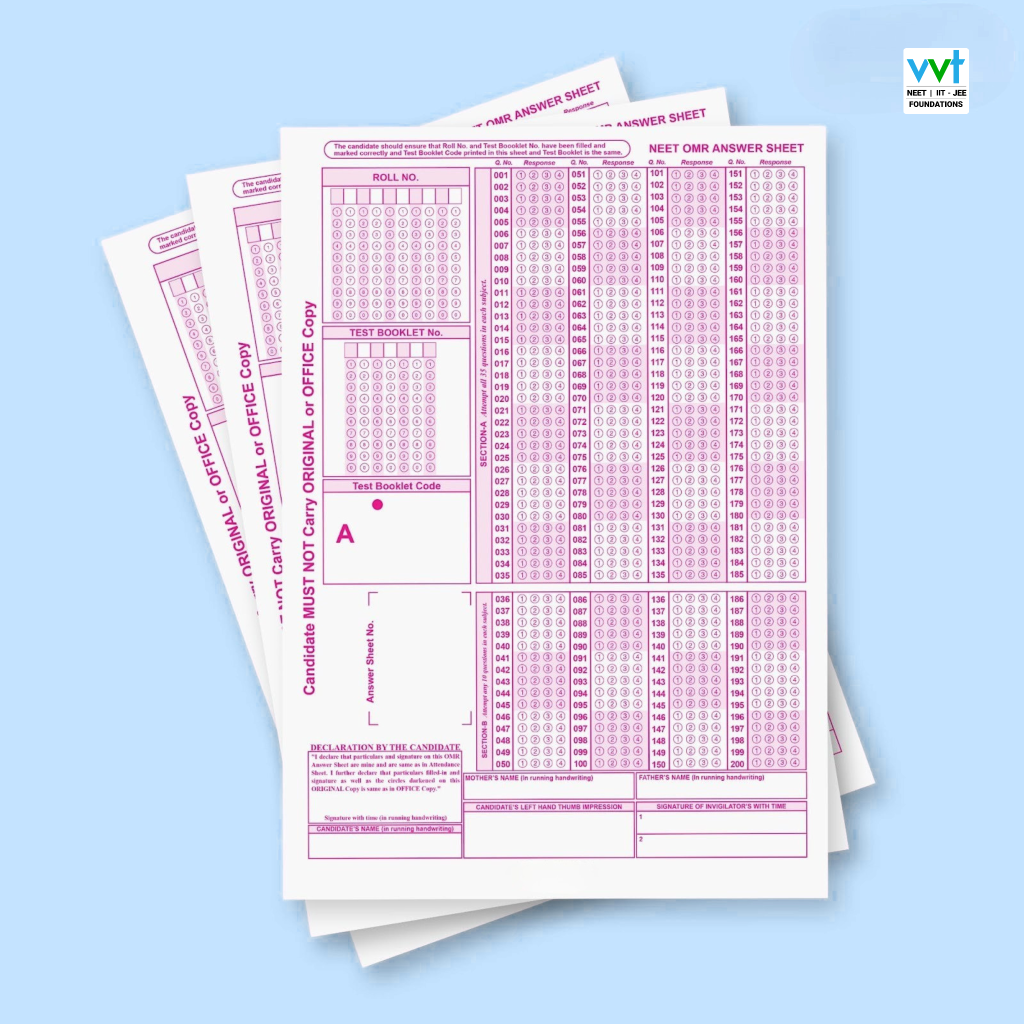
NEET 2026 OMR sheet “sample” — what students should expect
The official 2026 Announcement does not publish a decorative blog-style “sample OMR image” in the explanatory sections, but from the bulletin’s own wording, students can clearly understand the key parts they will deal with on exam day:
- an OMR Answer Sheet for marking responses,
- a Test Booklet Number that must be handled correctly,
- candidate-identification fields that must not be overwritten incorrectly,
- and an Attendance Sheet on which the candidate signs twice and gives a thumb impression.
So the best way to think of the “sample” is this:
The NEET OMR setup includes your answer-marking sheet, your test-booklet identity, and your attendance formalities, all of which must be handled calmly and accurately.
Official NEET 2026 OMR-related guidelines students must know
The official Announcement gives several rules that directly affect how students should behave around the OMR sheet.
First, candidates who come after 1:30 PM are not permitted to enter the examination centre under any circumstances. That matters because rushing in late increases the chance of OMR panic and procedural mistakes.
Second, candidates must bring the required documents, including the printed admit card and one passport-size photograph for the attendance sheet. This is part of the same official exam-day process and helps students complete the formalities smoothly.
Third, candidates must sign twice on the attendance sheet:
- once immediately after the exam starts,
- and once while handing over the answer sheet to the invigilator.
They must also put their thumb impression in the space provided on the attendance sheet.
Fourth, candidates must check that the test booklet contains as many pages as written on the cover page. This is a basic but important instruction.
Fifth, students must not:
- erase or obliterate information printed on the OMR sheet,
- overwrite critical identity details,
- tear or deface the filled OMR sheet,
- take the answer sheet out of the exam hall,
- or allow another candidate to write on their test booklet or OMR sheet.
All of these fall under serious rule violations in the bulletin.
How to fill the NEET 2026 OMR sheet correctly
1) Settle first, then begin carefully
The first OMR mistake often happens before marking even begins students rush. If you enter the hall, open the paper in a hurry, and start acting out of pressure, accuracy drops immediately. VVT’s exam-day guidance strongly supports the opposite approach, reach early, complete entry calmly, and avoid starting the exam in a stressed state.
So the first rule is simple: do not begin the OMR process emotionally. Begin it deliberately.
2) Read the identity and booklet details carefully
The official Announcement specifically names Roll No. and Test Booklet No. among the details where incorrect information or overwriting on the OMR Answer Sheet is a punishable issue. That means students must handle these fields with extreme care.
A good practical habit is to pause before filling in any identifying details and check them twice. One calm minute here is worth far more than one rushed correction later.
3) Check the test booklet before getting deep into the paper
The bulletin instructs candidates to ensure that the test booklet contains all the pages written on the top of the cover page. This should be done early, before getting fully engaged in solving.
This is one of those official rules students often ignore until something goes wrong. Do not ignore it.
4) Mark responses cleanly and consistently
The official announcement does not spend lines explaining bubble-darkening techniques in step-by-step language, but it does make one thing absolutely clear: overwriting, obliterating information, and tampering with OMR responses are serious problems.
That means your response-marking approach should be:
- neat,
- deliberate,
- and consistent.
5) Keep your OMR process simple
Students often overcomplicate the OMR strategy. Some try to solve too much first and bubble too late. Some bubble too frequently and break concentration. The right method is the one you have practiced and can execute without panic.do not depend on last-minute improvisation in the exam hall. Use a repeatable method that protects marks.
6) Complete the attendance formalities properly
One common mistake students make is focusing only on the question paper and forgetting the official attendance process. The bulletin clearly says candidates must sign twice on the attendance sheet and must also put their thumb impression there.
That means NEET exam-day discipline is not just academic. It is procedural too.
Common OMR mistakes NEET students should avoid
1) Overwriting important details
This is directly flagged in the official bulletin. Incorrect information and overwriting of key identity details on the OMR sheet are serious rule issues.
2) Tearing, folding badly, or damaging the OMR sheet
The bulletin specifically lists tearing/defacing of filled OMR Sheets as misconduct.
3) Taking the answer sheet out of the exam hall
This is also explicitly prohibited. The official announcement says taking away the answer sheet, original OMR or office copy out of the examination hall/room is not allowed.
4) Rushing the final stage
While the official Announcement does not phrase this as “do not rush bubbling,” that is the most practical interpretation of its OMR warnings. The more rushed the final minutes become, the more likely students are to overwrite, misread question numbers, or mishandle the answer sheet.

5) Writing or marking casually because “it can be fixed later”
This is one of the worst assumptions. The official rules make it clear that once OMR handling crosses into overwriting, tampering, or defacing, the problem is serious.
What happens to the OMR sheet after the exam?
This is one area where the official Announcement is very clear and very useful.
After the examination, NTA will display the scanned images of OMR Answer Sheets and the recorded responses by the machine for all candidates on the official website. Applicants will be allowed to submit representation against OMR grading by paying a non-refundable processing fee of ₹200 per question challenged. If the challenge is found correct, the data will be updated, though no separate individual intimation is promised.
This is important for two reasons:
- it means OMR handling has a traceable post-exam record,
- and it also means candidates later get a chance to review what the machine recorded.
So the OMR sheet is not just a sheet used in the hall and forgotten. It becomes part of the official post-exam process.
Why VVT Coaching’s guidance matters here
A topic like OMR filling looks simple until students make mistakes in it.
That is why VVT Coaching’s authority on this topic should not come from saying, “OMR is easy.”
It should come from saying something more useful:
Students do not lose marks only because they do not know answers. They also lose marks because they mishandle the process of recording those answers.
VVT’s current NEET 2026 exam-day article already supports this broader point by focusing on entry timing, documents, dress code, barred items, and exam-hall behaviour — all the practical things that help protect marks.
So in a VVT-style interpretation, the OMR message is simple:
- prepare for the paper,
- prepare for the hall,
- and prepare for the answer sheet.
That is how preparation becomes protected marks.
How VVT Coaching Helps Students Avoid OMR Mistakes and Protect Marks
In NEET, students do not lose marks only because they do not know the answer. They also lose marks because they panic while marking responses, mismanage time, bubble the wrong question number, leave OMR filling too late, or carry stress from one difficult section into the next.
That is why at VVT Coaching Chennai, preparation is not limited to syllabus completion alone. We also help students build the accuracy, rhythm, and control needed to handle the real pressure of the OMR-based exam format.
Error Exams — Fix the mistakes that repeat on the answer sheet
Many students make the same type of response mistakes again and again in mocks:
- bubbling the wrong option even after solving correctly
- marking against the wrong question number
- rushing through familiar questions and making avoidable errors
- spending too long on one question and disturbing the rest of the paper
- leaving too much OMR work for the final phase
Instead of giving only more random tests, VVT uses Error Exams built from the student’s own recent mistakes.
These include:
- questions similar to the ones they got wrong or skipped
- repeated practice on trap patterns that create OMR and attempt errors
- short cycles of attempt → analysis → re-attempt
- targeted correction until the same response mistake stops repeating
Result: avoidable OMR-linked mistakes are reduced confidence improves, and students enter the exam hall with better control over the exact patterns that were damaging their score.
AI-Powered Mock Tests — Improve OMR timing before the real exam
One of the biggest OMR mistakes in NEET is poor time use. Some students spend too long solving, some delay bubbling too much, and some do not realise where their paper starts slipping.
That is why VVT’s AI-powered mock tests do more than give a final score. They help students understand:
- topic-wise and section-wise accuracy
- time spent per question
- where overthinking is happening
- where careless errors are costing marks
- whether stamina drops in the later part of the paper
- which subject is disturbing overall paper balance
This helps students learn:
- when to move on from a question
- how to protect OMR filling time
- how to avoid last-minute rushing
- and how to maintain a cleaner response pattern across the full paper
Result: students manage the full paper better, protect their pace, and avoid OMR mistakes caused by poor timing and emotional decisions.
Personalised Guidance — Build a calmer OMR strategy
A student may know the chapter well and still lose marks if they walk into the exam hall tense, distracted, or unsure about how to manage the answer sheet.
That is where personalised mentoring at VVT helps.
Our mentors guide students on:
- how to approach the paper without panic
- when to bubble and how to keep the process consistent
- how to avoid rushing the last phase
- what to do after one difficult section instead of collapsing mentally
- how to prepare a stable exam-day plan for sleep, travel, entry, and paper handling
Result: students feel more settled before the exam begins and make fewer emotionally driven OMR mistakes inside the hall.
Remedy Classes — Repair the small leaks that become OMR losses
Many OMR mistakes do not begin on the answer sheet. They begin much earlier, from small unfinished weak areas such as:
- confusion between similar concepts
- repeated formula slips
- hesitation in specific micro-topics
- chapter-specific traps that waste time
- weak judgment in choosing what to attempt now and what to revisit later
VVT’s Remedy Classes are designed to fix these exact issues quickly and clearly, without forcing students to re-study the entire chapter.
These sessions are:
- short and focused
- built around one exact weakness at a time
- supported by mock analysis and faculty observation
- followed by quick retesting to confirm the fix worked
Result: students walk into NEET with fewer hidden weaknesses, fewer hesitation zones, and fewer response mistakes that show up under pressure.

Conclusion
If you want the most practical answer to “How to Fill NEET 2026 OMR Sheet”, it is this:
- enter early and stay calm,
- check the test booklet pages,
- fill identity details carefully,
- do not overwrite important information,
- follow a clean response-marking method,
- sign the attendance sheet twice,
- give your thumb impression where required,
- hand over the answer sheet properly,
- and never damage, tamper with, or remove the OMR sheet from the hall.
At VVT Coaching, we see OMR handling as part of exam performance, not a small formality. Because in NEET, one careless process mistake can waste the benefit of many correct answers.
Get to Know VVT’s Three Friendly Campuses: Always Nearby and Welcoming
VVT has three spots across Chennai, each easy to reach and full of support. No matter where you live, one is close by. Our campuses mix bright classrooms, helpful teachers, and a warm feel to keep you going. Here’s a quick look at each, with a focus on how they help with NEET and staying options.
Adyar Campus: Easy Access and Positive Vibes
Right on busy L.B. Road next to Adyar Ananda Bhavan, this spot is super convenient. Step inside, and you’ll see big, airy rooms where learning feels fun. Staff greet you with smiles, and the energy pushes you to turn weak areas like tough Physics problems into strengths. We also offer hostel facilities here for boys, with clean rooms, meals, and support to make your stay comfortable and focused. No distractions, just a safe place to rest and review after classes.
Adyar Campus (VVT Coaching Centre): “Nibav Buildings”, 4th & 5th Floor, No.23, Old No.11, L.B. Road, Adyar, Chennai – 600020. (Next to Adyar Ananda Bhavan)
Get Directions: Open in google maps!
Anna Nagar Campus: Focus in the City Centre
In Shanthi Colony, Anna Nagar, this campus feels like an extension of home. Good bus links make it simple for city kids. There is no on-site hostel, but nearby options are plentiful for those who need them.
Anna Nagar Campus (VVT Coaching Centre): No.1621, 9th Main Road, Shanthi Colony, Block AI, Anna Nagar, Chennai – 600040.
Get Directions: Open in google maps!
Pallikaranai Girls Campus: Your Safe Place with Full Hostel
This is our special girls-only residential campus in a quiet area. It’s built as a true home away from home, with clean dorms, healthy meals in the canteen, and round-the-clock help.
We offer full hostel facilities here, clean rooms, study areas, and a community of girls supporting each other. It’s perfect if you’re from outside Chennai or just want a focused, safe space.
Pallikaranai (Saraswathi Girls Residential Campus): Plot No. 395 & 396, 1st Main Road, Kamakoti Nagar, Pallikaranai, Chennai – 600100.
Get Directions: Open in google maps
Conclusion
“Scoring chapters vs time-consuming chapters” is not a motivational phrase. It is one of the most practical ways to think about NEET preparation.
A student who understands this distinction studies differently:
- they lock fast-return chapters earlier,
- they do not get trapped inside one difficult unit for too long,
- they keep revision active,
- and they use mocks to decide where time is actually paying back.
For NEET UG 2026, with the exam fixed for 3 May 2026 and the paper structure already defined, this kind of prioritisation matters even more. NEET is not just about how much you study. It is about how intelligently you use your time.
At VVT Coaching, the real goal is not just syllabus completion.
It is score-focused chapter management.
Visit: vvtcoaching.com
Call: +91 81221 22333
Scholarships: Up to 100% via VVTSAT!
Also read: How VVT Coaching Uses AI to Identify and Solve Your NEET Preparation Struggles!
Also read: Why Students Lose Easy Marks in NEET (And How to Stop It)!
FAQs
Is NEET 2026 still an OMR-based offline exam?
Yes. The official Announcement states that NEET UG 2026 is conducted in pen-and-paper mode for 180 compulsory questions in 180 minutes.
What OMR-related formalities are compulsory on exam day?
Candidates must sign twice on the attendance sheet and put their thumb impression in the space provided.
Can I overwrite details on the OMR sheet if I make a mistake?
The official Announcement specifically warns against incorrect information and overwriting of key details on the OMR Answer Sheet.
What is the best way to handle the NEET 2026 OMR sheet?
The best way to handle the NEET 2026 OMR sheet is to use a method you have already practised in mocks. Students should not rush the NEET 2026 OMR sheet at the end or bubble carelessly under pressure. A calm and consistent approach to the NEET 2026 OMR sheet helps reduce avoidable mistakes.
Will I be able to see my OMR sheet after the exam?
Yes. NTA says it will display scanned images of OMR Answer Sheets and recorded responses on the official website after the exam.