
List of Competitive Exams in 2026: Complete Exam Calendar, Strategy & Preparation Guide
December 23, 2025
NEET Cut Off 2026: Category-Wise Expected Marks & Percentile – VVT Coaching
December 28, 2025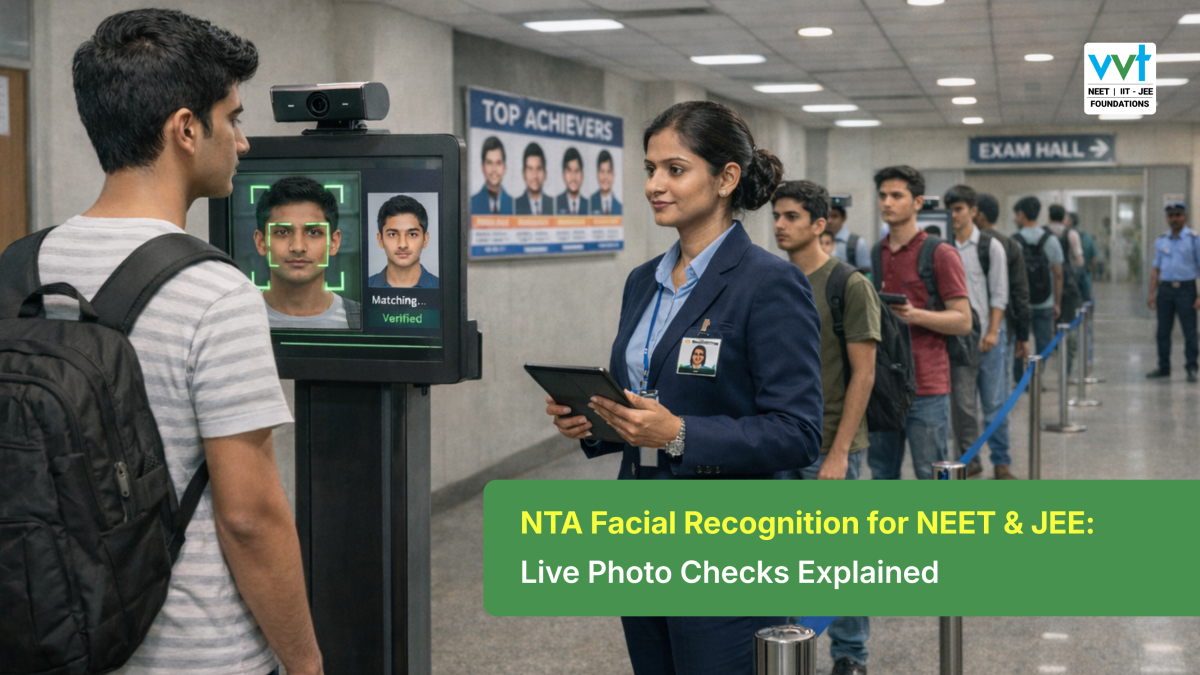
NTA to Roll Out Facial Recognition Live Photo Checks for NEET & JEE: What Students Must Know
VVT Coaching Chennai – Ranked #1 Best NEET&JEE Coaching Centre by Times Now!
The National Testing Agency (NTA) is set to introduce live facial recognition and photo verification checks for high-stakes entrance exams like NEET and JEE. This move marks one of the biggest changes in exam security protocols in recent years and directly impacts lakhs of aspirants preparing for competitive exams.
If you are appearing for NEET UG or JEE Main / Advanced, this update is not just news, it affects how you fill forms, how you enter exam centres, and how you prepare mentally for exam day.
Why NTA Is Introducing Facial Recognition for NEET & JEE
Over the past few years, NTA has faced serious challenges related to exam integrity, including:
- Impersonation cases
- Dummy candidates
- Photo mismatch at exam centres
- Organized cheating rackets
To address these issues, NTA plans to implement live photo capture and facial recognition verification, linked directly to:
- Application form photograph
- Aadhaar or government ID (where applicable)
- Exam centre live camera feed
This move aligns with global testing standards and aims to ensure that only the genuine candidate appears for the exam.
What Is Live Facial Recognition & Photo Verification?
Live facial recognition means:
- Your face is scanned in real time using a camera
- The system matches your live image with:
- The photo uploaded in the application form
- Previous verification records
- Entry is allowed only if the match is successful
Based on current updates, verification is expected mainly at two points:
- During application: live photo capture (webcam/mobile).
- At exam centre entry: real-time facial authentication
Any additional checks (if introduced) will be confirmed in the official information bulletin.
How the Facial Recognition Process Will Work (Step-by-Step)
| Stage | What happens (confirmed/expected from current updates) |
| Application Form | Upload scanned photo + capture live photo (webcam/mobile) |
| Exam Centre Entry | Real-time facial authentication/verification before entry |
| If mismatch happens | Manual verification / additional checks (don’t panic; cooperate) |
If your application photo is unclear or outdated, verification can take longer at the centre. Use a clear, recent photo and follow the official photo rules to avoid delays.
Key Student Concerns Answered Clearly
Will Aadhaar be mandatory?
Aadhaar-based face authentication was used in a pilot at select centres, but the exact ID requirement for all candidates will be clarified in the official exam bulletin. Keep a valid government photo ID ready.
Can exam entry be denied?
If verification doesn’t match instantly, candidates may face:
- Delayed entry
- Manual verification / additional checks
- Final decision will follow centre protocols and official instructions.
Will this increase exam-day stress?
For unprepared students, yes. For students who know the process and prepare calmly—no.
This is where structured coaching plays a huge role.
Why This Change Matters More Than You Think
Facial recognition is not just a security measure—it changes:
- Exam-day mindset
- Preparation discipline
- Error tolerance
Students who panic easily, rush form filling, or ignore guidelines are more vulnerable.
At VVT Coaching, exam readiness includes:
- Academic preparation
- Process awareness
- Mental conditioning
How VVT Coaching Helps Students Adapt to NTA’s New Rules
1. Error Exams – Training Your Brain to Stay Calm Under Scrutiny
When students are watched closely, small mistakes multiply:
- Misreading questions
- Second-guessing answers
- Panic-driven errors
VVT’s Error Exams are designed to eliminate this.
Instead of generic full tests, students face:
- Questions they previously got wrong or skipped
- Patterns where anxiety caused careless errors
- Repeated exposure to weak areas until confidence replaces fear
This builds mental stability, which is crucial when facial recognition and live monitoring are involved.
Especially effective for high-stakes NEET & JEE sections where one mistake can shift ranks.
2. AI-Powered Test Series – Simulating the New Exam Reality
Traditional mocks tell you only one thing: “Score: 145/300.”
That’s not enough in an era of strict surveillance.
VVT’s AI-powered test ecosystem reveals:
- Accuracy drop under time pressure
- Questions where students hesitate due to fear of making mistakes
- Time spent freezing vs solving
- Chapters where confidence collapses under monitoring
- How your behaviour compares with top performers
Students don’t just practice questions, they practice composure.
This is exactly what students need before walking into a strict, closely monitored exam environment.
3. Personalized Guidance – Because Stress Is Personal
Two students with the same syllabus knowledge can perform very differently under:
- Facial recognition checks
- Biometric verification
- Live invigilation
VVT’s Personalized Guidance leaves no student guessing.
Students get:
- A mentor who tracks mock history, error trends, and stress patterns
- Weekly guidance on what to fix — not just what to study
- Help balancing school, boards, and competitive exams
- Constant accountability so procrastination doesn’t creep in
This human layer is critical when exams become more process-heavy and psychologically demanding.
4. Remedy Classes – Fix Confidence Gaps Before They Become Panic
Facial recognition systems don’t cause stress — unprepared minds do.
When analytics show:
- Physics accuracy dropping after 90 minutes
- Organic Chemistry causing hesitation
- Maths sections leading to time panic
VVT doesn’t wait and hope things improve.
Remedy Classes act like surgical repair:
- Targeted concept correction
- Guided problem-solving under exam-like conditions
- Confidence rebuilding in weak areas
Students walk into the exam hall knowing:
“I’ve faced worse pressure in practice.”

What Students Must Do Now (Action Checklist)
- Upload clear, recent photographs
- Avoid filters, shadows, or low resolution
- Follow photo specifications strictly
- Carry valid ID proof
- Stay calm during verification
- Practice under exam-like pressure
Final Takeaway: Smart Preparation Beats Fear
NTA introduced facial recognition not to scare students but to protect genuine aspirants.
Students who:
- Understand the process
- Prepare under real exam conditions
- Train your mind, and at the same time, strengthen your concepts so that you will eventually walk into the exam hall confident and composed.
With VVT Coaching’s AI-powered preparation, error-based learning, and personalized guidance, students don’t just prepare for exams, they prepare for every situation inside the exam hall.
Frequently Asked Questions (FAQs)
1.Has NTA confirmed facial recognition for NEET and JEE?
NTA has included live photo capture and facial verification in its strengthened security plan and is expected to implement it from JEE Main 2026. The official bulletin will confirm the final process details.”
2. Will this apply to all exam centres?
Implementation may begin in phases (pilot/selected centres first) and expand. Exact rollout coverage will be clarified in official updates/bulletins
3. Can hairstyle or spectacles cause issues?
Major changes between application photo and exam appearance can trigger mismatch alerts.
4. Is this system foolproof?
No system is perfect—but preparation and awareness reduce risk drastically.