
NEET 2026 Application Form Released: Dates, Fees, Registration Steps & Complete Guide by VVT Coaching
February 8, 2026
NEET 2026 Registration Fees (Official): Category-Wise Charges + Payment Guide & Common Mistakes
February 10, 2026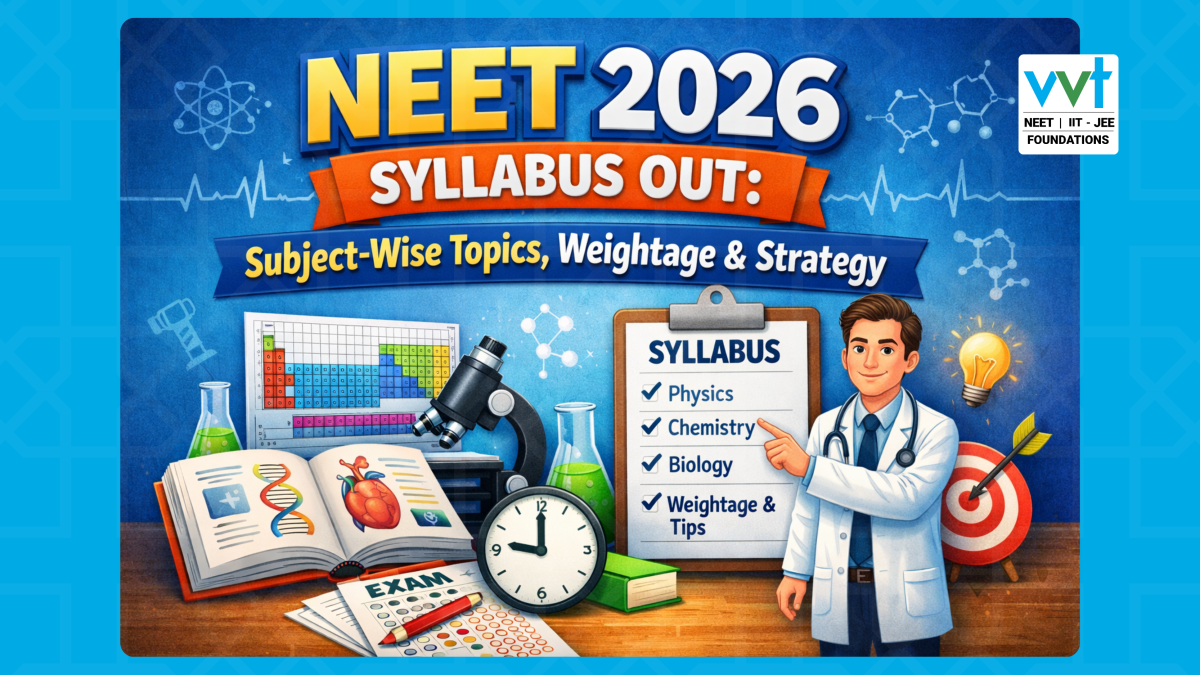
NEET 2026 Syllabus (Out): Complete Subject-Wise Breakdown, Weightage & Smart Preparation Guide
VVT Coaching Chennai – Ranked #1 Best NEET & JEE Coaching Centre by Times Now!
The NEET 2026 syllabus has been officially released based on the latest NCERT Class 11 and 12 curriculum prescribed by NTA.
For NEET aspirants, understanding what to study and what not tois critical. Many students lose marks not because they didn’t study hard, but because they studied irrelevant or deleted portions.
This detailed guide will help you:
- Understand the updated NEET 2026 syllabus
- Identify deleted and reduced topics
- Know subject-wise chapter distribution
- Focus on high-weightage areas
- Plan preparation the right way
NEET 2026 Syllabus Overview (What Has Changed This Year)
NEET 2026 follows NCERT rationalisation, meaning certain topics have been removed or reduced across Physics, Chemistry, and Biology. Students must align preparation strictly with the updated syllabus to avoid wasted effort.
| NEET 2026 Syllabus Overview | ||
| Subject | Total Chapters Included | Removed Topics (As per NCERT Rationalisation) |
| Physics | 19 Chapters (Classes 11 & 12 combined) | Class 11: – Units & Dimensions (reduced emphasis) – Motion in a Plane (some vector portions) – Work, Energy & Power (few examples removed)Class 12: – Communication Systems (deleted) – Semiconductors (partially reduced) – Nuclei (some numerical examples removed) |
| Chemistry | 30 Chapters (Classes 11 & 12 combined) | Class 11: – States of Matter (partially reduced) – Hydrogen (deleted)Class 12: – Polymers (partially removed) – Chemistry in Everyday Life (deleted) – Surface Chemistry (minor reduction) |
| Biology | 38 Chapters (Classes 11 & 12 combined) | Class 11: – Transport in Plants (minor topics removed) – Mineral Nutrition (reduced) – Digestion & Absorption (some sections removed)Class 12: – Reproduction in Organisms (deleted) – Strategies for Enhancement in Food Production (deleted) – Environmental Issues (reduced) |
This table clearly shows how many chapters are included and which topics have been deleted or reduced. Students should treat this as the syllabus baseline.
Subject-Wise NEET 2026 Syllabus
To help aspirants get a bird’s-eye view, NEET 2026 syllabus is divided into Biology, Physics, and Chemistry, covering both Class 11 and Class 12 NCERT topics.
| Subject-Wise NEET 2026 Syllabus | ||
| Biology | Physics | Chemistry |
| Diversity of Living Organisms Change | Physics And Measurement | Some Basic Concepts of Chemistry |
| Structural Organization in Plants & Animals Change | Kinematics | Structure of Atom |
| Cell Structure and Function No Change | Laws Of Motion | Classification of Elements and Periodicity in Properties |
| Plant Physiology | Work, Energy, and Power | Chemical Bonding and Molecular Structure |
| Human Physiology | Rotational Motion | States of Matter: Gases and Liquids |
| Reproduction | Gravitation | Thermodynamics |
| Genetics & Evolution | Properties of Solids and Liquids | Equilibrium |
| Biology and Human Welfare | Thermodynamics | Redox Reactions |
| Biotechnology and its Applications | Kinetic Theory of Gases | Classification of Elements and Periodicity in Properties |
| Ecology and Environment | Oscillation and Waves | P-Block Elements |
| – | Electrostatics | d- and f-Block Elements |
| – | Current Electricity | Coordination Compounds |
| – | Magnetic Effects of Current and Magnetism | Purification and Characterisation of Organic Compounds |
| – | Electromagnetic Induction and Alternating Currents | Some Basic Principles of Organic Chemistry |
| – | Electromagnetic Waves | Hydrocarbons |
| – | Optics | Organic Compounds Containing Halogens |
| – | Dual Nature of Matter and Radiation | Organic Compounds Containing Oxygen |
| – | Atoms and Nuclei | Organic Compounds Containing Nitrogen |
| – | Electronic Devices | Biomolecules |
| – | Experimental Skills | Principles Related to Practical Chemistry |
This table is ideal for students who want a quick checklist before diving deep into individual subjects.
NEET Biology Syllabus 2026 (Most Scoring Section)
Biology carries 50% of the NEET paper, making it the highest scoring subject. Questions are directly NCERT-based, especially from diagrams, examples, and in-text explanations.
| NEET Biology Syllabus 2026 | ||
| Unit | Chapter / Area | Important Topics for NEET |
| Unit 1 | Diversity in Living World | Five Kingdom Classification, Taxonomy & Binomial Nomenclature, Salient Features of Monera, Protista, Fungi, Viruses & Viroids, Plant Kingdom (Algae to Gymnosperms), Animal Kingdom (Non-chordates & Chordates) |
| Unit 2 | Structural Organisation in Animals & Plants | Morphology of Flowering Plants, Anatomy of Root, Stem & Leaf, Important Plant Families (Malvaceae, Leguminosae, Gramineae), Animal Tissues, Frog Organ Systems (brief) |
| Unit 3 | Cell Structure & Function | Prokaryotic vs Eukaryotic Cell, Cell Organelles, Biomolecules, Enzymes, Cell Cycle, Mitosis & Meiosis |
| Unit 4 | Plant Physiology | Photosynthesis (Light & Dark Reactions, C3 & C4 Pathway), Respiration (Glycolysis, TCA, ETS), Plant Growth Regulators |
| Unit 5 | Human Physiology | Breathing & Respiration, Circulation & Heart, Excretory System, Neural Control, Endocrine System, Locomotion & Disorders |
| Unit 6 | Reproduction | Sexual Reproduction in Flowering Plants, Human Reproductive System, Gametogenesis, Menstrual Cycle, Contraception & ART |
| Unit 7 | Genetics & Evolution | Mendel’s Laws, Chromosomal Disorders, DNA Structure & Replication, Transcription & Translation, Evolution Theories, Hardy-Weinberg Principle |
| Unit 8 | Biology & Human Welfare | Human Diseases & Pathogens, Immunity & Vaccines, Microbes in Human Welfare, Drug & Alcohol Abuse |
| Unit 9 | Biotechnology | Recombinant DNA Technology, GM Crops (Bt), Insulin & Vaccine Production, Gene Therapy, Biosafety Issues |
| Unit 10 | Ecology & Environment | Ecosystem & Energy Flow, Population Interactions, Biodiversity & Conservation, Environmental Issues |
Why Biology Decides Your Rank
- Direct NCERT lines
- Diagram-based questions
- High predictability of questions
At VVT Coaching, Biology is taught with line-by-line NCERT decoding, ensuring students don’t miss easy marks.
NEET Physics Syllabus 2026 (Concept + Numericals)
Physics tests both conceptual clarity and calculation accuracy.
Most students lose marks due to poor time management and weak fundamentals.
| NEET Physics Syllabus 2026 | ||
| Unit No. | Unit Name | Topics Covered |
| Unit 1 | Physics and Measurement | Units, SI system, errors, dimensions, significant figures |
| Unit 2 | Kinematics | Motion, vectors, projectile motion, circular motion |
| Unit 3 | Laws of Motion | Newton’s laws, friction, circular motion |
| Unit 4 | Work, Energy and Power | Work-energy theorem, collisions, power |
| Unit 5 | Rotational Motion | Torque, angular momentum, moment of inertia |
| Unit 6 | Gravitation | Kepler’s laws, satellites, escape velocity |
| Unit 7 | Properties of Solids and Liquids | Elasticity, viscosity, surface tension, fluid mechanics |
| Unit 8 | Thermodynamics | Laws of thermodynamics, processes |
| Unit 9 | Kinetic Theory of Gases | Gas laws, RMS speed, mean free path |
| Unit 10 | Oscillations and Waves | SHM, waves, sound, beats |
| Unit 11 | Electrostatics | Charges, fields, capacitors |
| Unit 12 | Current Electricity | Ohm’s law, circuits, Kirchhoff’s laws |
| Unit 13 | Magnetic Effects & Magnetism | Biot–Savart law, Ampere’s law |
| Unit 14 | Electromagnetic Induction & AC | Induction, transformers, AC circuits |
| Unit 15 | Electromagnetic Waves | Spectrum and applications |
| Unit 16 | Optics | Ray optics, wave optics |
| Unit 17 | Dual Nature of Matter | Photoelectric effect, de Broglie waves |
| Unit 18 | Atoms and Nuclei | Atomic models, nuclear physics |
| Unit 19 | Electronic Devices | Semiconductors, diodes, logic gates |
| Unit 20 | Experimental Skills | Vernier calipers, pendulum, prism, diode experiments |
How to Prepare Physics Smartly
- Master formulas + applications
- Practice NCERT examples
- Focus on error analysis, not just mock scores
NEET Chemistry Syllabus 2026 (NCERT Is Non-Negotiable)
Chemistry questions are heavily NCERT-driven, especially Inorganic and Organic Chemistry.
| NEET Chemistry Syllabus 2026 | ||
| Branch | Unit & Topics | Important Topics |
| Physical Chemistry | Unit 1: Some Basic Concepts | Mole concept, atomic & molecular masses, chemical equations, stoichiometry, empirical & molecular formula |
| Unit 2: Atomic Structure | Bohr model, hydrogen spectrum, quantum numbers, electronic configuration, de Broglie relation, Heisenberg uncertainty principle | |
| Unit 3: Chemical Bonding & Molecular Structure | Ionic & covalent bonding, VSEPR, hybridization, resonance, molecular orbital theory, bond order, hydrogen bonding | |
| Unit 4: Chemical Thermodynamics | First & second law of thermodynamics, enthalpy, Hess’s law, Gibbs energy, spontaneity, heat capacity | |
| Unit 5: Solutions | Concentration terms, Raoult’s law, colligative properties, van’t Hoff factor | |
| Unit 6: Equilibrium | Chemical & ionic equilibrium, Le Chatelier principle, buffer solutions, solubility product | |
| Unit 7: Redox & Electrochemistry | Oxidation number, balancing redox reactions, electrochemical cells, Nernst equation, fuel cells | |
| Unit 8: Chemical Kinetics | Rate law, order & molecularity, Arrhenius equation, activation energy, collision theory | |
| Inorganic Chemistry | Unit 9: Classification & Periodicity | Modern periodic table, s/p/d/f block, periodic trends (atomic/ionic radii, ionization energy, electron affinity, valence) |
| Unit 10: P-Block Elements | Group 13-18 elements, trends, properties, reactivity, first element special behavior | |
| Unit 11: d- & f-Block Elements | Transition elements, properties, K₂Cr₂O₇ & KMnO₄, lanthanoids, actinoids, lanthanoid contraction | |
| Unit 12: Coordination Compounds | Werner’s theory, ligands, coordination number, chelation, nomenclature, isomerism, bonding (VBT & CFT), color & magnetic properties | |
| Organic Chemistry | Unit 13: Purification & Characterisation | Crystallization, sublimation, distillation, chromatography, qualitative & quantitative analysis |
| Unit 14: Basic Principles | Tetravalency, hybridization, functional groups, homologous series, isomerism, nomenclature, electronic effects, types of reactions | |
| Unit 15: Hydrocarbons | Alkanes (halogenation), Alkenes (addition reactions), Alkynes (acidic nature, addition), Aromatic compounds (electrophilic substitution, Friedel-Crafts) | |
| Unit 16: Compounds with Halogens | C-X bond, substitution reactions, environmental effects of chloroform, freons, DDT | |
| Unit 17: Compounds with Oxygen | Alcohols (types & dehydration), Phenols (reactions), Ethers, Aldehydes & Ketones (nucleophilic addition, Grignard, oxidation/reduction), Carboxylic acids | |
| Unit 18: Compounds with Nitrogen | Amines (types, properties), Diazonium salts, reactions, uses | |
| Unit 19: Biomolecules | Carbohydrates, Proteins (structure & denaturation), Enzymes, Vitamins, Nucleic acids, Hormones | |
| Unit 20: Practical Chemistry Principles | Detection of elements & functional groups, titrimetric exercises, salt analysis, enthalpy of solution & neutralization, kinetics of iodide-H₂O₂ | |
Section-Wise Importance
- Physical Chemistry → Numericals & formulas
- Organic Chemistry → Reaction mechanisms
- Inorganic Chemistry → Memory + NCERT lines
Total Chapters & Subject Distribution in NEET 2026
Understanding how the syllabus is split helps students allocate time wisely.
| Total Chapters and Subject Distribution | |||
| Subject | Class 11 Chapters | Class 12 Chapters | Total Chapters |
| Physics | 10 | 9 | 19 |
| Chemistry | 14 | 16 | 30 |
| Biology | 15 | 23 | 38 |
| Total | 39 | 48 | 87 |
This table helps students understand why Biology must get maximum daily time.
Chapter-Wise Weightage Analysis (Based on Past Trends)
Knowing chapter weightage prevents blind studying and improves efficiency.
Biology Weightage
| Chapter-Wise NEET 2025 Biology Weightage | ||
| Class | Chapter Name | No. of Questions |
| NEET Biology Chapter-wise Weightage for Botany | ||
| 11th | Respiration in Plants | 1 |
| 11th | Cell: The Unit of Life | 5 |
| 11th | Morphology of Flowering Plants | 3 |
| 11th | Plant Growth and Development | 2 |
| 11th | Plant Kingdom | 5 |
| 11th | Biological Classification | 1 |
| 11th | Anatomy of Flowering Plants | 1 |
| 11th | Photosynthesis in Higher Plants | 2 |
| 11th | Cell Cycle and Cell Division | 1 |
| 12th | Molecular Basis of Inheritance | 7 |
| 12th | Organisms and Populations | 3 |
| 12th | Biodiversity and Conservation | 2 |
| 12th | Ecosystem | 4 |
| 12th | Sexual Reproduction in Flowering Plants | 5 |
| 12th | Microbes in Human Welfare | 4 |
| 12th | Principles of Inheritance and Variation | 3 |
| Total | 49 | |
| NEET Biology Chapter wise Weightage for Zoology | ||
| 11th | Structural Organisation in Animals (Animal Tissues) | 4 |
| 11th | Locomotion and Movement | 1 |
| 11th | Animal Kingdom | 4 |
| 11th | Body Fluids and Circulation | 1 |
| 11th | Biomolecules | 4 |
| 11th | Excretory Products and their Elimination | 1 |
| 11th | Chemical Coordination and Integration | 4 |
| 11th | Biotechnology and its Applications | 4 |
| 12th | Biotechnology – Principles and Processes | 6 |
| 12th | Reproductive Health | 1 |
| 12th | Human Reproduction | 5 |
| 12th | Biotechnology and its Applications | 5 |
| 12th | Human Health and Disease | 4 |
| 12th | Evolution | 1 |
| Total | 46 | |
Physics Weightage
| Chapter Wise NEET Weightage for Physics | ||
| Class | Chapter Name | No. of Questions |
| 11th | Mechanical Properties of Fluids | 1 |
| 11th | Laws of Motion | 1 |
| 11th | Work, Energy and Power | 1 |
| 11th | Circular Motion | 1 |
| 11th | Center of Mass and System of Particles | 1 |
| 11th | Kinetic Theory | 1 |
| 11th | Motion in a Straight Line | 2 |
| 11th | Rotational Motion | 3 |
| 11th | Thermal Properties of Matter | 1 |
| 11th | Oscillations | 2 |
| 11th | Units and Measurements | 3 |
| 11th | Thermodynamics | 2 |
| 11th | Gravitation | 2 |
| 11th | Waves | 1 |
| 12th | Ray Optics and Optical Instruments | 2 |
| 12th | Moving Charges and Magnetism | 3 |
| 12th | Current Electricity | 3 |
| 12th | Semiconductor Electronics: Materials, Devices and Simple Circuits | 2 |
| 12th | Electromagnetic Waves | 2 |
| 12th | Electromagnetic Induction | 1 |
| 12th | Alternating Current | 1 |
| 12th | Electrostatic Potential and Capacitance | 2 |
| 12th | Wave Optics | 2 |
| 12th | Electric Charges and Fields | 1 |
| 12th | Atoms | 2 |
| 12th | Dual Nature of Radiation and Matter | 2 |
Chemistry Weightage
| Chapter Wise NEET Weightage for Chemistry | ||
| Class | Chapter Name | No. of Questions |
| 11th | Structure of Atom | 2 |
| 11th | Classification of Elements and Periodicity in Properties | 2 |
| 11th | Hydrocarbons | 3 |
| 11th | Some Basic Concepts of Chemistry | 2 |
| 11th | Redox Reactions | 1 |
| 11th | Organic Chemistry: Some Basic Principles and Techniques | 4 |
| 11th | Equilibrium | 3 |
| 11th | Chemical Bonding and Molecular Structure | 2 |
| 11th | Thermodynamics | 1 |
| 12th | Biomolecules | 2 |
| 12th | Principles of Qualitative Analysis | 1 |
| 12th | Coordination Compounds | 4 |
| 12th | The p-Block Elements (XII) | 2 |
| 12th | Chemical Kinetics | 3 |
| 12th | Electrochemistry | 1 |
| 12th | Solutions | 3 |
| 12th | Amines | 2 |
| 12th | Aldehydes, Ketones and Carboxylic Acids | 3 |
| 12th | The d and f-Block Elements | 1 |
| 12th | Haloalkanes and Haloarenes | 2 |
| 12th | Alcohols, Phenols and Ethers | 1 |
| Total | 45 | |
At VVT Coaching, these weightage insights are used to design priority-based study plans and revision cycles.
NEET 2026 Exam Pattern (Know Before You Prepare)
| NEET 2026 Exam Pattern | |||
| Subject | Number of Questions | Total Marks | Time |
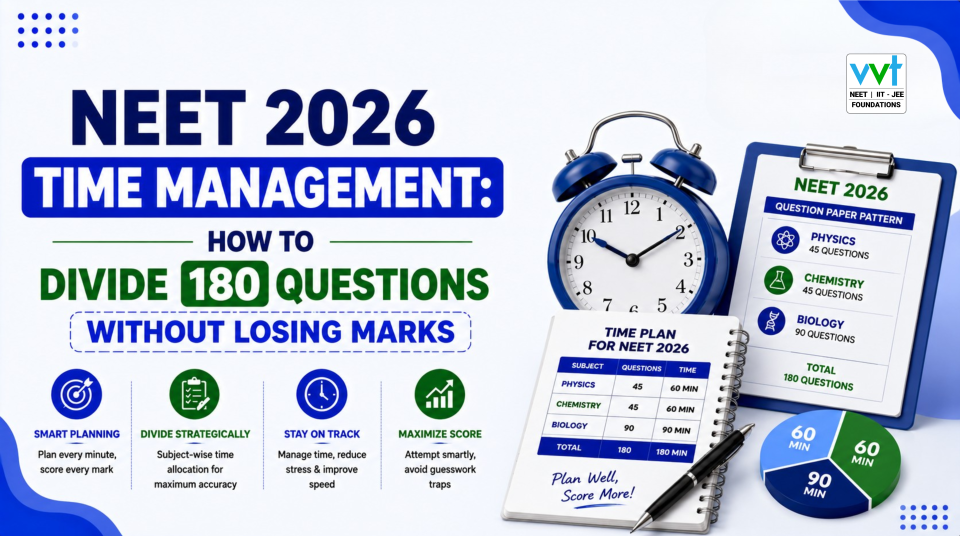
| Physics | 45 | 180 | 3 hours 20 minutes |
| Chemistry | 45 | 180 | |
| Biology (Botany + Zoology) | 90 | 360 | |
| Total | 180 | 7 | |
Key Takeaways
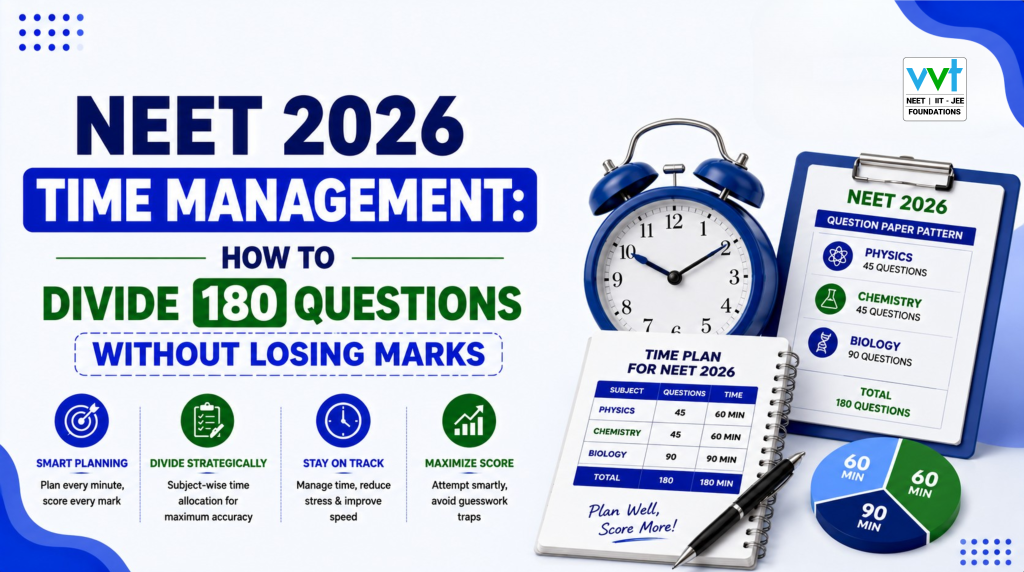
- 180 questions total
- Negative marking applies
- Biology dominates scoring
Smart Tips to Cover NEET 2026 Syllabus Effectively
- Stick strictly to NCERT Class 11 & 12
- Revise Biology daily
- Practice Physics numericals under time pressure
- Make short notes for Chemistry reactions and exceptions
- Analyse mistakes weekly (not just test scores)
How VVT Coaching Helps You Master the NEET 2026 Syllabus
As one of the Top NEET Coaching Centres in Tamil Nadu, VVT Coaching follows a data-driven, student-centric approach:
- Personalised study plans based on syllabus coverage
- AI-powered mock tests with topic-wise analytics
- Error Exams created from your own mistakes
- Remedy classes to fix weak chapters quickly
- Strict NCERT-aligned teaching
Our students don’t just complete the syllabus, they master it strategically.
Get to Know VVT’s Three Friendly Campuses: Always Nearby and Welcoming
VVT has three spots across Chennai, each easy to reach and full of support. No matter where you live, one is close by. Our campuses mix bright classrooms, helpful teachers, and a warm feel to keep you going. Here’s a quick look at each, with a focus on how they help with NEET and staying options.
Adyar Campus: Easy Access and Positive Vibes
Right on busy L.B. Road next to Adyar Ananda Bhavan, this spot is super convenient. Step inside, and you’ll see big, airy rooms where learning feels fun. Staff greet you with smiles, and the energy pushes you to turn weak areas like tough Physics problems into strengths.We also offer hostel facilities here for boys, with clean rooms, meals, and support to make your stay comfortable and focused. No distractions, just a safe place to rest and review after classes.
Adyar Campus (VVT Coaching Centre): “Nibav Buildings”, 4th & 5th Floor, No.23, Old No.11, L.B. Road, Adyar, Chennai – 600020. (Next to Adyar Ananda Bhavan)
Get Directions: Open in google maps!
Anna Nagar Campus: Focus in the City Centre
In Shanthi Colony, Anna Nagar, this campus feels like an extension of home. Good bus links make it simple for city kids. There is no on-site hostel, but nearby options are plentiful for those who need them.
Anna Nagar Campus (VVT Coaching Centre): No.1621, 9th Main Road, Shanthi Colony, Block AI, Anna Nagar, Chennai – 600040.
Get Directions: Open in google maps!
Pallikaranai Girls Campus: Your Safe Place with Full Hostel
This is our special girls-only residential campus in a quiet area. It’s built as a true home away from home, with clean dorms, healthy meals in the canteen, and round-the-clock help.
We offer full hostel facilities here, clean rooms, study areas, and a community of girls supporting each other. It’s perfect if you’re from outside Chennai or just want a focused, safe space.
Pallikaranai (Saraswathi Girls Residential Campus): Plot No. 395 & 396, 1st Main Road, Kamakoti Nagar, Pallikaranai, Chennai – 600100.
Get Directions: Open in google maps!
Conclusion
The NEET 2026 syllabus is not about studying more, it’s about studying right. Students who align preparation strictly with the updated syllabus, focus on weightage, and correct errors early gain a massive advantage.
If you want structured guidance from one of the Best NEET Coaching Centres in Tamil Nadu, VVT Coaching is here to guide you from syllabus to selection.
Visit: vvtcoaching.com
Call: +91 81221 22333
Scholarships: Up to 100% via VVTSAT!
Frequently Asked Questions (FAQs)
Q1. Is the NEET 2026 syllabus fully based on NCERT?
Yes. NEET 2026 strictly follows the NCERT Class 11 and 12 syllabus. Most questions, especially in Biology and Inorganic Chemistry, are directly NCERT-based.
Q2. Have any chapters been deleted from the NEET 2026 syllabus?
Yes. As per NCERT rationalisation, some topics across Physics, Chemistry, and Biology have been deleted or reduced, which are clearly listed in the official syllabus overview.
Q3. Which subject carries the highest weightage in NEET 2026?
Biology carries the highest weightage with 90 questions (360 marks), making it the most important subject for scoring high.
Q4. Is studying reference books necessary for NEET 2026?
NCERT textbooks are mandatory and sufficient for theory. Reference books should be used only for practice and numericals, not for learning concepts.
Q5. How should I plan NEET 2026 preparation using the syllabus?
Start with high-weightage chapters, follow a subject-wise timetable, revise NCERT regularly, and take mock tests with proper error analysis.