
JEE Main 2026 Photo & Signature Guidelines (Full Detailed Guide + Samples + Requirements)
November 27, 2025
How to Handle Stress During IIT JEE Preparation (2026 Guide) – Complete Stress-Free Strategy for JEE Aspirants
November 29, 2025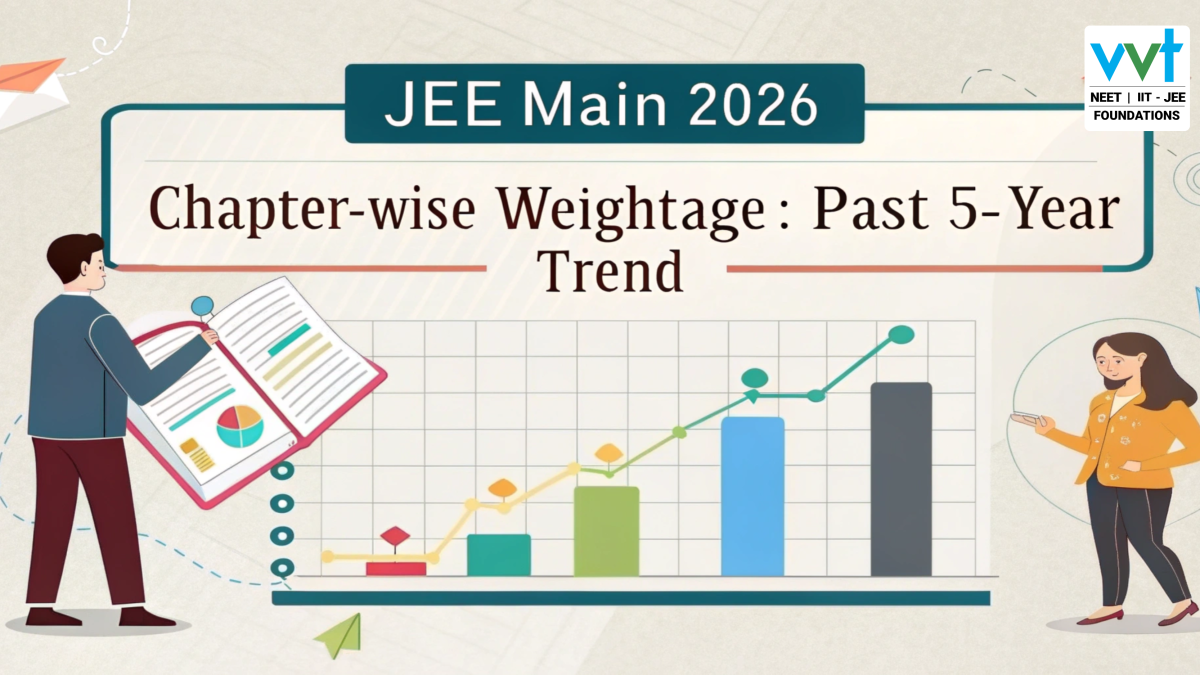
JEE Main 2026 Chapter-wise Weightage: Physics, Chemistry, Maths (Past 5 Years Trend + High-Value Topics)
VVT Coaching Chennai – Ranked #1 Best NEET&JEE Coaching Centre by Times Now!
If you want to score high in JEE Main 2026, you can’t treat all chapters equally. Some topics carry more questions, more often, and understanding this chapter-wise weightage gives you a huge strategic advantage.
This guide brings together:
- Past 5-year chapter-wise weightage for Maths, Physics, and Chemistry
- Chapter-wise question distribution in JEE Main 2025 (Jan & April sessions)
- Sub-discipline trends (like Mechanics vs Electromagnetism vs Modern Physics)
- Class XI vs Class XII question distribution
- And how to convert all this data into a smart, score-focused study plan with the help of VVT Coaching.
All the numbers are based on previous years’ papers. While the official JEE Main 2026 pattern may shift slightly, these trends are your best realistic guide.
Why Chapter-wise Weightage Matters So Much
Most students read “everything” and still score around 120–150 because:
- They don’t prioritise chapters based on actual exam frequency
- They underplay high-weightage but doable topics
- They treat all chapters as equal in revision
When you know which chapters have contributed the most questions over 5+ years, you can:
- Maximise marks in less time
- Avoid wasting energy on ultra-low-yield topics early on
- Build a strong core in topics that appear again and again
VVT Coaching uses exactly this kind of weightage + error pattern + AI analytics to help students plan a clean, no-drama JEE strategy.
JEE Main Past 5 Years Chapter-wise Weightage (Overview)
Below are the past 5-year chapter-wise weightage tables for:
- Mathematics
- Physics
- Chemistry
These percentages tell you:
“Out of all questions in 5 years, what percentage came from this chapter?”
Use them to mark your A-List (must master), B-List (solid practice), and C-List (late-stage coverage) chapters.
JEE Main Past 5 Years Chapter-wise Weightage – Mathematics
Class XI Maths – Chapter-wise Weightage (Past 5 Years)
| S. No. | Chapter Name | Weightage (%) |
| 1 | Basic Mathematics and Logarithm | 0.59% |
| 2 | Sets | 1.00% |
| 3 | Trigonometric Ratios and Identities | 1.02% |
| 4 | Trigonometric Equations | 1.35% |
| 5 | Quadratic Equations | 3.30% |
| 6 | Complex Number | 4.75% |
| 7 | Sequences and Series | 5.74% |
| 8 | Binomial Theorem | 5.05% |
| 9 | Permutations and Combinations | 3.60% |
| 10 | Straight Lines | 2.71% |
| 11 | Circles | 3.24% |
| 12 | Conic Sections: Parabola | 2.44% |
| 13 | Conic Sections: Ellipse | 2.11% |
| 14 | Conic Sections: Hyperbola | 1.65% |
| 15 | Statistics | 3.00% |
| 16 | Properties of Triangle | 0.36% |
Class XII Maths – Chapter-wise Weightage (Past 5 Years)
| S. No. | Chapter Name | Weightage (%) |
| 1 | Determinants | 4.00% |
| 2 | Matrices | 3.46% |
| 3 | Relations and Functions | 1.25% |
| 4 | Inverse Trigonometric Functions | 1.59% |
| 5 | Limit, Continuity and Differentiability | 5.50% |
| 6 | Methods of Differentiation | 1.24% |
| 7 | Applications of Derivatives | 4.75% |
| 8 | Indefinite Integration | 1.65% |
| 9 | Definite Integration | 5.08% |
| 10 | Application of Integrals | 2.97% |
| 11 | Differential Equations | 4.16% |
| 12 | Vector Algebra | 4.69% |
| 13 | Three Dimensional Geometry | 7.35% |
| 14 | Probability | 3.09% |
Key Maths Insights
- 3D Geometry, Sequences & Series, Binomial, Definite Integration, Limits/Continuity/Differentiability are high-return areas.
- A large chunk of the paper is covered if your Calculus + Algebra + 3D/Vector base is very strong.
JEE Main Past 5 Years Chapter-wise Weightage – Physics
Class XI Physics – Chapter-wise Weightage
| S. No. | Chapter Name | Weightage (%) |
| 1 | Mathematical Tools | 0.00% |
| 2 | Units and Measurements | 4.24% |
| 3 | Motion in a Straight Line | 2.63% |
| 4 | Motion in a Plane | 2.92% |
| 5 | Newton’s Laws of Motion | 2.05% |
| 6 | Work, Energy & Power | 2.37% |
| 7 | Centre of Mass & System of Particles | 2.56% |
| 8 | Rotational Motion | 4.31% |
| 9 | Gravitation | 4.49% |
| 10 | Mechanical Properties of Solids | 2.08% |
| 11 | Mechanical Properties of Fluids | 3.00% |
| 12 | Thermal Properties of Matter | 2.08% |
| 13 | Kinetic Theory of Gases | 2.88% |
| 14 | Thermodynamics | 3.06% |
| 15 | Oscillations | 3.25% |
| 16 | Waves | 1.94% |
Class XII Physics – Chapter-wise Weightage
| S. No. | Chapter Name | Weightage (%) |
| 1 | Electric Charges and Fields | 3.18% |
| 2 | Electrostatic Potential and Capacitance | 4.49% |
| 3 | Current Electricity | 6.57% |
| 4 | Moving Charges and Magnetism | 2.89% |
| 5 | Magnetism and Matter | 1.90% |
| 6 | Electromagnetic Induction | 3.25% |
| 7 | Alternating Current | 3.73% |
| 8 | Electromagnetic Waves | 2.96% |
| 9 | Ray Optics and Optical Instruments | 5.04% |
| 10 | Wave Optics | 2.30% |
| 11 | Dual Nature of Radiation and Matter | 4.05% |
| 12 | Atoms | 2.48% |
| 13 | Nuclei | 3.14% |
| 14 | Semiconductor Electronics: Materials, Devices & Circuits | 4.75% |
Key Physics Insights
- Current Electricity, Optics, Electrostatics, Rotational Motion, Gravitation, Semiconductors are critical.
- Mechanics + Electrostatics + Current + Optics together cover most of your serious scoring potential.
JEE Main Past 5 Years Chapter-wise Weightage – Chemistry
Class XI Chemistry – Chapter-wise Weightage
| S. No. | Chapter Name | Weightage (%) |
| 1 | Atomic Structure | 3.34% |
| 2 | Some Basic Concepts of Chemistry | 2.82% |
| 3 | Classification of Elements and Periodicity in Properties | 1.93% |
| 4 | Chemical Bonding and Molecular Structure | 3.34% |
| 5 | States of Matter | 1.89% |
| 6 | Chemical Thermodynamics and Energetics | 3.65% |
| 7 | Redox Reaction | 1.75% |
| 8 | Equilibrium | 4.44% |
| 9 | The p-Block Elements | 1.79% |
| 10 | Some Basic Principles & Techniques: IUPAC Nomenclature | 0.10% |
| 11 | Some Basic Principles & Techniques: Isomerism | 0.27% |
| 12 | Some Basic Principles & Techniques: General Organic Chemistry | 1.20% |
| 13 | Hydrocarbons | 3.03% |
| 14 | Purification & Analysis of Organic Compounds | 1.94% |
| 15 | Hydrogen | 2.82% |
| 16 | s-Block Elements | 4.16% |
| 17 | Environmental Chemistry | 2.99% |
Class XII Chemistry – Chapter-wise Weightage
| S. No. | Chapter Name | Weightage (%) |
| 1 | Solutions | 4.54% |
| 2 | Electrochemistry | 3.30% |
| 3 | Chemical Kinetics | 3.61% |
| 4 | Haloalkanes and Haloarenes | 2.65% |
| 5 | Alcohols, Phenols and Ethers | 3.54% |
| 6 | Aldehydes, Ketones and Carboxylic Acids | 5.95% |
| 7 | Amines | 4.40% |
| 8 | Biomolecules | 3.99% |
| 9 | Coordination Compounds | 5.33% |
| 10 | The p-Block Elements (Group 15 to 18) | 3.68% |
| 11 | The d and f-Block Elements | 4.69% |
| 12 | Principles of Qualitative Analysis (Salt Analysis) | 0.50% |
| 13 | The Solid State | 1.72% |
| 14 | Surface Chemistry | 2.99% |
| 15 | General Principles & Processes of Isolation of Metals | 3.37% |
| 16 | Polymers | 2.06% |
| 17 | Chemistry in Everyday Life | 2.20% |
Key Chemistry Insights
- Equilibrium, Thermodynamics, Aldehydes/Ketones/Acids, Coordination Compounds, d–f Block, Solutions, Kinetics carry strong, repeatable weightage.
- Organic + Physical chemistry together dominate, but Inorganic is still too important to ignore.
Topic-wise Questions in JEE Main 2025 (Real Question Count)
These tables show how many questions were asked from each chapter across January and April 2025 sessions combined. This tells you what actually appeared most recently.
A. JEE Main 2025 – Maths Chapter-wise Questions
| Chapter Name | Jan 2025 | April 2025 |
| Three Dimensional Geometry | 18 | 17 |
| Matrices and Determinants | 18 | 15 |
| Differential Equations | 15 | 9 |
| Vector Algebra | 12 | 10 |
| Definite Integration | 11 | 9 |
| Sequence and Series | 13 | 13 |
| Straight Lines | 11 | 9 |
| Binomial Theorem | 11 | 13 |
| Set Theory and Relations | 11 | 9 |
| Application of Derivatives | 4 | 9 |
| Functions | 10 | 11 |
| Probability | 12 | 9 |
| Limits of Functions | 10 | 9 |
| Permutations and Combinations | 12 | 9 |
| Circle | 5 | 4 |
| Differentiability & Method of Diff. | 2 | 2 |
| Quadratic Equations | 8 | 8 |
| Complex Numbers | 8 | 8 |
| Statistics | 4 | 5 |
| Hyperbola | 5 | 7 |
| Continuity | 2 | 2 |
| Trigonometric Equations | 2 | 5 |
| Parabola | 10 | 6 |
| Indefinite Integration | 5 | 3 |
| Inverse Trigonometric Functions | 7 | 4 |
| Ellipse | 7 | 9 |
| Trig Ratios and Identities | 3 | 2 |
| Solutions of Triangles | 0 | 0 |
| Basic Mathematics and Logarithms | 1 | 0 |
B. JEE Main 2025 – Chemistry Chapter-wise Questions
| Chapter Name | Jan 2025 | April 2025 |
| Organic Chemistry – Some Basic Principles & Techniques | 20 | 20 |
| Coordination Compounds | 18 | 22 |
| Aldehydes, Ketones and Carboxylic Acids | 15 | 18 |
| Thermodynamics | 15 | 15 |
| Equilibrium | 17 | 10 |
| Solutions | 11 | 16 |
| Chemical Kinetics | 12 | 13 |
| The d and f-Block Elements | 15 | 9 |
| Electrochemistry | 14 | 9 |
| Some Basic Concepts of Chemistry | 11 | 11 |
| Biomolecules | 11 | 11 |
| Haloalkanes and Haloarenes | 14 | 7 |
| Classification of Elements & Periodicity | 14 | 6 |
| Structure of Atom | 10 | 9 |
| Hydrocarbons | 13 | 6 |
| Amines | 10 | 9 |
| Alcohols, Phenols and Ethers | 8 | 7 |
| Chemical Bonding and Molecular Structure | 8 | 6 |
| Principles Related to Practical Chemistry | 5 | 8 |
| The p-Block Elements (Group 15 to 18) | 4 | 6 |
| The p-Block Elements | 2 | 7 |
| Redox Reactions | 3 | 0 |
C. JEE Main 2025 – Physics Chapter-wise Questions
| Chapter Name | April 2025 | Jan 2025 |
| Ray Optics and Optical Instruments | 19 | 23 |
| Units and Measurements | 13 | 20 |
| Rotational Motion | 13 | 14 |
| Electric Charges and Fields | 13 | 14 |
| Fluid Mechanics | 10 | 16 |
| Moving Charges and Magnetism | 12 | 12 |
| Thermodynamics | 9 | 13 |
| Electrostatic Potential and Capacitance | 12 | 9 |
| Wave Optics | 9 | 10 |
| Dual Nature of Radiation and Matter | 7 | 12 |
| Semiconductor Electronics | 9 | 10 |
| Current Electricity | 8 | 9 |
| Work, Power and Energy | 4 | 11 |
| Gravitation | 6 | 8 |
| Electromagnetic Waves | 5 | 9 |
| Thermal Properties of Matter | 5 | 8 |
| Waves | 10 | 3 |
| Alternating Current | 6 | 7 |
| Kinetic Theory of Gases | 7 | 5 |
| Atoms | 7 | 5 |
| Newton’s Laws of Motion | 8 | 3 |
| Motion in a Plane | 6 | 4 |
| Motion in a Straight Line | 5 | 4 |
| Simple Harmonic Motion | 4 | 5 |
| System of Particles and Centre of Mass | 3 | 5 |
| Nuclei | 5 | 3 |
| Mechanical Properties of Solids | 6 | 1 |
| Electromagnetic Induction | 1 | 6 |
| Magnetism and Matter | 3 | 0 |
| Vector and Calculus | 0 | 1 |
Subdiscipline Trends: What Big Buckets Matter Most?
Maths – Subdiscipline-wise Weightage (2024 vs 2025)
| Subdiscipline | JEE 2024 (%) | JEE 2025 (%) |
| Calculus | 37.3% | 30.7% |
| Algebra | 33.5% | 39.4% |
| 3D Geometry | 13.3% | 12.0% |
| 2D Geometry | 12.3% | 15.4% |
| Trigonometry | 3.5% | 2.5% |
Takeaway:
If your Calculus + Algebra + 2D/3D Geometry is not strong, you’re leaving a big chunk of your score on the table.
Physics – Subdiscipline-wise Trends
| Year | Mechanics | Electromagnetism | Modern Physics | Heat & Thermodynamics | Optics | Oscillation & Waves |
| 2025 | 252 (35.0%) | 194 (26.9%) | 123 (17.1%) | 50 (6.9%) | 63 (8.8%) | 38 (5.3%) |
| 2024 | 218 (36.3%) | 186 (31.0%) | 88 (14.7%) | 42 (7.0%) | 42 (7.0%) | 24 (4.0%) |
Takeaway:
Mechanics + Electromagnetism + Modern Physics ≈ 75% of Physics
These must be treated as core pillars, not optional.
Chemistry – Subdiscipline-wise Trends
| Year | Organic Chemistry | Physical Chemistry | Inorganic Chemistry |
| 2024 | 228 questions | 207 questions | 165 questions |
| 2025 | 169 questions | 176 questions | 130 questions |
Takeaway:
- Organic dominated in 2024
- Physical took the lead in 2025
- Inorganic is fewer questions but still high-scoring NCERT-based — great for stability.
Class XI vs Class XII Question Split
Maths – Class-wise Question Distribution
| Year | Session | Class XI Questions | Class XII Questions |
| 2024 | April | 115 | 185 |
| 2024 | January | 119 | 181 |
| 2025 | April | 110 | 115 |
| 2025 | January | 116 | 134 |
Physics – Class-wise Distribution
| Year | Attempt | Class XI | Class XII |
| 2024 | January | 141 | 159 |
| 2024 | April | 143 | 157 |
| 2025 | January | 121 | 129 |
| 2025 | April | 109 | 116 |
Chemistry – Class-wise Distribution
| Year | Class | April Attempt | January Attempt |
| 2024 | XI | 130 | 125 |
| 2024 | XII | 170 | 175 |
| 2025 | XI | 90 | 113 |
| 2025 | XII | 135 | 137 |
Overall, Class XII has a slight edge, but Class XI content is still 45–50%. Ignoring XI is not an option.
How to Use This Weightage Data in Your Study Plan
- Lock high-weightage, high-control chapters first
- Maths: 3D Geometry, Sequences & Series, Binomial, Limits, Definite Integration
- Physics: Current Electricity, Optics, Electrostatics, Rotational Motion
- Chemistry: Equilibrium, Thermodynamics, Aldehydes/Ketones/Acids, Coordination, d–f Block
- Build a “core 50%” list
- Pick 10–12 chapters per subject that make up the bulk of questions.
- Pick 10–12 chapters per subject that make up the bulk of questions.
- Align mocks with weightage
- Your tests should reflect chapter frequency, not equal sampling of all topics.
- Your tests should reflect chapter frequency, not equal sampling of all topics.
- Run error-focused revision
- Every mock → identify your top 5 error-heavy chapters → revise just those next 2–3 days.
This is exactly the workflow VVT Coaching builds for its students.
How VVT Coaching Turns Weightage Data into Real Marks
Most students look at weightage tables once… and then go back to random studying.
VVT Coaching turns these insights into a living system that:
- Targets high-weightage chapters
- Exposes & fixes recurring mistakes
- Guides your week-by-week plan
- Uses AI analytics to show what truly moves your rank
Here’s how.
1. Error Exams
Instead of giving only generic tests, VVT creates Error Exams:
- Tests built primarily from questions you got wrong or left earlier
- Forces you to re-face those weak patterns until they stop being weak
- Perfect for high-weightage topics like 3D, Calculus, Optics, Electrostatics, Organic
2. AI-Powered Test Series
Traditional tests tell you “Score: 142/300”.
VVT’s AI-powered mock ecosystem goes much deeper. It shows:
- Accuracy by chapter and subtopic
- Time spent per question and per section
- Where you overthink vs guess vs skip
- How you compare with top scorers
- Which high-weightage topics are still underperforming for you
Explore how this AI engine works:
How AI Is Transforming JEE Preparation: VVT Journey to Becoming Chennai’s Top Coaching Centre!
3. Personalized Guidance
Data is powerful only if someone helps you act on it.
VVT’s Personalized Guidance gives you:
- A mentor who tracks your mock history, chapter accuracy, and consistency
- Weekly course-correction calls: what to drop, what to double down on
- Help balancing school, boards, and JEE
- A real person who ensures you don’t slip into “I’ll do it later” mode
4. Remedy Classes – Surgical Repair of Weak Topics
When analytics show:
- Your Mechanics is lagging
- Or Organic GOC is pulling you down
- Or Coordinate Geometry is patchy
You don’t just “hope it improves”.
VVT’s Remedy Classes directly target those topics for concept repair and problem-level confidence.
Conclusion
Chapter-wise weightage for JEE Main 2026 is not just a curiosity, it’s a roadmap.
The past 5 years show you where marks are hiding:
- Mechanics + Electrostatics + Current + Optics in Physics
- Calculus + Algebra + Geometry in Maths
- Equilibrium, Thermodynamics, Organic & Coordination in Chemistry
When you align your daily practice, mocks, and revision with this weightage, and then use your mistakes as fuel for Error Exams, AI analytics, Remedy Classes, and mentored planning, your score doesn’t grow by luck. It grows by design.
That’s what VVT Coaching does for serious aspirants:
turns scattered effort into a structured, data-backed, rank-focused system.
If you’re aiming for a top JEE Main score in 2026:
- Start building around high-weightage chapters today
- Use tests + analysis + targeted fixes
- Don’t prepare blindly when you can prepare intelligently
For guidance, systems, and support that actually move your rank:
Visit: www.vvtcoaching.com
Call: +91 81221 22333
Get to Know VVT’s Three Friendly Campuses: Always Nearby and Welcoming
VVT has three spots across Chennai, each easy to reach and full of support. No matter where you live, one is close by. Our campuses mix bright classrooms, helpful teachers, and a warm feel to keep you going. Here’s a quick look at each, with a focus on how they help with NEET and staying options.
Adyar Campus: Easy Access and Positive Vibes
Right on busy L.B. Road next to Adyar Ananda Bhavan, this spot is super convenient. Step inside, and you’ll see big, airy rooms where learning feels fun. Staff greet you with smiles, and the energy pushes you to turn weak areas like tough Physics problems into strengths.We also offer hostel facilities here for boys, with clean rooms, meals, and support to make your stay comfortable and focused. No distractions, just a safe place to rest and review after classes.
Adyar Campus (VVT Coaching Centre): “Nibav Buildings”, 4th & 5th Floor, No.23, Old No.11, L.B. Road, Adyar, Chennai – 600020. (Next to Adyar Ananda Bhavan)
Get Directions: Open in google maps!
Anna Nagar Campus: Focus in the City Centre
In Shanthi Colony, Anna Nagar, this campus feels like an extension of home. Good bus links make it simple for city kids. There is no on-site hostel, but nearby options are plentiful for those who need them.
Anna Nagar Campus (VVT Coaching Centre): No.1621, 9th Main Road, Shanthi Colony, Block AI, Anna Nagar, Chennai – 600040.
Get Directions: Open in google maps!
Pallikaranai Girls Campus: Your Safe Place with Full Hostel
This is our special girls-only residential campus in a quiet area. It’s built as a true home away from home, with clean dorms, healthy meals in the canteen, and round-the-clock help.
We offer full hostel facilities here, clean rooms, study areas, and a community of girls supporting each other. It’s perfect if you’re from outside Chennai or just want a focused, safe space.
Pallikaranai (Saraswathi Girls Residential Campus): Plot No. 395 & 396, 1st Main Road, Kamakoti Nagar, Pallikaranai, Chennai – 600100.
Get Directions: Open in google maps
FAQs – JEE Main 2026 Chapter-wise Weightage
1. Is chapter-wise weightage officially announced by NTA?
No. NTA does not publish any official chapter-wise weightage. All weightage analysis comes from studying previous year question papers and trends.
2. Does weightage change every year?
Yes, but only slightly. Patterns evolve, but high-weight chapters (like Calculus, Mechanics, Electrostatics, Organic Carbonyls, etc.) tend to stay important over many years.
3. Should I skip low-weight chapters?
No. Questions can be picked from any part of the syllabus. Use weightage to prioritize, not to delete chapters.
4. How should I use weightage tables in the last 60–90 days?
First, secure all major high-weight chapters (accuracy > 80%).
Second, do quick NCERT-level revision of remaining chapters.
Third, use mock tests + analysis to see if any high-weight area is still leaking marks.
5. How does VVT Coaching integrate weightage into its JEE preparation system?
Uses PYQ-based data to identify high-yield chapters.
Designs Error Exams around your personal weak patterns in these chapters.
Uses AI analytics to monitor progress across topics.
Provides Remedy Classes for high-impact weak areas.
Gives Personalized Guidance so your study plan always matches your target rank