
MBBS Seat Matrix 2026-27: State Wise MBBS Seats, New Additions and NEET Counselling Guide
July 18, 2026
NEET Cut Off 2026: Category Wise Qualifying Marks, Government College Safe Score & Counselling Guide
July 20, 2026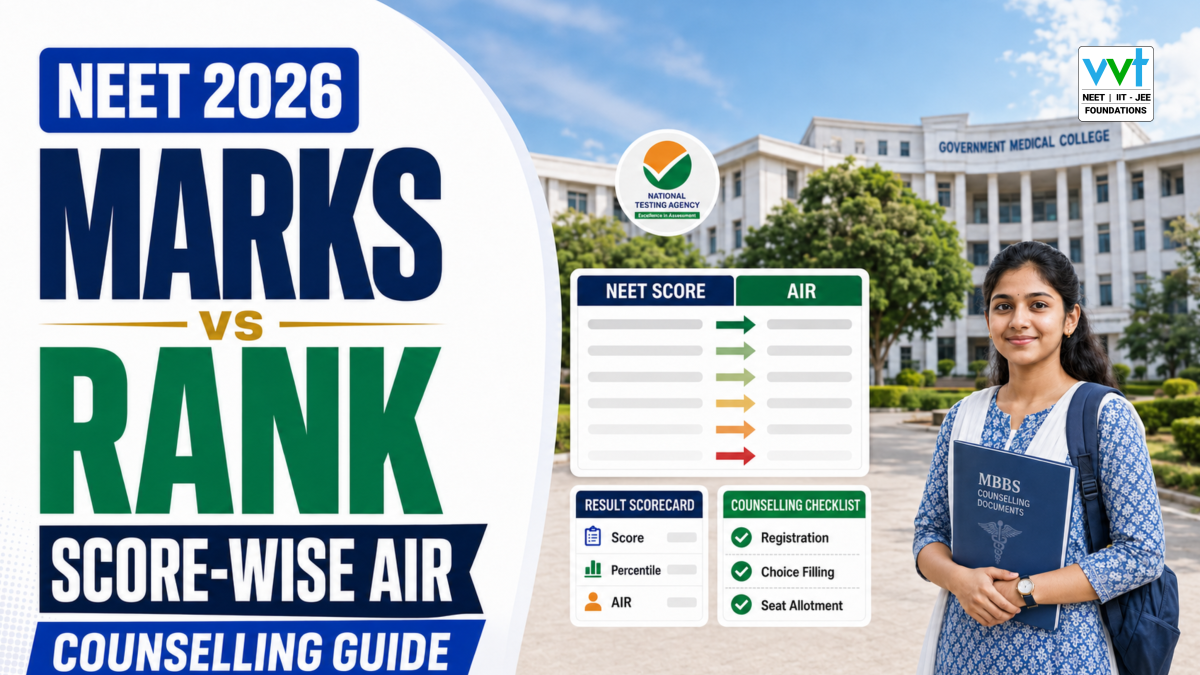
NEET 2026 Marks vs Rank: Score Wise AIR Analysis, Cut off & Counselling Guide
NEET 2026 Marks vs Rank: What Your Score Really Means
After the NEET 2026 result, almost every student has the same question: “With my marks, what rank can I expect, and which medical colleges should I target?”
Marks are important, but in NEET counselling, rank is what finally decides your movement. A score of 600, 550 or even 500 can mean very different things depending on the year, paper difficulty, number of candidates, category, state quota, seat matrix and counselling choices.
NTA declared the NEET UG 2026 result on 16 July 2026. As per the official press release, close to 20 lakh candidates appeared, and 11.21 lakh candidates qualified for undergraduate medical, dental, AYUSH and allied programmes. The scorecards are available on the official NEET website.
At VVT Coaching, our advice to students is simple: do not look at marks alone. Look at your All India Rank, category rank, state eligibility, previous allotment trends and realistic choice filling strategy before deciding your next step.
NEET 2026 Result: Official Snapshot
Here are the most important numbers from the NEET UG 2026 result:
| Particulars | NEET 2026 Data |
| Registered candidates | 22,79,743 |
| Appeared candidates | 19,99,895 |
| Qualified candidates | 11,21,185 |
| Highest score | 715 / 720 |
| Candidates scoring above 700 | 19 |
| Candidates scoring 650 and above | 1,492 |
| Candidates scoring 600 and above | 10,160 |
| Candidates scoring 500 and above | 90,780 |
The highest score in NEET 2026 was 715 out of 720, secured jointly by Aryan Gupta from Punjab and Panshul Bansal from Haryana. NTA also reported that 138 candidates scored above 690 marks.
For Tamil Nadu students, NEET 2026 had 1,42,494 registered candidates, 1,08,601 appeared candidates, and 61,306 qualified candidates, as per NTA’s state wise data.
NEET 2026 Marks vs Rank: Expected Score Wise AIR Range
The table below gives a practical marks vs rank estimate based on the official NEET 2026 score distribution and previous counselling behaviour. This is not a replacement for your official scorecard. Your actual AIR will be the rank printed on your NEET result.
| NEET 2026 Marks Range | Expected AIR Range | What It Usually Means |
| 705–715 | AIR 1–20 | Top AIIMS, JIPMER, top central/government colleges possible |
| 690–704 | AIR 20–140 | Excellent chance for top government medical colleges |
| 650–689 | AIR 140–1,500 | Very strong score; top state and AIQ options possible |
| 600–649 | AIR 1,500–10,200 | Good government MBBS chances depending on category/state |
| 550–599 | AIR 10,200–40,000 approx. | State quota becomes very important |
| 500–549 | AIR 40,000–90,800 approx. | Private, state quota, semi-government and category-based chances |
| 450–499 | AIR 90,800–1,60,000 approx. | Need broader college/course strategy |
| 400–449 | AIR 1.6 lakh–2.8 lakh approx. | MBBS chances depend heavily on category, state and fee budget |
| 350–399 | AIR 2.8 lakh–4.5 lakh approx. | Consider BDS, AYUSH, private options and state counselling |
| 300–349 | AIR 4.5 lakh–6.5 lakh approx. | Counselling planning must be very practical |
| 250–299 | AIR 6.5 lakh–8.8 lakh approx. | Category and course options matter more |
| 177–249 | Lower qualified range | Mainly qualifying range; admission depends on category and seat route |
A key point: NEET 2026 had only 10,160 candidates scoring 600 and above, but 90,780 candidates scoring 500 and above. This means the rank gap becomes much wider as marks move below 600.
NEET Rank for 700 Marks in 2026
A score around 700+ is an exceptional score in NEET 2026. Since only 19 candidates scored above 700, this range puts a student among the country’s top performers.
Students in this range should prepare a very careful preference list. At this level, the question is usually not “Will I get MBBS?” But which top college should I choose first?
NEET Rank for 650 Marks in 2026
A score of 650 is still a very powerful score in NEET 2026. NTA reported 1,492 candidates scoring 650 and above, so students around this range are likely to be placed within a highly competitive but strong AIR band.
At this score, students should not make random choices. You need to compare:
Your AIR, category, home state, AIQ closing ranks, state quota closing ranks, government vs private options, fee structure, bond rules and location preference.
This is where professional counselling support can make a major difference.
NEET Rank for 600 Marks in 2026
A score of 600 is usually seen as a strong NEET score, but the final admission chance depends on the year. In NEET 2026, 10,160 candidates scored 600 and above, which gives a better idea of how competitive the top score range is.
For many students, 600 can still keep government MBBS hopes alive, especially through state quota or reserved category routes. But it is important not to assume. A student with 600 marks must check:
AIQ past closing ranks, Tamil Nadu state quota trends, category movement, newly added seats, mop up possibilities and backup options like BDS or AYUSH if required.
NEET Rank for 550 Marks in 2026
A score of 550 is a middle high score where counselling strategy becomes very important. This is not a score where students should panic, but it is also not a score where they should be careless.
At this range, admission chances depend strongly on:
State quota, category, college type, annual fee budget, preference order and willingness to consider private or semi government colleges.
For Tamil Nadu students, this score range needs a separate state level analysis because state quota, community rank and college preference can change the final outcome.
NEET Rank for 500 Marks in 2026
A score around 500 can still keep several options open, but students must be realistic. NTA reported that 90,780 candidates scored 500 and above, so the competition below this level becomes much wider.
At 500 marks, students should not depend only on AIQ. They should check:
State counselling, private medical colleges, BDS, AYUSH, deemed universities, fee affordability and previous closing ranks.
A smart choice list can still help, but a poor choice list can waste a round.
NEET 2026 Qualifying Cutoff Marks
The NEET cutoff has two meanings. One is the qualifying cutoff, which decides whether a student has qualified NEET. The other is the admission cutoff, which changes college by college during counselling.
Here is the official NEET 2026 qualifying cutoff range:
| Category | Qualifying Percentile | NEET 2026 Marks Range |
| UR / EWS | 50th percentile | 715–213 |
| OBC | 40th percentile | 212–177 |
| SC | 40th percentile | 212–177 |
| ST | 40th percentile | 212–177 |
| UR / EWS & PwBD | 45th percentile | 212–194 |
| OBC & PwBD | 40th–45th percentile | 193–177 |
| SC & PwBD | 40th–45th percentile | 193–177 |
| ST & PwBD | 40th–45th percentile | 191–177 |
This cutoff only means the candidate is eligible to participate in admission processes where applicable. It does not guarantee MBBS admission.
How NEET 2026 Rank Is Calculated
NEET rank is not calculated only by looking at your marks separately. NTA prepares the All India Rank based on the overall performance of candidates in the exam.
The NEET 2026 paper had 180 compulsory questions for 720 marks. The marking pattern was +4 for a correct answer, -1 for an incorrect answer and 0 for an unanswered question. If a question is dropped, NTA’s rule decides how marks are awarded.
When two or more students get the same marks, tie breaking rules are applied. As per the NEET 2026 information bulletin, priority is given first to higher marks in Biology, then Chemistry, then Physics, followed by lower proportion of incorrect answers and further tie breaking rules if needed.
This is why two students with the same total marks may not always get the same rank.
Why Marks vs Rank Changes Every Year
Students often compare their marks with last year and become either overconfident or disappointed. That is risky.
Marks vs rank changes every year because of:
Paper difficulty, number of candidates, top score clustering, number of students above each score range, reservation category, tie breaking impact and seat availability.
For example, if the paper is easier, more students score high marks. In that case, even a good score can get a slightly lower rank than expected. If the paper is tougher, the same score may give a better rank.
That is why VVT Coaching always recommends using marks vs rank only as a planning tool, not as a final admission prediction.
Marks vs Rank vs Counselling: What Students Should Do Next
Once your NEET 2026 scorecard is available, do not stop with your marks. Keep these details ready:
NEET score, All India Rank, category rank, community/category details, state eligibility, domicile documents, Class 10 and 12 certificates, income certificate if applicable, PwBD certificate if applicable and preferred college list.
For MBBS and BDS All India Quota seats, counselling is conducted by the Medical Counselling Committee. State quota counselling is conducted by the respective state authorities. NTA has clearly advised candidates to rely only on official websites such as the NEET website, MCC website and state counselling portals.
Conclusion
NEET 2026 marks vs rank is useful, but it is only the first step. Your final admission chance depends on your rank, category, state quota, seat matrix, counselling rules and the order in which you fill your choices.
A student with a strong score can still make a counselling mistake. A student with an average score can still make a smart move with the right strategy.
If you are confused after your NEET 2026 result, do not look at random predictions alone. Sit with your scorecard, understand your rank, compare previous trends and build a practical counselling plan.
At VVT Coaching, our focus is not just to help students write NEET. Our goal is to help them move from preparation to admission with clarity, confidence and the right guidance.
Visit: vvtcoaching.com
Call: +91 81221 22333
Scholarships: Up to 100% via VVTSAT!
Also read: NEET Response Sheet 2026: OMR Sheet, Score Calculation & Next Steps
Also read: NEET OMR Sheet 2026: Expected Release Date & Download Guide

FAQs
What is NEET 2026 marks vs rank?
NEET 2026 marks vs rank helps students understand the expected All India Rank based on their NEET score. It gives an idea of where a student may stand among other candidates and helps in planning MBBS, BDS, AYUSH, and other medical counselling choices.
Is 500 marks enough for MBBS in NEET 2026?
500 marks may keep some options open, but government MBBS chances depend heavily on state, category, quota and seat availability. Students in this range should also explore private, semi-government, BDS and AYUSH options.
Does NEET qualifying cutoff guarantee medical admission?
No. The qualifying cutoff only makes a candidate eligible for counselling wherever applicable. Admission depends on rank, category, seat availability and counselling rules.
Who conducts NEET UG counselling?
MCC conducts counselling for All India Quota MBBS/BDS seats, while state counselling authorities conduct state quota counselling. Candidates should follow official MCC and state counselling websites only.