
Best Physics Chapters to Score High in NEET 2026
April 2, 2026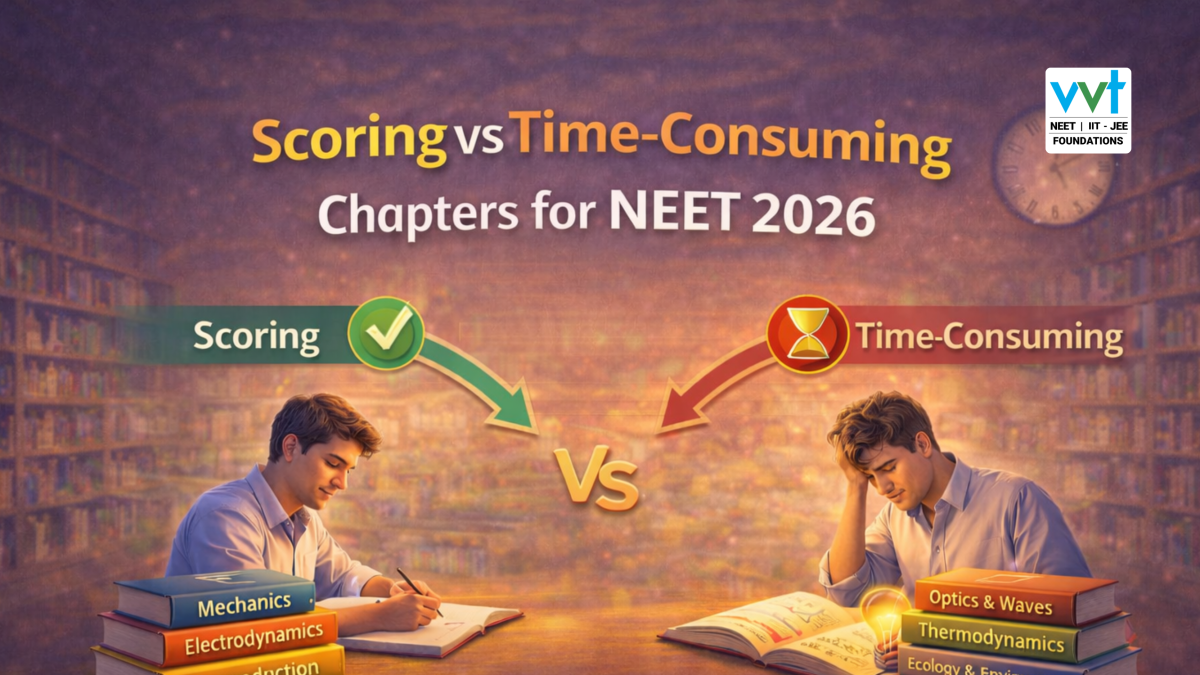
Scoring Chapters vs Time-Consuming Chapters for NEET 2026
VVT Coaching Chennai – Ranked #1 Best NEET & JEE Coaching Centre by Times Now!
With NEET UG 2026 scheduled for 3 May 2026, students are now in the phase where chapter selection matters almost as much as chapter completion. NEET 2026 remains a 180-question, 720-mark exam to be attempted in 180 minutes, with Physics, Chemistry, and Biology all carrying major weight in the final score. That means preparation cannot stay random for long. Students have to start asking a sharper question: Which chapters give faster marks, and which chapters consume a lot of time before they start paying back?
This is where the idea of scoring chapters vs time-consuming chapters becomes very useful.
Now, one important thing must be said clearly: NTA does not officially classify chapters as “scoring” or “time-consuming.”
A student who understands the difference between a fast-conversion chapter and a slow-burn chapter prepares with much less panic and much more control.
What is a scoring chapter?
A scoring chapter is not always the easiest chapter.
A scoring chapter is usually one that gives students one or more of these advantages:
- the concepts are more direct,
- formulas or facts are easier to revise repeatedly,
- question patterns are more familiar,
- the chapter gives a better mark return for the time spent,
- and students can stabilise it faster through practice.
VVT’s own NEET 2026 chapter-weightage article uses almost the same preparation mindset. It tells students to prioritise high-return chapters, improve score per hour of preparation, and reduce low-yield effort. That is the core logic behind this entire blog.
Also read: NEET 2026 Registrations: Record-Breaking Numbers, Trends & What They Mean for Aspirants!
Also read: NEET 2026 Exam Day Guidelines: Important Instructions, Dress Code & What to Carry (VVT Coaching)!
What is a time-consuming chapter?
A time-consuming chapter is not necessarily a bad chapter.
It is usually a chapter that:
- takes longer to understand properly,
- needs more concept-building before MCQs become comfortable,
- creates more errors if revised casually,
- or gives students slower score return unless they invest enough time.
Some chapters are time-consuming because they are genuinely concept-heavy. Others are time-consuming because students try to prepare them in the wrong way. In Physics, for example, VVT’s public chapter-weightage article explicitly describes the subject as calculation-heavy, time-consuming, and high-risk for negative marking when strategy is poor.
So the goal is not to avoid time-consuming chapters forever, the goal is to handle them intelligently.
Why this distinction matters more in NEET 2026
In a paper where you have a fixed time limit and a very large syllabus, chapter priority directly affects:
- revision speed,
- mock performance,
- confidence,
- and how quickly your score improves.
VVT’s public 3-month study-plan article makes this same point in practical language. In the final phase, students do not have time for random study, perfect notes, or endless detail. What they need is fast syllabus coverage of high-return chapters, daily MCQ practice, weekly tests, and an error-fix loop. That preparation philosophy becomes even stronger when you look at chapters through the lens of scoring vs time-consuming.

Scoring chapters vs time-consuming chapters in Biology
Biology is the biggest scoring section in NEET because it carries 360 out of 720 marks. VVT’s chapter-weightage analysis also calls Biology the most scoring and rank-determining section.
Biology chapters that are usually more scoring
These are usually the chapters that respond quickly to repeated NCERT-based revision and MCQ practice:
- Human Physiology
- Genetics and Evolution
- Ecology and Environment
- Reproduction
- Biotechnology
- Cell Biology
VVT’s published 2026 chapter-weightage article lists these among the consistently high-weightage Biology areas based on past-paper trend analysis, while also reminding students that NTA itself does not officially publish chapter-wise weightage.
Why are these often more scoring? Because many of them are highly NCERT-linked, repeatedly revised, and more direct to convert into marks through:
- line-by-line revision,
- diagrams,
- statement-based MCQs,
- and factual recall.
Biology chapters that often feel more time-consuming
This is partly a strategy inference, not an official label. In practice, students often find some chapters more time-consuming because they are broad, memory-heavy, or structurally dense, such as:
- Diversity in Living World
- Structural Organisation in Animals and Plants
- some parts of Plant Physiology if basics are weak
These chapters are not “bad” chapters. They just need longer retention cycles for many students. The mistake is not that students study them. The mistake is that they spend too much time on them too early while ignoring faster-scoring Biology units.
Scoring chapters vs time-consuming chapters in Chemistry
Chemistry often becomes the score stabiliser in NEET, and VVT’s own public article uses exactly that kind of language for the subject. It highlights areas like Coordination Compounds, Chemical Bonding, Thermodynamics, Equilibrium, Organic Named Reactions, Biomolecules, and Electrochemistry as high-return areas in its trend-based analysis.
Chemistry chapters that are usually more scoring
For many students, these chapters convert well:
- Chemical Bonding
- Thermodynamics
- Equilibrium
- Coordination Compounds
- Electrochemistry
- Organic Named Reactions
- Biomolecules
These chapters often become scoring because they reward pattern memory, concept clarity, and repeated question practice. VVT’s article also breaks Chemistry preparation into Physical, Organic, and Inorganic focus areas and recommends conceptual clarity, reaction pattern memory, and time control rather than random coverage.
Chemistry chapters that often feel more time-consuming
This is again a preparation inference rather than an official rank order. Many students find the following more time-consuming when their basics are shaky:
- some numerically heavy Physical Chemistry chapters,
- deeper mechanism-based Organic Chemistry portions,
- and bulky memory zones in Inorganic when revision is inconsistent.
The problem is usually not the chapter itself. The problem is the lack of repeated revision. Chemistry becomes time-consuming when students read it once and expect long-term retention without reaction recall or formula repetition.
Scoring chapters vs time-consuming chapters in Physics
Physics is where this distinction becomes most important.
VVT’s own NEET 2026 chapter-weightage article identifies Current Electricity, Laws of Motion, Work Energy and Power, Electrostatics, Modern Physics, Ray Optics, and Rotational Motion among the major high-weightage Physics chapters in its trend analysis. The same article also openly says Physics needs strategy because it is calculation-heavy, time-consuming, and risky under negative marking.
Physics chapters that are often more scoring
The most scoring Physics chapters are usually the ones that become predictable with formula revision and standard-model practice:
- Current Electricity
- Modern Physics
- Electrostatics
- Ray Optics
- Work, Energy and Power
- Physics and Measurement
- Electronic Devices
These are usually strong candidates for fast score improvement because many students can turn them into stable chapters with:
- formula sheets,
- chapter-wise MCQs,
- timed short sets,
- and error correction.
Physics chapters that often feel more time-consuming
For many students, the slow-burn chapters are:
- Rotational Motion
- deeper Mechanics blocks if Class 11 basics are weak
- parts of Magnetism/EMI/AC
- multi-step numerical chapters that require stronger concept linking
These chapters absolutely matter. But they often take longer before the student starts feeling “comfortable” in them. That is why they should be handled with patience and sequencing, not panic.
The biggest mistake students make
The biggest mistake is choosing one extreme.
Some students only study scoring chapters and ignore the rest.
Some students get stuck for weeks inside time-consuming chapters and stop scoring anywhere.
Both approaches are wrong.
VVT’s own public guidance is clear on this too: students should not ignore low-weightage chapters completely, and they should also not study only high-weightage chapters. The recommended approach is to master high-return chapters first, build moderate chapters next, and keep light revision for low-weightage chapters.
That same logic applies perfectly to scoring vs time-consuming chapters.
The right strategy: don’t choose one, balance both
A good NEET strategy usually looks like this:
Step 1: Lock your scoring chapters first
This gives you early confidence and visible score movement.
Step 2: Start one time-consuming chapter alongside them
Do not postpone all hard chapters. But do not let them swallow the whole week either.
Step 3: Use mocks to judge return on time
If a chapter is taking too long but still giving no improvement, your approach needs adjustment.
Step 4: Keep revision active
A scoring chapter stays scoring only if it stays revised.
Step 5: Convert time-consuming chapters into partial scoring chapters
You do not need total mastery immediately. First aim for basic accuracy, then build upward.
A practical subject-wise balance model
A useful weekly preparation model can look like this:
Biology revision should focus mostly on high-return, NCERT-based chapters, with one lighter slot reserved for a slower chapter.
In Chemistry, combine one scoring chapter with one moderate or slower chapter so memory-based and concept-based learning move together.
For Physics, pair a fast-return chapter like Current Electricity or Modern Physics with one heavier topic to keep confidence steady.
This matches VVT’s broader public preparation style, where smart sequencing and correction-based learning matter more than brute-force hours alone.

How VVT Coaching gives authority to this topic
VVT’s authority on this topic should not come from saying “every chapter is easy.”
It should come from saying something much more useful:
Not all chapters should be treated with the same time budget.
That message is already reflected in VVT’s own 2026 content. Their public NEET strategy articles repeatedly talk about:
- prioritising high-return chapters,
- maximising score per hour,
- reducing low-yield effort,
- using weekly tests,
- and fixing errors rather than just accumulating study time.
That gives VVT a strong authority angle:
We do not just teach the syllabus, we teach chapter priority, time allocation, and score conversion.
Get to Know VVT’s Three Friendly Campuses: Always Nearby and Welcoming
VVT has three spots across Chennai, each easy to reach and full of support. No matter where you live, one is close by. Our campuses mix bright classrooms, helpful teachers, and a warm feel to keep you going. Here’s a quick look at each, with a focus on how they help with NEET and staying options.
Adyar Campus: Easy Access and Positive Vibes
Right on busy L.B. Road next to Adyar Ananda Bhavan, this spot is super convenient. Step inside, and you’ll see big, airy rooms where learning feels fun. Staff greet you with smiles, and the energy pushes you to turn weak areas like tough Physics problems into strengths.We also offer hostel facilities here for boys, with clean rooms, meals, and support to make your stay comfortable and focused. No distractions, just a safe place to rest and review after classes.
Adyar Campus (VVT Coaching Centre): “Nibav Buildings”, 4th & 5th Floor, No.23, Old No.11, L.B. Road, Adyar, Chennai – 600020. (Next to Adyar Ananda Bhavan)
Get Directions: Open in google maps!
Anna Nagar Campus: Focus in the City Centre
In Shanthi Colony, Anna Nagar, this campus feels like an extension of home. Good bus links make it simple for city kids. There is no on-site hostel, but nearby options are plentiful for those who need them.
Anna Nagar Campus (VVT Coaching Centre): No.1621, 9th Main Road, Shanthi Colony, Block AI, Anna Nagar, Chennai – 600040.
Get Directions: Open in google maps!
Pallikaranai Girls Campus: Your Safe Place with Full Hostel
This is our special girls-only residential campus in a quiet area. It’s built as a true home away from home, with clean dorms, healthy meals in the canteen, and round-the-clock help.
We offer full hostel facilities here, clean rooms, study areas, and a community of girls supporting each other. It’s perfect if you’re from outside Chennai or just want a focused, safe space.
Pallikaranai (Saraswathi Girls Residential Campus): Plot No. 395 & 396, 1st Main Road, Kamakoti Nagar, Pallikaranai, Chennai – 600100.
Get Directions: Open in google maps
Conclusion
“Scoring chapters vs time-consuming chapters” is not a motivational phrase. It is one of the most practical ways to think about NEET preparation.
A student who understands this distinction studies differently:
- they lock fast-return chapters earlier,
- they do not get trapped inside one difficult unit for too long,
- they keep revision active,
- and they use mocks to decide where time is actually paying back.
For NEET UG 2026, with the exam fixed for 3 May 2026 and the paper structure already defined, this kind of prioritisation matters even more. NEET is not just about how much you study. It is about how intelligently you use your time.
At VVT Coaching, the real goal is not just syllabus completion.
It is score-focused chapter management.
Visit: vvtcoaching.com
Call: +91 81221 22333
Scholarships: Up to 100% via VVTSAT!
Also read: How VVT Coaching Uses AI to Identify and Solve Your NEET Preparation Struggles!
Also read: Why Students Lose Easy Marks in NEET (And How to Stop It)!
FAQs
1.Does NTA officially classify chapters as scoring or time-consuming?
No. NTA publishes the syllabus and exam pattern, not a chapter priority list. This blog uses strategy-based categorisation instead.
2.Should I study only scoring chapters for NEET 2026?
No. VVT’s own public guidance says students should not ignore other chapters completely. The right approach is to master high-return chapters first, then build the rest in a balanced way.
3.Which subject has the biggest scoring potential?
Biology has the largest weight in the paper at 360 marks, so it usually offers the fastest score return when revised properly.
4.Why is Physics often called time-consuming?
Because it is more calculation-heavy, time-sensitive, and risky under negative marking if students do not prepare strategically. VVT’s public 2026 chapter-weightage article says this directly.
5.What is the safest preparation strategy now?
Lock scoring chapters first, keep one heavier chapter running alongside them, revise continuously, and use mock-test analysis to decide where your time is producing marks.