
Only 38 Days Left for NEET 2026: Why Students Lose Easy Marks and How to Stop It
March 29, 2026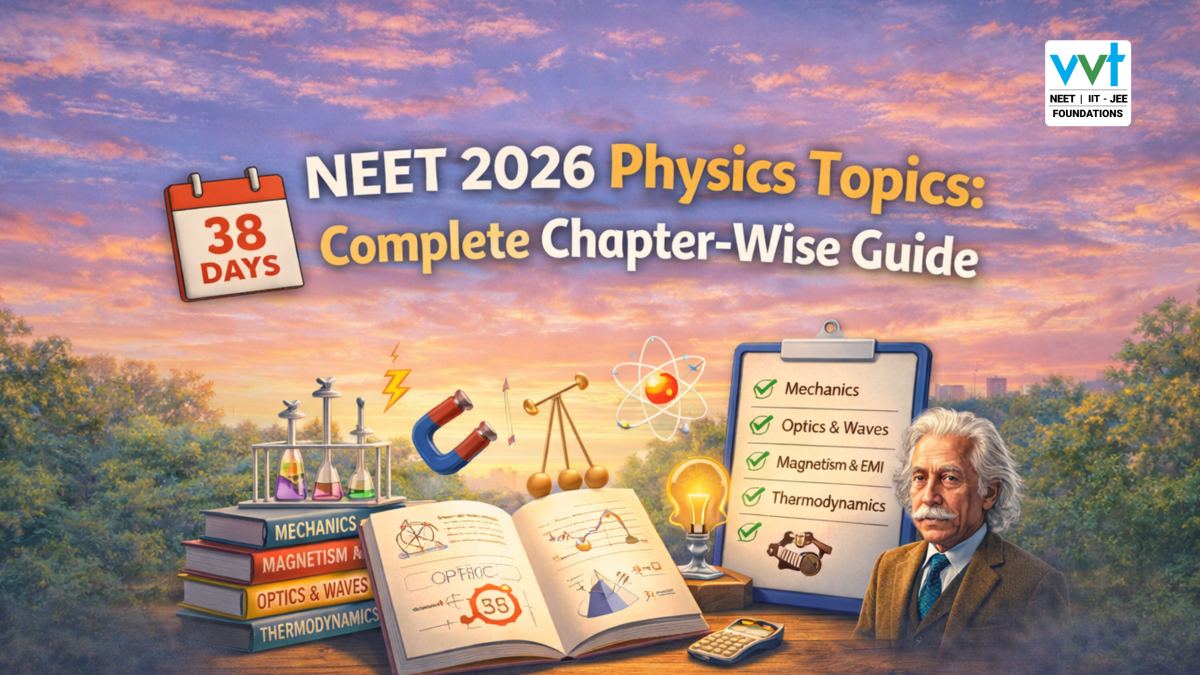
Common Physics Topics for NEET 2026: Complete Chapter-Wise Guide
VVT Coaching Chennai – Ranked #1 Best NEET & JEE Coaching Centre by Times Now!
Physics is the one NEET subject that can either lift your score or quietly pull it down.
A lot of students are comfortable with Biology and can still stabilise Chemistry with revision, but Physics often feels different. The subject demands concept clarity, formula memory, numerical control, unit discipline, and the ability to stay calm under time pressure. That is why students do not usually struggle in Physics because the syllabus is “too big.” They struggle because they are not clear about which chapters matter, what exactly to revise inside them, and how to prepare those topics in NEET format.
For NEET UG 2026, NMC has already finalised the updated syllabus, and the official NEET 2026 Information Bulletin says that Physics remains one of the three subjects in the paper. The test pattern is also clear: 45 Physics questions for 180 marks, inside the overall 180-question, 720-mark paper, to be attempted in 180 minutes on 3 May 2026 in pen-and-paper mode.
That means Physics is not a side subject. It carries a full 180 marks, and even a 15–20 mark improvement here can change the total score meaningfully.
This blog gives you a clear chapter-wise guide to the common Physics topics for NEET 2026, using the official syllabus as the base and the VVT preparation lens to show you how students should actually approach these chapters.
Also read: NEET 2026 Expected Difficulty Level: Exam Analysis & Cut Off Trend!

NEET Physics Highlights 2026
The official NEET 2026 exam pattern confirms that Physics contributes 45 questions and 180 marks, and that the exam is scheduled for 03 May 2026, from 2:00 PM to 5:00 PM. The official syllabus for NEET 2026 was finalised by the Under Graduate Medical Education Board under NMC in December 2025 and is listed on the NEET website.
| Particulars | Details |
| Exam Name | NEET UG 2026 |
| Conducting Body | NTA |
| Official Physics Weightage | 45 Questions, 180 Marks |
| Total Exam Marks | 720 |
| Exam Date | 03 May 2026 |
| Exam Duration | 180 Minutes |
| Mode of Exam | Pen and Paper |
| Official Website | neet.nta.nic.in |
| Syllabus Source | NMC-notified NEET UG 2026 syllabus |
Also read: NEET Exam Centre Rules 2026: NTA Guidelines, Dress Code, Reporting Time & Allowed Items!
What “common Physics topics” means for NEET 2026
The official syllabus does not use the phrase “common topics.” It gives the full syllabus as 20 Physics units, from Physics and Measurement all the way to Electronic Devices and Experimental Skills. But in real preparation, students usually think in a more practical way. They want to know:
- which chapters appear again and again in preparation plans,
- which chapters form the base for multiple numericals,
- which areas are repeatedly revised in mocks,
- and which chapters students should definitely not leave weak.
Complete chapter-wise guide to common Physics topics for NEET 2026
The official NEET 2026 Physics syllabus, which forms the base of the Common Physics Topics for NEET 2026, contains these 20 units: Physics and Measurement, Kinematics, Laws of Motion, Work Energy and Power, Rotational Motion, Gravitation, Properties of Solids and Liquids, Thermodynamics, Kinetic Theory of Gases, Oscillations and Waves, Electrostatics, Current Electricity, Magnetic Effects of Current and Magnetism, Electromagnetic Induction and Alternating Currents, Electromagnetic Waves, Optics, Dual Nature of Matter and Radiation, Atoms and Nuclei, Electronic Devices, and Experimental Skills.
To make this easier to study, VVT students should think of them in blocks rather than as one long list.
1) Measurement and Mechanics block
This block includes:
- Physics and Measurement
- Kinematics
- Laws of Motion
- Work, Energy and Power
- Rotational Motion
- Gravitation
This is one of the most important starting zones in Physics because it builds the language of the subject. Units, dimensions, errors, vectors, equations of motion, friction, circular motion, collisions, torque, angular momentum, and gravitation are not isolated topics. They shape how students understand problem-solving itself.
If a student is weak here, Physics starts feeling confusing everywhere else.
At VVT Coaching, this block should not be studied as only theory.
It should be studied as:
- concept understanding,
- formula mapping,
- and repeated numerical pattern practice.
This is especially true for chapters like Kinematics, Laws of Motion, Work Energy Power, and Rotational Motion, where many students know the idea but lose marks in execution.
2) Properties of Matter and Thermal Physics block
This block includes:
- Properties of Solids and Liquids
- Thermodynamics
- Kinetic Theory of Gases
These chapters often feel less glamorous than Electricity or Modern Physics, but they are part of the official syllabus and they matter because they train students in physical interpretation. Topics like elasticity, viscosity, surface tension, calorimetry, heat transfer, laws of thermodynamics, RMS speed, degrees of freedom, and equipartition are all clearly listed in the official 2026 syllabus.
Students usually struggle here not because these chapters are impossible, but because they revise them too casually. In NEET, many mistakes in this block happen due to:
- mixed-up definitions,
- wrong formula selection,
- and poor conceptual distinction between related terms.
These chapters become much easier when students build short concept sheets and revise them with mixed MCQs rather than reading them passively.
3) Oscillations and Waves block
This block includes:
- Oscillations and Waves
Even though this is one unit officially, it contains many of the most familiar NEET-style question areas: SHM, time period, energy in SHM, pendulum, travelling waves, standing waves, organ pipes, harmonics, and beats.
Students often think this is one small chapter to “finish later,” but that is a mistake. This unit is a classic example of a chapter that becomes strong only when formulas, graphs, and standard models are revised repeatedly. It is not enough to just read SHM once. The student has to become comfortable with the recurring question shapes.
4) Electrostatics and Current Electricity block
This block includes:
- Electrostatics
- Current Electricity
This is one of the most important Class 12 Physics zones for NEET. The official syllabus includes Coulomb’s law, electric field, dipoles, Gauss’s law, electric potential, capacitors, drift velocity, Ohm’s law, resistivity, internal resistance, Kirchhoff’s laws, Wheatstone bridge, and Metre Bridge.
These are common Physics topics in the strongest sense because students preparing seriously for NEET almost always revisit them multiple times. Why? Because they combine formulas with concept logic. They are not purely memory-based, but they are also not as unpredictable as students think.
At VVT Coaching, students should prepare this block in a sequence:
- concept clarity,
- formula list,
- standard solved models,
- timed mixed numericals.
That sequence usually improves confidence much faster than solving random difficult problems too early.
5) Magnetism, EMI and AC block
This block includes:
- Magnetic Effects of Current and Magnetism
- Electromagnetic Induction and Alternating Currents
- Electromagnetic Waves
This is another high-value Class 12 cluster. The official syllabus includes Biot-Savart law, Ampere’s law, magnetic force, galvanometer, magnetic dipole, para/ dia/ ferromagnetism, Faraday’s law, Lenz’s law, self and mutual inductance, LCR circuits, resonance, AC generator, transformer, displacement current, and the electromagnetic spectrum.
Students often find this zone difficult because it looks like many chapters, but the better way to see it is as one connected flow:
- current creates magnetic field,
- changing magnetic field induces current,
- alternating current brings circuit behaviour,
- and electromagnetic waves extend the same physics idea further.
When students see the connection, the block becomes much lighter.
6) Optics block
This block includes:
- Optics
Optics remains one of the most important and common Physics areas for NEET. The official syllabus includes reflection, refraction, mirrors, lenses, prism, microscope, telescope, interference, Young’s double slit experiment, diffraction, and polarization.
This block is especially important because it contains both:
- formula-based ray optics,
- and concept-based wave optics.
That makes it a very useful scoring zone if students prepare it properly.
At VVT, the right way to prepare Optics is not to mix everything together. First stabilise mirror, lens, prism, magnification, and image formation. Then handle interference, diffraction, and polarization separately. Once students separate ray and wave optics mentally, the chapter becomes easier to revise.
7) Modern Physics block
This block includes:
- Dual Nature of Matter and Radiation
- Atoms and Nuclei
The official syllabus includes photoelectric effect, Einstein’s equation, de Broglie relation, Rutherford model, Bohr model, hydrogen spectrum, mass defect, binding energy, nuclear fission, and fusion.
This is one of the most student-friendly blocks in Physics when studied correctly. Many students treat Modern Physics as a last-minute chapter, but it is actually one of the best areas to make stable if the formulas and ideas are revised repeatedly.
This is also a block where VVT mentors usually push students to become extremely clear on direct concept-question patterns, because confusion here is often unnecessary.
8) Semiconductors and Logic Gates block
This block includes:
- Electronic Devices
The official syllabus includes semiconductors, diode characteristics, rectifier, LED, photodiode, solar cell, Zener diode, voltage regulation, and logic gates such as OR, AND, NOT, NAND, and NOR.
This is one of the most manageable parts of the syllabus when revised properly. Students usually lose marks here because they postpone it or revise it only once. But this is exactly the kind of chapter that rewards short repeated revision.
9) Experimental Skills block
This block includes:
- Experimental Skills
The official syllabus specifically includes Vernier calipers, screw gauge, pendulum, metre scale, Young’s modulus, viscosity, surface tension, resonance tube, specific heat, metre bridge, Ohm’s law, galvanometer, focal length experiments, prism deviation, refractive index, diode characteristics, Zener diode, and identification of electronic components.
Many students underestimate this part because they think NEET is only about theoretical chapters. That is a mistake. Experimental Skills is an official syllabus unit, and students should revise observations, apparatus familiarity, and standard lab relationships clearly.
How to study these common Physics topics for NEET 2026
A chapter-wise list alone does not improve marks. What matters is how students use it.
The most effective Physics loop for NEET is:
- learn the concept
- make the formula and rule sheet
- solve chapter-wise MCQs
- take a chapter test
- analyse mistakes
- retest the same weak area
This is exactly why VVT’s broader NEET content keeps pushing the same pattern: revision, MCQs, tests, analysis, and error correction.
On VVT’s recent NEET planning pages, the institute repeatedly positions mentorship, analytics, remedy sessions, and error-fix systems as the difference between “studying” and “improving.”
How VVT Coaching gives authority and structure to Physics preparation
A Physics syllabus blog becomes useful only when it helps students turn a chapter list into marks.
That is where VVT Coaching has a stronger authority angle.
The institute’s published NEET content already frames preparation around:
- tight systems instead of random study
- daily MCQ practice
- weekly tests
- analytics
- remedy sessions
- and error-fix loops that stop repeated mistakes.
For Physics specifically, that matters because most students do not fail due to lack of effort. They fail because:
- they do not know where to start,
- they revise formulas but do not practice,
- they solve problems but do not analyse,
- or they keep repeating the same mistakes in numericals.
So the VVT authority on this topic should sound like this:
Physics improves fastest when preparation becomes structured.
Not when students keep collecting new PDFs, new teachers, and new shortcuts.
Get to Know VVT’s Three Friendly Campuses: Always Nearby and Welcoming
VVT has three spots across Chennai, each easy to reach and full of support. No matter where you live, one is close by. Our campuses mix bright classrooms, helpful teachers, and a warm feel to keep you going. Here’s a quick look at each, with a focus on how they help with NEET and staying options.
Adyar Campus: Easy Access and Positive Vibes
Right on busy L.B. Road next to Adyar Ananda Bhavan, this spot is super convenient. Step inside, and you’ll see big, airy rooms where learning feels fun. Staff greet you with smiles, and the energy pushes you to turn weak areas like tough Physics problems into strengths.We also offer hostel facilities here for boys, with clean rooms, meals, and support to make your stay comfortable and focused. No distractions, just a safe place to rest and review after classes.
Adyar Campus (VVT Coaching Centre): “Nibav Buildings”, 4th & 5th Floor, No.23, Old No.11, L.B. Road, Adyar, Chennai – 600020. (Next to Adyar Ananda Bhavan)
Get Directions: Open in google maps!
Anna Nagar Campus: Focus in the City Centre
In Shanthi Colony, Anna Nagar, this campus feels like an extension of home. Good bus links make it simple for city kids. There is no on-site hostel, but nearby options are plentiful for those who need them.
Anna Nagar Campus (VVT Coaching Centre): No.1621, 9th Main Road, Shanthi Colony, Block AI, Anna Nagar, Chennai – 600040.
Get Directions: Open in google maps!
Pallikaranai Girls Campus: Your Safe Place with Full Hostel
This is our special girls-only residential campus in a quiet area. It’s built as a true home away from home, with clean dorms, healthy meals in the canteen, and round-the-clock help.
We offer full hostel facilities here, clean rooms, study areas, and a community of girls supporting each other. It’s perfect if you’re from outside Chennai or just want a focused, safe space.
Pallikaranai (Saraswathi Girls Residential Campus): Plot No. 395 & 396, 1st Main Road, Kamakoti Nagar, Pallikaranai, Chennai – 600100.
Get Directions: Open in google maps
Conclusion
The official NEET 2026 Physics syllabus contains 20 units, and the smartest way to prepare it is not as one giant subject, but as connected blocks: Mechanics, Thermal Physics, Waves, Electrostatics and Current Electricity, Magnetism and EMI, Optics, Modern Physics, Electronics, and Experimental Skills.
If students understand these common Physics topics clearly and revise them through the right loop, Physics stops feeling random and starts feeling trainable.
That is the real goal.
NEET UG 2026 is already fixed for 03 May 2026, and Physics will still contribute 45 questions and 180 marks in the paper. So students who want a better score cannot afford to keep this subject vague.
If you want a guided Physics strategy with chapter-wise planning, MCQ systems, tests, analysis, and correction support, VVT Coaching is the right place to turn syllabus into score.
Visit: vvtcoaching.com
Call: +91 81221 22333
Scholarships: Up to 100% via VVTSAT!
Also read: NEET Exam Centre Rules 2026: NTA Guidelines, Dress Code, Reporting Time & Allowed Items!
FAQs
Q1) How many Physics units are there in the official NEET 2026 syllabus?
The official NEET 2026 syllabus lists 20 Physics units, from Physics and Measurement to Experimental Skills.
Q2) How many Physics questions come in NEET 2026?
NEET UG 2026 has 45 Physics questions for 180 marks.
Q3) Is the NEET 2026 Physics syllabus officially updated?
Yes. The updated NEET UG 2026 syllabus was finalised by UGMEB under NMC in December 2025 and is listed on the official NEET website.
Q4) Which Physics areas are the most common for NEET preparation?
Students usually prepare Physics in recurring blocks like Mechanics, Thermal Physics, Waves, Electricity, Magnetism, Optics, Modern Physics, Electronics, and Experimental Skills, based on the official syllabus chapters.
Q5) Is Experimental Skills part of NEET 2026 Physics?
Yes. Experimental Skills is explicitly listed as Unit 20 in the official Physics syllabus.