
Common Physics Topics for NEET 2026: Complete Chapter-Wise Guide
March 30, 2026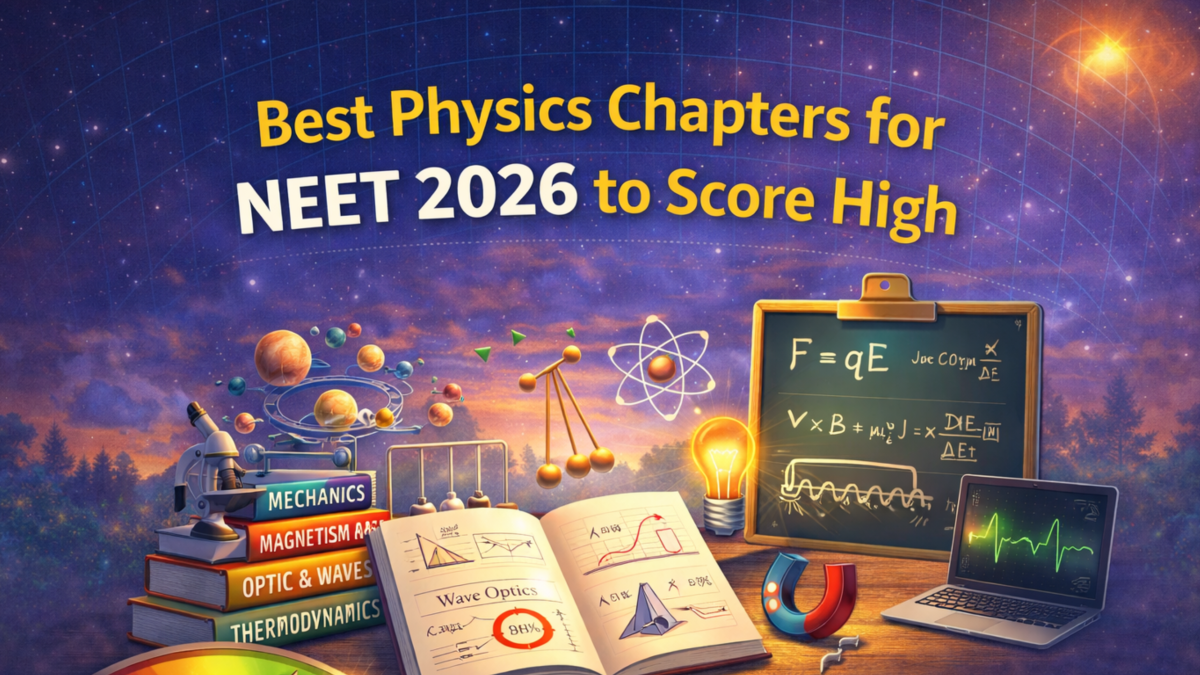
Best Physics Chapters to Score High in NEET 2026
VVT Coaching Chennai – Ranked #1 Best NEET & JEE Coaching Centre by Times Now!
Physics is the subject that often decides whether a NEET student stays stuck or moves up sharply.Most students do not struggle in Physics because the syllabus is impossible. They struggle because they do not know which chapters to stabilise first, which topics are easiest to convert into marks, and how to prepare Physics in NEET format instead of board-exam format. For NEET UG 2026, Physics carries 45 questions for 180 marks in a paper of 180 compulsory questions for 720 marks, and the exam is scheduled for 3 May 2026, from 2:00 PM to 5:00 PM.
That means Physics is too big to ignore and too important to leave vague.
The official NEET 2026 syllabus, finalised by UGMEB under NMC, includes the full Physics spread from Physics and Measurement to Electronic Devices and Experimental Skills. But the official syllabus does not label any chapter as “best” or “most important.” So this blog uses the official syllabus as the base and then applies a VVT-style exam strategy lens, which chapters are the best to prioritise first if your goal is to score high with smart preparation.
That is an important difference.
This is not a list of “officially most important chapters.”
This is a scoring-priority list built from the current syllabus, exam pattern, and VVT’s chapter-wise preparation approach.
Also read: Only 38 Days Left for NEET 2026: Why Students Lose Easy Marks and How to Stop It!
Also read: NEET Exam Centre Rules 2026: NTA Guidelines, Dress Code, Reporting Time & Allowed Items!
NEET 2026 Physics highlights
| Particulars | Details |
| Exam | NEET UG 2026 |
| Physics Questions | 45 |
| Physics Marks | 180 |
| Total Questions | 180 |
| Total Marks | 720 |
| Exam Date | 03 May 2026 |
| Exam Time | 02:00 PM to 05:00 PM |
| Mode | Pen and Paper |
| Official Syllabus Source | NMC/NEET 2026 syllabus |
These numbers matter because they show why Physics cannot be treated like a secondary subject. Even improving by 10–15 questions here can create a major swing in the final score.
How to understand “best chapters” the right way
The best Physics chapters for NEET are not always the hardest chapters or the longest chapters. In practice, the best chapters are usually the ones that offer one or more of these advantages:
- clear formulas,
- repeatable question patterns,
- relatively direct concepts,
- good scoring potential in limited time,
- and strong revision value during the last phase.
This is also how VVT publicly frames chapter-wise preparation: not just “complete everything,” but prioritise high-return chapters, maximise score per hour, and reduce low-yield effort.
Best Physics chapters to score high in NEET 2026
1) Current Electricity
If one chapter has to be on every serious student’s priority list, it is Current Electricity.
The official NEET 2026 syllabus includes drift velocity, mobility, Ohm’s law, resistivity, colour code of resistors, combination of resistors, cells in series and parallel, Kirchhoff’s laws, Wheatstone bridge, and Metre Bridge. This is a chapter with strong formula logic, direct numerical application, and repeated NEET-style models.
Why is it one of the best chapters? Because it is highly trainable. Students usually improve here through practice, not guesswork. Once the formulas and standard circuit patterns are revised properly, the chapter becomes far less scary than it first appears. At VVT Coaching, this is exactly the kind of chapter that should be turned into a scoring block through formula sheets, standard-model questions, and timed practice. That approach matches VVT’s published focus on chapter-wise prioritisation and score-per-hour planning.
2) Modern Physics: Dual Nature, Atoms and Nuclei
If you want chapters that often feel lighter and more scoring after proper revision, Modern Physics is one of the best areas to build.
The official 2026 syllabus includes Dual Nature of Matter and Radiation and Atoms and Nuclei, covering topics such as photoelectric effect, Einstein’s equation, de Broglie relation, atomic models, line spectra, radioactive decay, mass defect, and binding energy. These chapters are usually more direct than heavy rotational or deep electrodynamics sections, and they respond very well to short repeated revision.
This is why VVT students should not postpone Modern Physics to the very end. It is one of the most efficient places to convert revision into marks, especially for students who want a score jump without getting trapped in too many long derivation-style ideas.
3) Semiconductor and Electronic Devices
Electronic Devices is one of the most manageable and high-return chapters in the syllabus.
The official NEET 2026 syllabus includes semiconductors, intrinsic and extrinsic semiconductors, diodes, rectifiers, LED, photodiode, solar cell, Zener diode, voltage regulation, and logic gates such as AND, OR, NOT, NAND, and NOR. This chapter is concept-based, compact, and very revision-friendly.
Students often lose easy marks here not because the chapter is hard, but because they treat it as too small to revise properly. That is a mistake. If you want one Physics chapter that can become reliable quickly, Electronics should be near the top of your list.
4) Ray Optics and Optical Instruments
The official syllabus places Optics as a single large unit, but from a preparation point of view, Ray Optics is one of the best places to stabilise first.
The syllabus includes reflection, refraction, spherical mirrors, thin lenses, power of a lens, combination of lenses, microscopes, telescopes, and prism-related ideas, along with wave-optics concepts like interference, diffraction, and polarization.
Why is this one of the best scoring areas? Because a good portion of ray optics becomes much easier once students become comfortable with image formation rules, lens formulas, sign handling, and magnification. It is highly visual, highly pattern-based, and improves well with repeated question practice. VVT’s chapter-priority logic fits perfectly here, once a student learns to identify standard models, the chapter stops feeling random.
5) Electrostatics
Electrostatics is one of the biggest Class 12 foundations in NEET Physics.
The official syllabus includes Coulomb’s law, electric field, field lines, electric flux, Gauss’s law, electric potential, equipotential surfaces, capacitors, dielectrics, and combinations of capacitors.
This is one of the best chapters not because it is easy on day one, but because it gives very strong returns once the concepts settle. Many later Electricity topics also feel cleaner when Electrostatics is clear. So if a student wants to score high in Physics, leaving this chapter weak is a bad strategy.
6) Kinematics and Laws of Motion
These are not always the “easiest” chapters, but they are among the best foundational chapters.
The official syllabus includes motion in one and two dimensions, vectors, equations of motion, relative motion ideas, Newton’s laws, friction, circular motion, and dynamics-based concepts.
Students who are weak in these chapters often feel weak in Physics generally. Students who become strong here usually find later mechanics less intimidating. So while these chapters may take a little more time, they are worth prioritising because they improve both marks and confidence.
7) Work, Energy and Power
This chapter is one of the most scoring mechanics areas when revised correctly.
The official syllabus includes work done by variable force, kinetic and potential energy, work-energy theorem, power, conservation of energy, collisions, and center-of-mass ideas linked to the mechanics block.
It is a high-value chapter because many NEET questions from this area follow familiar application patterns. Once the student becomes comfortable with energy thinking, the chapter often feels simpler than force-based mechanics.
8) Oscillations and Waves
The official syllabus includes SHM, periodic motion, simple harmonic motion equations, restoring force, energy in SHM, wave motion, longitudinal and transverse waves, superposition, standing waves, beats, and Doppler effect.
This chapter is a good scoring choice because it is formula-driven and concept-linked. Students who revise SHM and wave formulas regularly usually find the questions very manageable. It is also one of those chapters that becomes easier with every revision cycle.
9) Magnetism, EMI and Alternating Current
This is a heavier block, but still one of the best scoring regions for students who want to move beyond basic Physics scores.
The syllabus includes magnetic force, Biot–Savart law, Ampere’s law, moving coil galvanometer, magnetic dipole, electromagnetic induction, Lenz’s law, self and mutual inductance, AC circuits, resonance, transformers, and AC generators.
These chapters are not always first-choice chapters for weak students, but for students aiming higher, they are extremely important. Once current electricity and electrostatics are stable, this block should become a major focus.
10) Physics and Measurement
Students often underestimate this chapter because it looks basic. That is exactly why it should not be ignored.
The official syllabus includes units, dimensions, errors in measurement, significant figures, dimensional analysis, and applications.
This is one of the most useful support chapters in Physics because it gives direct marks and also reduces silly mistakes in numericals across the subject. A student chasing high marks should keep this chapter clean and active.
Also read: How to Study Chemistry for NEET 2026: Section-Wise Strategy for Success – VVT Coaching!
Also read: Safe Score for NEET 2026: Category-Wise MBBS Targets & Expected Cutoffs – VVT Coaching!
Which chapters should you prioritise first?
If a student wants the most practical VVT-style answer, this is a good priority order:
First priority:
Current Electricity, Modern Physics, Electronic Devices, Physics and Measurement
Second priority:
Electrostatics, Ray Optics, Oscillations and Waves, Work Energy and Power
Third priority:
Kinematics, Laws of Motion, Magnetism, EMI and AC
This is a strategy recommendation, not an official NTA ranking. It is based on scoring friendliness, revision value, and how quickly many students can convert these chapters into marks with proper practice. The reasoning is consistent with VVT’s public chapter-weightage philosophy of focusing on high-return areas first.
How VVT Coaching adds authority to this topic
A blog like this becomes useful only if it does more than list chapter names.
VVT’s published NEET 2026 content already positions the institute around:
- chapter-wise prioritisation,
- syllabus clarity,
- score-per-hour preparation,
- and smart sequencing of revision.
That gives VVT a stronger authority angle here:
not just “study Physics,” but “study Physics in the right order.”
For students, that matters because Physics scores improve most when preparation becomes structured. Random problem-solving rarely fixes the subject. Chapter selection, formula revision, timed sets, and error analysis do.
How to study these chapters for maximum score
Once you choose the best chapters, the right loop is simple:
First learn the concept clearly.
Then make a short formula or rule sheet.
Then solve chapter-wise MCQs.
Then give a timed chapter test.
Then analyse your mistakes.
Then retest the same weak areas.
That loop is far more effective than reading theory again and again without question practice. It also matches the broader VVT preparation style shown in its public NEET content: clear syllabus understanding, targeted chapter focus, and practical score-building.
Get to Know VVT’s Three Friendly Campuses: Always Nearby and Welcoming
VVT has three spots across Chennai, each easy to reach and full of support. No matter where you live, one is close by. Our campuses mix bright classrooms, helpful teachers, and a warm feel to keep you going. Here’s a quick look at each, with a focus on how they help with NEET and staying options.
Adyar Campus: Easy Access and Positive Vibes
Right on busy L.B. Road next to Adyar Ananda Bhavan, this spot is super convenient. Step inside, and you’ll see big, airy rooms where learning feels fun. Staff greet you with smiles, and the energy pushes you to turn weak areas like tough Physics problems into strengths.We also offer hostel facilities here for boys, with clean rooms, meals, and support to make your stay comfortable and focused. No distractions, just a safe place to rest and review after classes.
Adyar Campus (VVT Coaching Centre): “Nibav Buildings”, 4th & 5th Floor, No.23, Old No.11, L.B. Road, Adyar, Chennai – 600020. (Next to Adyar Ananda Bhavan)
Get Directions: Open in google maps!
Anna Nagar Campus: Focus in the City Centre
In Shanthi Colony, Anna Nagar, this campus feels like an extension of home. Good bus links make it simple for city kids. There is no on-site hostel, but nearby options are plentiful for those who need them.
Anna Nagar Campus (VVT Coaching Centre): No.1621, 9th Main Road, Shanthi Colony, Block AI, Anna Nagar, Chennai – 600040.
Get Directions: Open in google maps!
Pallikaranai Girls Campus: Your Safe Place with Full Hostel
This is our special girls-only residential campus in a quiet area. It’s built as a true home away from home, with clean dorms, healthy meals in the canteen, and round-the-clock help.
We offer full hostel facilities here, clean rooms, study areas, and a community of girls supporting each other. It’s perfect if you’re from outside Chennai or just want a focused, safe space.
Pallikaranai (Saraswathi Girls Residential Campus): Plot No. 395 & 396, 1st Main Road, Kamakoti Nagar, Pallikaranai, Chennai – 600100.
Get Directions: Open in google maps
Conclusion
The best Physics chapters to score high in NEET 2026 are not “best” because NTA labels them that way. They are best because they offer the strongest scoring return when prepared properly.
If you want a high-return Physics plan, start with:
- Current Electricity
- Modern Physics
- Electronic Devices
- Physics and Measurement
- Electrostatics
- Ray Optics
- Oscillations and Waves
Then build upward into the heavier chapters.
NEET UG 2026 is already fixed for 3 May 2026, and Physics will still carry 45 questions and 180 marks. So the smartest move now is not to fear the subject, it is to prioritise it properly.
Visit: vvtcoaching.com
Call: +91 81221 22333
Scholarships: Up to 100% via VVTSAT!
Also read: NEET Exam Centre Rules 2026: NTA Guidelines, Dress Code, Reporting Time & Allowed Items
Also read: NEET 2026 Eligibility for MBBS & BDS: NTA Rules, Age Limit, Marks & Qualification!
Also read: NEET Qualifying Codes 2026: Meaning, Eligibility & Common Mistakes!
FAQs
1.How many Physics questions are there in NEET 2026?
NEET UG 2026 has 45 Physics questions for 180 marks.
2.Does the official syllabus mention “best chapters”?
No. The official syllabus lists the full Physics units, but it does not rank them. “Best chapters” is a preparation strategy idea, not an official NTA category.
3.Which Physics chapters are easiest to convert into marks?
For many students, Current Electricity, Modern Physics, Electronic Devices, Physics and Measurement, and Ray Optics are among the most revision-friendly scoring chapters. This is a strategy inference based on the syllabus and preparation style, not an official ranking.
4.Is Modern Physics important for NEET 2026?
Yes. The official syllabus includes Dual Nature of Matter and Radiation, Atoms, and Nuclei.
5.What is the best way to improve Physics marks fast?
Choose high-return chapters first, revise formulas, solve timed MCQs, and analyse errors. VVT’s public NEET content consistently emphasises chapter-wise prioritisation and smart prep rather than random coverage.