
What After NEET 2026? Courses, Counselling, Career Paths & Next Steps for Students
March 17, 2026
Safe Score for NEET 2026: Category-Wise MBBS Targets & Expected Cutoffs – VVT Coaching
March 19, 2026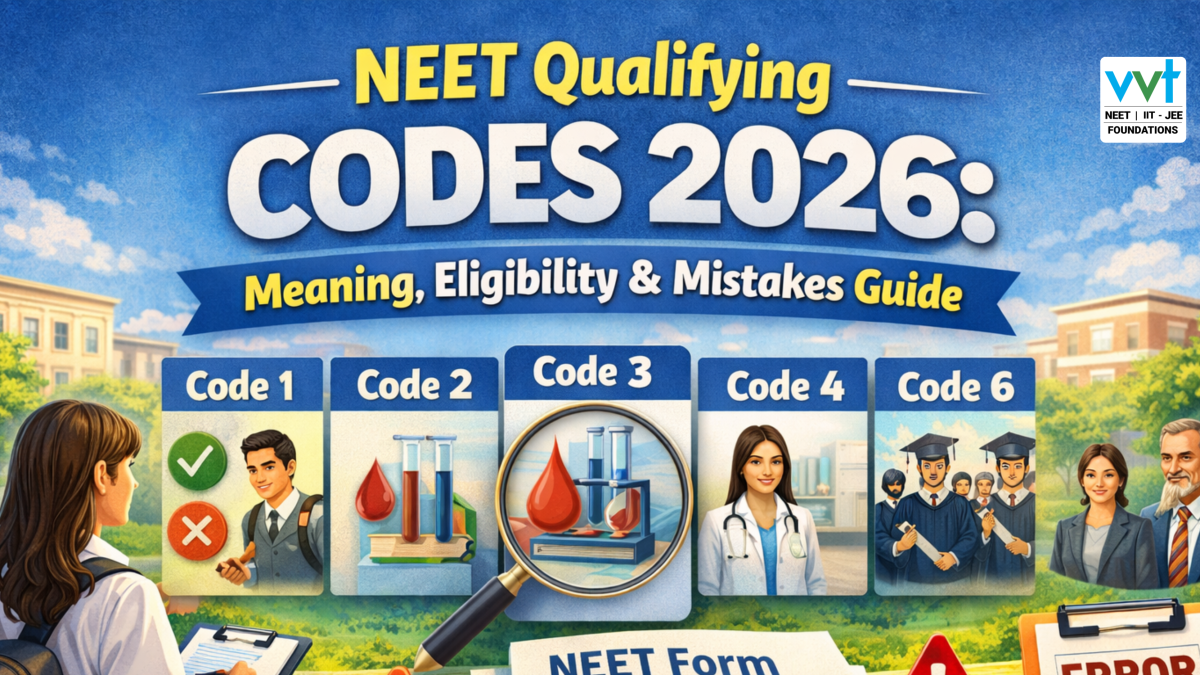
NEET Qualifying Codes 2026: Meaning, Eligibility & Common Mistakes
VVT Coaching Chennai – Ranked #1 Best NEET & JEE Coaching Centre by Times Now!
While filling the NEET application form, one small section creates a lot of confusion for students:
“Which qualifying code should I select?”
Many students know their board, subjects, and marks. But when they see Code 01 to Code 07, they are not fully sure which one applies to them.
This is important because the qualifying code is not a random formality. It reflects the candidate’s educational status and qualifying examination background in the NEET application form. The official NEET UG 2026 Information Bulletin says that candidates appearing in Class 12 in 2026 should choose Code 01, while candidates who have already passed should choose Code 02 to Code 07 depending on their qualification route.
In this guide, we explain:
- what NEET qualifying codes mean
- the complete list of Code 01 to 07
- who should choose which code
- common mistakes students make
- important eligibility points students should not miss
Let’s go step by step.
Also read: NEET Exam Centre Rules 2026: NTA Guidelines, Dress Code, Reporting Time & Allowed Items!
What are NEET qualifying codes in NEET 2026?
NEET qualifying codes are the official educational qualification categories used in the application form. These codes help NTA identify whether a student is:
- still appearing in Class 12,
- already passed 10+2,
- from a pre-degree or pre-medical route,
- in a degree course,
- a B.Sc. graduate,
- or from an equivalent Indian or foreign qualification route.
In simple words, the code tells NTA what kind of qualifying examination background you have.
Why choosing the correct qualifying code matters
Students sometimes think this field is a minor detail.
It is not.
The NEET 2026 bulletin clearly links the code to actual eligibility conditions. For example, students choosing Code 01 are allowed to apply if their Class 12 result is awaited, but they will not be eligible for admission if they do not pass the qualifying examination by the time of the first round of counselling.
So the correct code matters because:
- it reflects your real qualification status,
- it connects directly to eligibility,
- and choosing the wrong code can create problems later during admission verification.
NEET Qualifying Codes 2026: Quick list
Here is the simple meaning of each code as per the official NEET UG 2026 Information Bulletin:
- Code 01 – Class 12 appearing / result awaited
- Code 02 – Passed 10+2 / Higher Secondary / ISC equivalent
- Code 03 – Passed Intermediate / Pre-degree in Science
- Code 04 – Passed Pre-professional / Pre-medical
- Code 05 – First year of a 3-year degree course with PCB
- Code 06 – Passed B.Sc.
- Code 07 – Any other examination equivalent to Indian Intermediate Science / 10+2 with PCB and English
Now let us understand each one properly.
Code 01 – For students appearing in Class 12 in 2026
Code 01 is for a candidate who is appearing in the qualifying examination and whose Class 12 result is awaited. NTA says such a candidate may apply and appear in NEET UG 2026, but will not be eligible for admission if they do not pass the qualifying examination by the first round of counselling.
This is the correct code for:
- current Class 12 students,
- students whose board result is not yet declared,
- students who are writing their qualifying exam in 2026.
Important 2026 note under Code 01
The bulletin also says that candidates who studied the required subjects Physics, Chemistry, Biology/Biotechnology, and English, even as additional subjects after passing Class 12 from duly recognized boards are permitted, subject to documentary proof.
This is an important update because many students still assume additional-subject cases are automatically disallowed. The 2026 bulletin does not say that.
Code 02 – For students who have already passed 10+2 / Higher Secondary
Code 02 is for students who have already passed the Higher/Senior Secondary Examination or the Indian School Certificate Examination, or another equivalent Class 12 examination after 12 years of study, with Physics, Chemistry, Biology/Biotechnology, and English, along with Mathematics or any other elective subject. The bulletin also says this route includes practical tests in the science subjects.
This is the code that applies to most droppers and most students who already passed Class 12. That is an inference from the official definitions, because Code 02 directly covers the regular 10+2 pass route, while Codes 03 to 07 are for more specific academic pathways.
Important 2026 note under Code 02
Just like Code 01, the bulletin says candidates who studied Physics, Chemistry, Biology/Biotechnology, and English as additional subjects after passing Class 12 from duly recognized boards are permitted under the updated approach, and can be considered eligible subject to the required documentary proof.
Code 03 – For Intermediate / Pre-degree Science candidates
Code 03 applies to candidates who passed the Intermediate / Pre-degree Examination in Science from an Indian University, Board, or other recognized examining body with:
- Physics,
- Chemistry,
- Biology/Biotechnology,
- and English as a compulsory subject,
including practical tests in the science subjects.
This code is not the regular choice for most current CBSE/State Board Class 12 students. It is mainly for candidates whose qualifying route is formally classified as Intermediate or Pre-degree in Science. That reading follows the exact wording in the official code list.
Code 04 – For Pre-professional / Pre-medical candidates
Code 04 is for candidates who passed a Pre-professional / Pre-medical Examination with Physics, Chemistry, Biology/Biotechnology, and English after passing either the Higher Secondary Examination, Pre-University, or an equivalent examination. The bulletin adds that the pre-professional or pre-medical examination must include practical tests in these subjects and English as a compulsory subject.
This code is used far less commonly today, but it still exists in the 2026 code structure.
Code 05 – For first year of a three-year degree course
Code 05 is for candidates who have completed the first year of a three-year degree course from a recognized university with Physics, Chemistry, and Biology/Biotechnology including practical tests in these subjects, provided:
- The exam is a university examination, and
- The candidate had already passed the earlier qualifying examination with Physics, Chemistry, Biology/Biotechnology, and English at a level not less than a core course.
This is one of the most misunderstood codes.
Students should notice that Code 05 is not just “I joined a degree course”. The bulletin places specific conditions on the course and on the earlier qualifying examination as well.
Code 06 – For B.Sc. candidates
Code 06 applies to candidates who passed the B.Sc. Examination of an Indian University, provided:
- they passed B.Sc. with not less than two of these subjects: Physics, Chemistry, Biology (Botany, Zoology) / Biotechnology,
- and they had also passed the earlier qualifying examination with Physics, Chemistry, Biology, and English.
This is another code where students often make mistakes.
A student does not automatically become eligible under Code 06 just because they have a B.Sc. degree. The official definition still requires the earlier qualifying examination to include Physics, Chemistry, Biology, and English.
Code 07 – For other equivalent examinations, including some foreign/international boards
Code 07 is for candidates who passed any other examination which, in scope and standard, is found equivalent to the Intermediate Science Examination of an Indian University/Board. The bulletin specifies that the last two years of study must include Physics, Chemistry, Biology/Biotechnology, practical tests in these subjects, and English.
This code often becomes relevant for:
- students from certain foreign boards,
- students from international curricula,
- or candidates whose qualification is not easily placed under the regular Indian Class 12 route. That is an inference from the wording of Code 07 and the specific note for foreign/international boards.

Important note for foreign/international board students
The official bulletin specifically says that candidates who studied from a Foreign/International Board should ensure that their qualification is, in scope and standard, as explained in Code 07.
So if a student is from an international board, they should not guess their code casually.
Which code should most students choose?
In practical terms:
- If you are writing Class 12 in 2026 and your result is awaited → Code 01
- If you already passed regular Class 12 / 10+2 with PCB and English → Code 02
- If your route is Intermediate / Pre-degree Science → Code 03
- If your route is Pre-medical / Pre-professional → Code 04
- If you are in the first year of a 3-year degree course with the required science background → Code 05
- If you passed B.Sc. with the required conditions → Code 06
- If your qualification is equivalent but not a standard Indian Class 12 route, especially some foreign/international routes → Code 07
For most school students and droppers, the real confusion is usually only between Code 01 and Code 02. That is because NTA separately says appearing Class 12 candidates should choose Code 01, while already passed candidates should choose Code 02 to 07.
Common mistakes students make while choosing NEET qualifying codes
1) Droppers choosing Code 01
If a student has already passed Class 12, they should not choose Code 01. The bulletin clearly separates appearing candidates and passed candidates.
2) Assuming B.Sc. automatically means Code 06
Code 06 has extra conditions. The candidate must not only pass B.Sc. with the right subject combination, but must also have passed the earlier qualifying examination with Physics, Chemistry, Biology, and English.
3) Ignoring the “additional subjects” update
The 2026 bulletin allows candidates who studied the required subjects as additional subjects after Class 12, subject to documentary proof, in the relevant cases. Students who still rely on outdated assumptions may misunderstand their eligibility.
4) Foreign/international board students guessing the code
The bulletin explicitly asks such candidates to ensure their qualification matches the scope and standard explained in Code 07.
5) Thinking the code alone makes admission possible
The code is only one part of eligibility. For admission to undergraduate medical courses, NEET 2026 also requires candidates to meet the relevant qualifying percentile: 50th percentile for General/General-EWS, 40th percentile for SC/ST/OBC-NCL, and 45th percentile for PwBD candidates in Unreserved/GEN-EWS, with 40th percentile for PwBD in SC/ST/OBC-NCL.
Important additional eligibility notes students should not miss
The NEET 2026 bulletin includes two course-specific language points that many students do not know:
- For BUMS, the candidate must have passed Class 10 with Urdu, Arabic, or Persian as a subject, or clear the Urdu test where such a test is conducted.
- For BSMS, the candidate must have passed Tamil as one of the subjects in Class 10 or Higher Secondary, or study Tamil during the First Professional course.
These are not qualifying code rules by themselves, but they are important eligibility details connected to specific NEET-linked courses.
How VVT Coaching helps students avoid this confusion
Understanding NEET qualifying codes is step one.
Using the correct code confidently, without making avoidable form mistakes, is what actually protects a student’s application.
At VVT Coaching, students are not left to guess their way through important NEET form details. They are guided with:
- clarity on official eligibility rules,
- support in understanding the difference between appearing, passed, and equivalent qualification routes,
- practical guidance on form-filling mistakes that can create later problems,
- and preparation support that stays connected to real NEET requirements.
Because many students do not struggle only in preparation.
Sometimes they lose confidence even before the exam because they are confused about form details, eligibility, and documentation.
That is why correct guidance matters from the beginning.
Get to Know VVT’s Three Friendly Campuses: Always Nearby and Welcoming
VVT has three spots across Chennai, each easy to reach and full of support. No matter where you live, one is close by. Our campuses mix bright classrooms, helpful teachers, and a warm feel to keep you going. Here’s a quick look at each, with a focus on how they help with NEET and staying options.
Adyar Campus: Easy Access and Positive Vibes
Right on busy L.B. Road next to Adyar Ananda Bhavan, this spot is super convenient. Step inside, and you’ll see big, airy rooms where learning feels fun. Staff greet you with smiles, and the energy pushes you to turn weak areas like tough Physics problems into strengths.We also offer hostel facilities here for boys, with clean rooms, meals, and support to make your stay comfortable and focused. No distractions, just a safe place to rest and review after classes.
Adyar Campus (VVT Coaching Centre): “Nibav Buildings”, 4th & 5th Floor, No.23, Old No.11, L.B. Road, Adyar, Chennai – 600020. (Next to Adyar Ananda Bhavan)
Get Directions: Open in google maps!
Anna Nagar Campus: Focus in the City Centre
In Shanthi Colony, Anna Nagar, this campus feels like an extension of home. Good bus links make it simple for city kids. There is no on-site hostel, but nearby options are plentiful for those who need them.
Anna Nagar Campus (VVT Coaching Centre): No.1621, 9th Main Road, Shanthi Colony, Block AI, Anna Nagar, Chennai – 600040.
Get Directions: Open in google maps!
Pallikaranai Girls Campus: Your Safe Place with Full Hostel
This is our special girls-only residential campus in a quiet area. It’s built as a true home away from home, with clean dorms, healthy meals in the canteen, and round-the-clock help.
We offer full hostel facilities here, clean rooms, study areas, and a community of girls supporting each other. It’s perfect if you’re from outside Chennai or just want a focused, safe space.
Pallikaranai (Saraswathi Girls Residential Campus): Plot No. 395 & 396, 1st Main Road, Kamakoti Nagar, Pallikaranai, Chennai – 600100.
Get Directions: Open in google maps
Final words
NEET qualifying codes 2026 may look like a small section in the application form, but they matter a lot.
The safest way to choose the right code is simple:
- first identify whether you are appearing or already passed,
- then match your qualification route exactly with the official code definition,
- and do not guess if your case falls under degree, B.Sc., or foreign/international equivalence.
For most students:
- Code 01 is for Class 12 appearing candidates,
- Code 02 is for regular 10+2 passed candidates,
- and the remaining codes are for more specific educational pathways.
A correct qualifying code helps keep your NEET application aligned with your real academic background.
Visit: vvtcoaching.com
Call: +91 81221 22333
Scholarships: Up to 100% via VVTSAT!
Also read: NEET 2026 Exam Mode: Details, Guidelines & Complete Student Strategy Guide!
Also read: Self Study Time Table for NEET Preparation 2026!
FAQs
1.Which qualifying code should a Class 12 student appearing in 2026 choose?
A candidate appearing in Class 12 in 2026 should choose Code 01.
2. Which code should a dropper who already passed Class 12 choose?
A dropper who has already passed Class 12 should choose from Code 02 to Code 07 based on the correct qualification route. In the regular 10+2 pass case, that is usually Code 02.
3. Is Code 06 for every B.Sc. student?
No. Code 06 applies only if the candidate passed B.Sc. with the required subject combination and had also passed the earlier qualifying examination with Physics, Chemistry, Biology, and English.
4. Is Code 07 used for foreign or international board students?
Often yes, where the qualification falls under the “equivalent examination” route. The bulletin specifically says foreign/international board students must ensure their qualification matches the scope and standard explained under Code 07.
5. If I choose the correct code, is that enough for admission?
No. The code is only one part of eligibility. Candidates must also meet the relevant NEET qualifying percentile and other course-specific eligibility conditions.
6. Can additional subjects after Class 12 be considered in NEET 2026?
Yes, the bulletin says candidates who studied Physics, Chemistry, Biology/Biotechnology, and English as additional subjects after passing Class 12 from duly recognized boards are permitted in the relevant cases, subject to documentary proof.